
自下而上的结构蛋白质组学:从细胞环境中富集的蛋白质复合物的冷冻电镜。
Bottom-up structural proteomics: cryoEM of protein complexes enriched from the cellular milieu.
机构信息
The Molecular Biology Institute, University of California, Los Angeles, CA, USA.
Department of Microbiology, Immunology, & Molecular Genetics, University of California, Los Angeles, CA, USA.
出版信息
Nat Methods. 2020 Jan;17(1):79-85. doi: 10.1038/s41592-019-0637-y. Epub 2019 Nov 25.
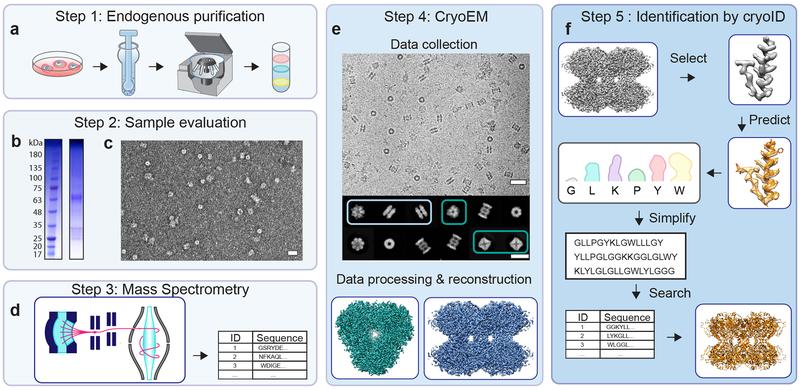
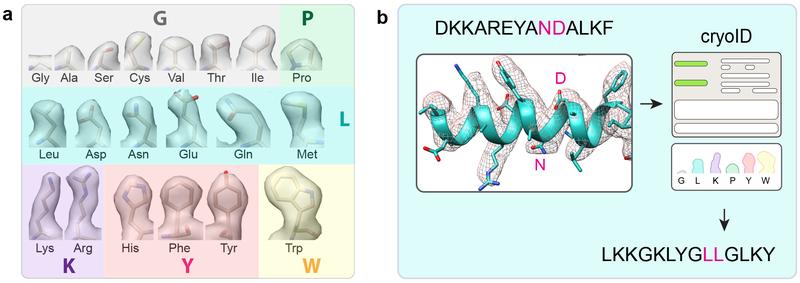
X-ray crystallography often requires non-native constructs involving mutations or truncations, and is challenged by membrane proteins and large multicomponent complexes. We present here a bottom-up endogenous structural proteomics approach whereby near-atomic-resolution cryo electron microscopy (cryoEM) maps are reconstructed ab initio from unidentified protein complexes enriched directly from the endogenous cellular milieu, followed by identification and atomic modeling of the proteins. The proteins in each complex are identified using cryoID, a program we developed to identify proteins in ab initio cryoEM maps. As a proof of principle, we applied this approach to the malaria-causing parasite Plasmodium falciparum, an organism that has resisted conventional structural-biology approaches, to obtain atomic models of multiple protein complexes implicated in intraerythrocytic survival of the parasite. Our approach is broadly applicable for determining structures of undiscovered protein complexes enriched directly from endogenous sources.
X 射线晶体学通常需要涉及突变或截断的非天然结构,并且受到膜蛋白和大型多组分复合物的挑战。我们在这里提出了一种自下而上的内源性结构蛋白质组学方法,通过该方法,可以从头开始重建接近原子分辨率的冷冻电子显微镜(cryoEM)图谱,这些图谱是直接从内源性细胞环境中富集的未鉴定蛋白质复合物中重建的,然后对蛋白质进行鉴定和原子建模。每个复合物中的蛋白质都是使用 cryoID 进行鉴定的,这是我们开发的一个程序,用于鉴定从头开始的 cryoEM 图谱中的蛋白质。作为原理的证明,我们将这种方法应用于引起疟疾的寄生虫疟原虫(Plasmodium falciparum),这种生物体抵制了传统的结构生物学方法,以获得与寄生虫在红细胞内生存有关的多个蛋白质复合物的原子模型。我们的方法广泛适用于直接从内源性来源富集确定未发现的蛋白质复合物的结构。



 Zotero 插件