
通过子颗粒重建减轻冷冻电镜平均对柔性和高度对称蛋白复合物的模糊效应。
Mitigating the Blurring Effect of CryoEM Averaging on a Flexible and Highly Symmetric Protein Complex through Sub-Particle Reconstruction.
机构信息
Department of Molecular Biology and Biochemistry, University of California Irvine, Irvine, CA 92697, USA.
出版信息
Int J Mol Sci. 2024 May 23;25(11):5665. doi: 10.3390/ijms25115665.
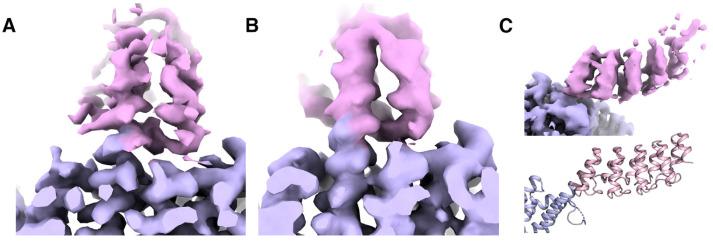
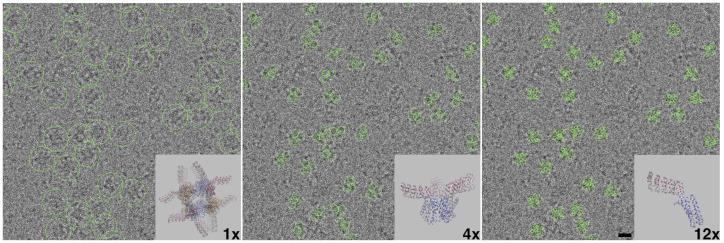
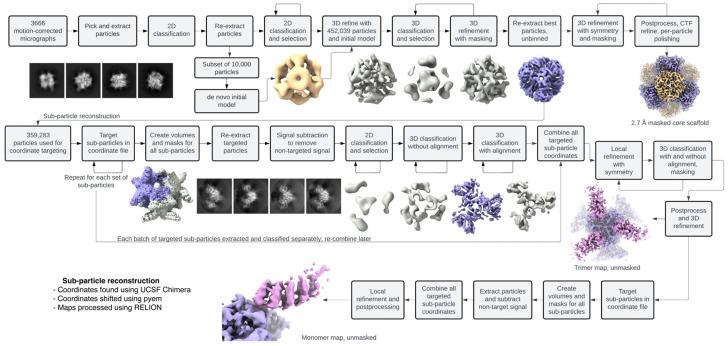
Many macromolecules are inherently flexible as a feature of their structure and function. During single-particle CryoEM processing, flexible protein regions can be detrimental to high-resolution reconstruction as signals from thousands of particles are averaged together. This "blurring" effect can be difficult to overcome and is possibly more pronounced when averaging highly symmetric complexes. Approaches to mitigating flexibility during CryoEM processing are becoming increasingly critical as the technique advances and is applied to more dynamic proteins and complexes. Here, we detail the use of sub-particle averaging and signal subtraction techniques to precisely target and resolve flexible DARPin protein attachments on a designed tetrahedrally symmetric protein scaffold called DARP14. Particles are first aligned as full complexes, and then the symmetry is reduced by alignment and focused refinement of the constituent subunits. The final reconstructions we obtained were vastly improved over the fully symmetric reconstructions, with observable secondary structure and side-chain placement. Additionally, we were also able to reconstruct the core region of the scaffold to 2.7 Å. The data processing protocol outlined here is applicable to other dynamic and symmetric protein complexes, and our improved maps could allow for new structure-guided variant designs of DARP14.
许多大分子由于其结构和功能的特点而具有内在的灵活性。在单颗粒 cryoEM 处理过程中,由于数千个颗粒的信号被平均在一起,因此柔性蛋白区域可能对高分辨率重建有害。这种“模糊”效应很难克服,在平均高度对称的复合物时可能更为明显。随着该技术的发展以及更多动态蛋白和复合物的应用,在 cryoEM 处理过程中减轻柔性的方法变得越来越重要。在这里,我们详细介绍了使用子颗粒平均和信号减法技术来精确靶向和解决称为 DARP14 的设计四面体对称蛋白支架上的灵活 DARPin 蛋白附着。首先将颗粒作为完整复合物进行对齐,然后通过对齐和聚焦于组成亚基来降低对称性。与完全对称的重建相比,我们获得的最终重建得到了极大的改善,可观察到二级结构和侧链放置。此外,我们还能够重建支架的核心区域至 2.7 Å。此处概述的数据处理方案适用于其他动态和对称蛋白复合物,并且我们改进的图谱可以为 DARP14 的新结构导向变体设计提供依据。

 Zotero 插件