
在埃塞俄比亚西北部德布雷马科斯转诊医院,接受抗逆转录病毒疗法的艾滋病毒阳性成年人中结核病的发病率和预测因素:一项回顾性病历回顾研究。
Incidence and predictors of tuberculosis among HIV-positive adults on antiretroviral therapy at Debre Markos referral hospital, Northwest Ethiopia: a retrospective record review.
机构信息
Debre Markos Referral Hospital, Debre Markos, Ethiopia.
College of Health Science, Debre Markos University, P.O. Box 269, Debre Markos, Ethiopia.
出版信息
BMC Public Health. 2019 Nov 27;19(1):1566. doi: 10.1186/s12889-019-7912-9.
BACKGROUND
Tuberculosis is the leading cause of morbidity and mortality among people living with human immunodeficiency virus. Almost one-third of deaths among people living with human immunodeficiency virus are attributed to tuberculosis. Despite this evidence, in Ethiopia, there is a scarcity of information regarding the incidence and predictors of tuberculosis among people living with HIV. Thus, this study assessed the incidence and predictors of tuberculosis among HIV-positive adults on antiretroviral therapy.
METHODS
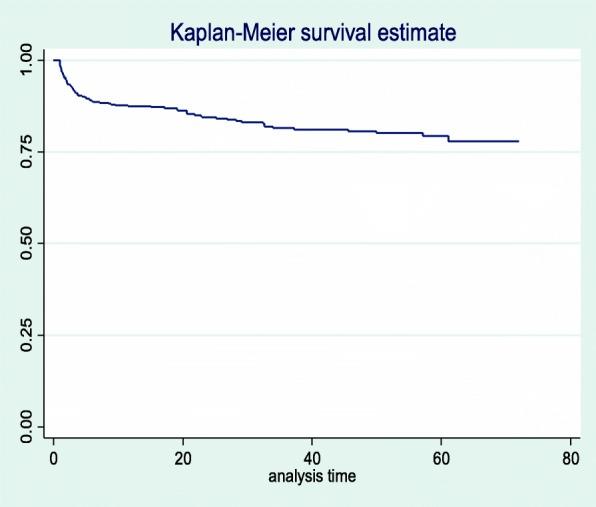
This study was a retrospective record review including 544 HIV-positive adults on antiretroviral therapy at Debre Markos Referral Hospital between January 1, 2012 and December 31, 2017. The study participants were selected using a simple random sampling technique. The data extraction format was adapted from antiretroviral intake and follow-up forms. Cox-proportional hazards regression model was fitted and Cox-Snell residual test was used to assess the goodness of fit. Tuberculosis free survival time was estimated using the Kaplan-Meier survival curve. Both the bi-variable and multivariable Cox-proportional hazard regression models were used to identify predictors of tuberculosis.
RESULTS
In the final analysis, a total of 492 HIV-positive adults were included, of whom, 83 (16.9%) developed tuberculosis at the time of follow-up. This study found that the incidence of tuberculosis was 6.5 (95% CI: 5.2, 8.0) per 100-person-years (PY) of observation. Advanced World Health Organization clinical disease stage (III and IV) (AHR: 2.1, 95% CI: 1.2, 3.2), being ambulatory and bedridden (AHR: 1.8, 95% CI: 1.1, 3.1), baseline opportunistic infections (AHR: 2.8, 95% CI: 1.7, 4.4), low hemoglobin level (AHR: 3.5, 95% CI: 2.1, 5.8), and not taking Isonized Preventive Therapy (AHR: 3.9, 95% CI: 1.9, 7.6) were found to be the predictors of tuberculosis.
CONCLUSION
The study found that there was a high rate of tuberculosis occurrence as compared to previous studies. Baseline opportunistic infections, being ambulatory and bedridden, advanced disease stage, low hemoglobin level, and not taking Isonized Preventive Therapy were found to be the predictors of tuberculosis. Therefore, early detection and treatment of opportunistic infections like tuberculosis should get a special attention.
背景
结核病是导致艾滋病毒感染者发病率和死亡率的主要原因。艾滋病毒感染者中约有三分之一的死亡归因于结核病。尽管有这一证据,但在埃塞俄比亚,关于艾滋病毒感染者中结核病的发病率和预测因素的信息仍然匮乏。因此,本研究评估了在抗逆转录病毒治疗中艾滋病毒阳性成年人的结核病发病率和预测因素。
方法
这是一项回顾性病历回顾研究,纳入了 2012 年 1 月 1 日至 2017 年 12 月 31 日期间在德布雷马科斯转诊医院接受抗逆转录病毒治疗的 544 名艾滋病毒阳性成年人。研究参与者采用简单随机抽样技术选择。数据提取格式改编自抗逆转录病毒摄入和随访表格。拟合 Cox 比例风险回归模型,并使用 Cox-Snell 残差检验评估拟合优度。使用 Kaplan-Meier 生存曲线估计结核病无生存时间。使用双变量和多变量 Cox 比例风险回归模型确定结核病的预测因素。
结果
在最终分析中,共有 492 名艾滋病毒阳性成年人入组,其中 83 名(16.9%)在随访时发生结核病。本研究发现,结核病的发病率为 6.5(95%CI:5.2,8.0)/100 人年。晚期世界卫生组织临床疾病阶段(III 和 IV)(AHR:2.1,95%CI:1.2,3.2)、活动和卧床(AHR:1.8,95%CI:1.1,3.1)、基线机会性感染(AHR:2.8,95%CI:1.7,4.4)、低血红蛋白水平(AHR:3.5,95%CI:2.1,5.8)和未接受异烟肼预防性治疗(AHR:3.9,95%CI:1.9,7.6)是结核病的预测因素。
结论
与之前的研究相比,本研究发现结核病的发生率较高。基线机会性感染、活动和卧床、晚期疾病阶段、低血红蛋白水平和未接受异烟肼预防性治疗是结核病的预测因素。因此,应特别注意早期发现和治疗结核病等机会性感染。

 Zotero 插件