
URB597 通过抑制慢性脑低灌注大鼠模型中的自噬功能障碍来防止 NLRP3 炎性小体的激活。
URB597 protects against NLRP3 inflammasome activation by inhibiting autophagy dysfunction in a rat model of chronic cerebral hypoperfusion.
机构信息
Department of Neurosurgery, Tongji Hospital, Tongji University School of Medicine, 389 Xincun Road, Shanghai, 200065, China.
Department of Pharmacy, Institutes of Medical Sciences, Shanghai Jiao Tong University School of Medicine, Shanghai, 200025, China.
出版信息
J Neuroinflammation. 2019 Dec 9;16(1):260. doi: 10.1186/s12974-019-1668-0.
BACKGROUND
Previous studies reported that URB597 (URB) had therapeutic potential for treating chronic cerebral hypoperfusion (CCH)-induced neuroinflammation and autophagy dysfunction. However, the interaction mechanisms underlying the CCH-induced abnormal excessive autophagy and neuroinflammation remain unknown. In this study, we investigated the roles of impaired autophagy in nucleotide-binding oligomerization domain-like receptor family pyrin domain-containing (NLRP) 3 inflammasome activation in the rat hippocampus and the underlying mechanisms under the condition of induced CCH as well as the effect of URB treatment.
METHODS
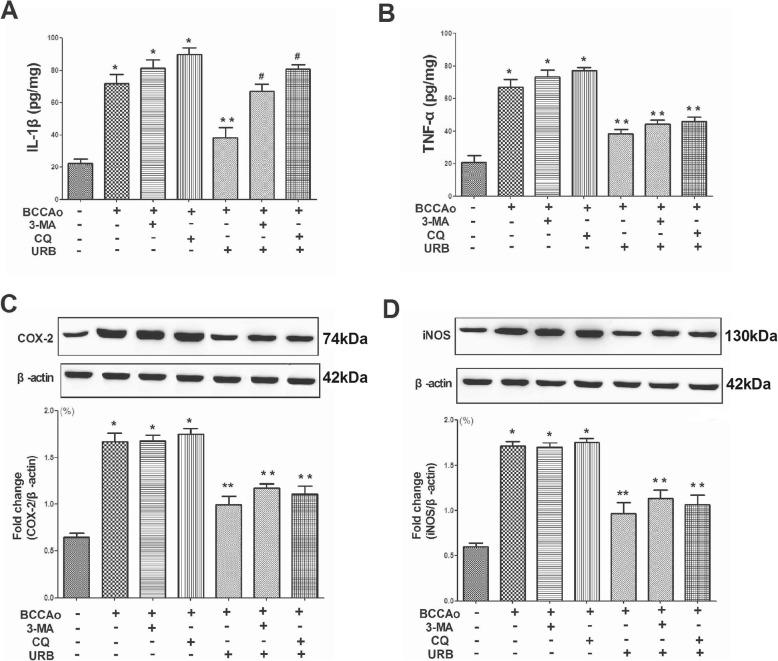
The CCH rat model was established by bilateral common carotid artery occlusion (BCCAo), and rats were randomly divided into 11 groups as follows: (1) sham-operated, (2) BCCAo; (3) BCCAo+autophagy inhibitor 3-methyladenine (3-MA), (4) BCCAo+lysosome inhibitor chloroquine (CQ), (5) BCCAo+microglial activation inhibitor minocycline, (6) BCCAo+ROS scavenger N-acetylcysteine (NAC), (7) BCCAo+URB, (8) BCCAo+URB+3-MA, (9) BCCAo+URB+CQ, (10) BCCAo+URB+minocycline, (11) BCCAo+URB+NAC. The cell localizations of LC3, p62, LAMP1, TOM20 and NLRP3 were assessed by immunofluorescence staining. The levels of autophagy-related proteins (LC3, p62, LAMP1, BNIP3 and parkin), NLRP3 inflammasome-related proteins (NLRP3, CASP1 and IL-1β), microglial marker (OX-42) and proinflammatory cytokines (iNOS and COX-2) were evaluated by western blotting, and proinflammatory cytokines (IL-1β and TNF-a) were determined by ELISA. Reactive oxygen species (ROS) were assessed by dihydroethidium staining. The mitochondrial ultrastructural changes were examined by electron microscopy.
RESULTS
CCH induced microglial overactivation and ROS accumulation, promoting the activation of the NLRP3 inflammasome and the release of IL-1β. Blocked autophagy and mitophagy flux enhanced the activation of the NLRP3-CASP1 inflammasome pathway. However, URB alleviated impaired autophagy and mitophagy by decreasing mitochondrial ROS and microglial overactivation as well as restoring lysosomal function, which would further inhibit the activation of the NLRP3-CASP1 inflammasome pathway.
CONCLUSION
These findings extended previous studies indicating the function of URB in the mitigation of chronic ischemic injury of the brain.
背景
先前的研究表明,URB597(URB)在治疗慢性脑灌注不足(CCH)诱导的神经炎症和自噬功能障碍方面具有治疗潜力。然而,CCH 诱导的异常过度自噬和神经炎症的潜在相互作用机制尚不清楚。在这项研究中,我们研究了自噬受损在核苷酸结合寡聚结构域样受体家族富含pyrin 结构域(NLRP)3 炎性小体激活中的作用在诱导的 CCH 条件下以及 URB 治疗的潜在机制在大鼠海马体中的作用。
方法
通过双侧颈总动脉闭塞(BCCAo)建立 CCH 大鼠模型,将大鼠随机分为 11 组:(1)假手术组,(2)BCCAo 组,(3)BCCAo+自噬抑制剂 3-甲基腺嘌呤(3-MA)组,(4)BCCAo+溶酶体抑制剂氯喹(CQ)组,(5)BCCAo+小胶质细胞激活抑制剂米诺环素(minocycline)组,(6)BCCAo+ROS 清除剂 N-乙酰半胱氨酸(NAC)组,(7)BCCAo+URB 组,(8)BCCAo+URB+3-MA 组,(9)BCCAo+URB+CQ 组,(10)BCCAo+URB+minocycline 组,(11)BCCAo+URB+NAC 组。通过免疫荧光染色评估 LC3、p62、LAMP1、TOM20 和 NLRP3 的细胞定位。通过 Western blot 评估自噬相关蛋白(LC3、p62、LAMP1、BNIP3 和 parkin)、NLRP3 炎性小体相关蛋白(NLRP3、CASP1 和 IL-1β)、小胶质细胞标志物(OX-42)和促炎细胞因子(iNOS 和 COX-2)的水平,并通过 ELISA 测定促炎细胞因子(IL-1β 和 TNF-a)。通过二氢乙啶染色评估活性氧(ROS)。通过电子显微镜检查线粒体超微结构变化。
结果
CCH 诱导小胶质细胞过度激活和 ROS 积累,促进 NLRP3 炎性小体的激活和 IL-1β 的释放。阻断自噬和线粒体自噬流增强了 NLRP3-CASP1 炎性小体途径的激活。然而,URB 通过减少线粒体 ROS 和小胶质细胞过度激活以及恢复溶酶体功能来减轻受损的自噬和线粒体自噬,从而进一步抑制 NLRP3-CASP1 炎性小体途径的激活。
结论
这些发现扩展了先前的研究,表明 URB 在减轻慢性缺血性脑损伤中的作用。



 Zotero 插件