
缺氧诱导因子-1α 的表达与对侧乳腺癌不良预后和他莫昔芬耐药有关。
Expression of HIF-1α is related to a poor prognosis and tamoxifen resistance in contralateral breast cancer.
机构信息
Department of Laboratory Medicine, Translational Cancer Research, Lund University Cancer Center at Medicon Village, Lund University, Lund, Sweden.
Lund University, Skåne University Hospital, Department of Clinical Sciences Lund, Division of Oncology and Pathology, Lund, Sweden.
出版信息
PLoS One. 2019 Dec 10;14(12):e0226150. doi: 10.1371/journal.pone.0226150. eCollection 2019.
BACKGROUND
Adjuvant endocrine treatment improves survival after estrogen receptor (ER) positive breast cancer. Recurrences occur, and most patients with metastatic breast cancer develop treatment resistance and incurable disease. An influential factor in relation to endocrine treatment resistance is tumor hypoxia and the hypoxia inducible transcription factors (HIFs). Poor perfusion makes tumors hypoxic and induces the HIFs, which promote cell survival. We previously showed that hypoxic breast cancer cells are tamoxifen-resistant, and that HIF-inhibition restored tamoxifen-sensitivity. We found that HIF-induced tamoxifen-resistance involve cross-talk with epithelial growth factor receptor (EGFR), which itself is linked to tamoxifen resistance. Contralateral breast cancer (CBC), i.e. development of a second breast cancer in the contralateral breast despite adjuvant tamoxifen treatment is in essence a human in vivo-model for tamoxifen-resistance that we explore here to find molecular pathways of tamoxifen-resistance.
METHODS
We constructed a tissue-microarray including tumor-tissue from a large well-defined cohort of CBC-patients, a proportion of which got their second breast cancer despite ongoing adjuvant therapy. Using immunohistochemistry >500 patients were evaluable for HIF-1α and EGFR in both tumors, and correlations to treatment, patient outcome, prognostic and predictive factors were analyzed.
RESULTS
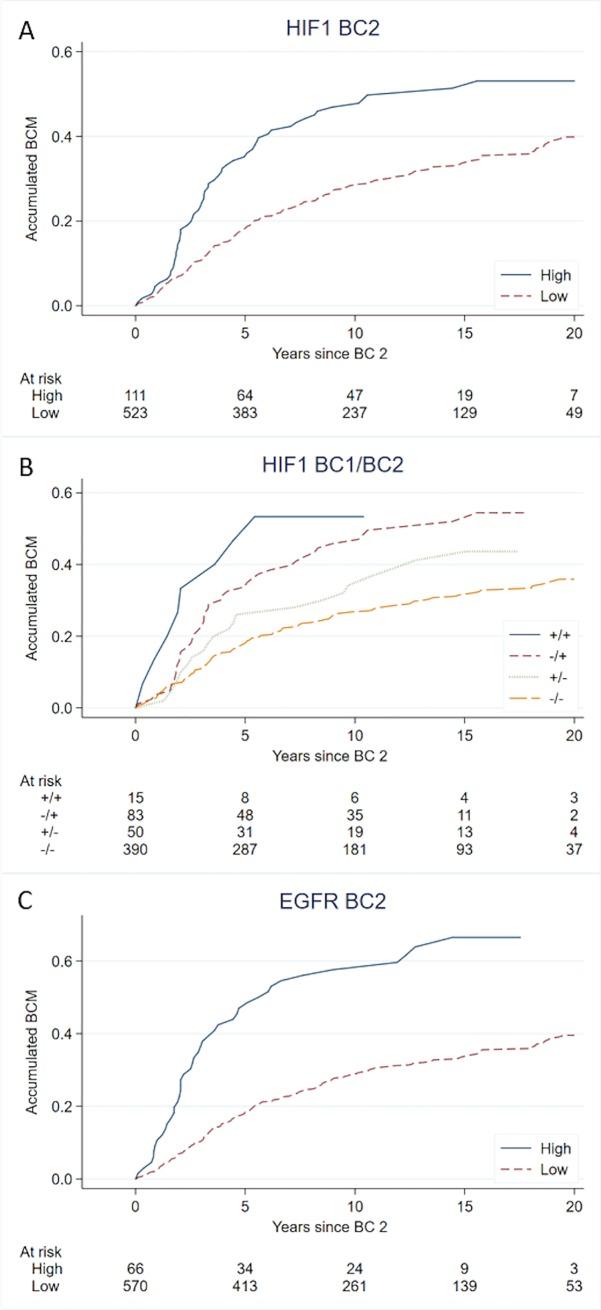
We found an increased proportion of HIF-1α-positive tumors in tamoxifen-resistant (CBC during adjuvant tamoxifen) compared to naïve tumors (CBC without prior tamoxifen). Tumor HIF-1α-positivity correlated to increased breast cancer mortality, and negative prognostic factors including low age at diagnosis and ER-negativity. There was a covariance of HIF-1α- and EGFR-expression and also EGFR-expression correlated to poor prognosis.
CONCLUSIONS
The increased percentage of HIF-1α-positive tumors formed during adjuvant tamoxifen suggests a role for HIF-1α in escaping tamoxifen's restraining effects on breast cancer. Implicating a potential benefit of HIF-inhibitors in targeting breast cancers resistant to endocrine therapy.
背景
雌激素受体 (ER) 阳性乳腺癌患者接受辅助内分泌治疗后可改善生存。肿瘤仍会复发,且大多数转移性乳腺癌患者会产生治疗耐药和不可治愈的疾病。与内分泌治疗耐药相关的一个重要因素是肿瘤缺氧和缺氧诱导转录因子 (HIFs)。灌注不良使肿瘤缺氧,并诱导 HIFs,促进细胞存活。我们之前的研究表明,缺氧的乳腺癌细胞对他莫昔芬耐药,而 HIF 抑制可恢复他莫昔芬敏感性。我们发现,HIF 诱导的他莫昔芬耐药与表皮生长因子受体 (EGFR) 有关,而 EGFR 本身与他莫昔芬耐药有关。对侧乳腺癌(CBC),即在接受辅助他莫昔芬治疗的情况下对侧乳房发生第二原发乳腺癌,本质上是我们在此处探索的他莫昔芬耐药的人体体内模型,以寻找他莫昔芬耐药的分子途径。
方法
我们构建了一个组织微阵列,其中包括来自大样本明确 CBC 患者队列的肿瘤组织,其中一部分患者尽管正在接受辅助治疗,但仍发生了第二原发乳腺癌。通过免疫组织化学,对 500 多名患者的两种肿瘤中的 HIF-1α 和 EGFR 进行了评估,并分析了与治疗、患者结局、预后和预测因素的相关性。
结果
我们发现,与未接受他莫昔芬治疗的肿瘤(无先前他莫昔芬的 CBC)相比,在接受他莫昔芬辅助治疗时发生耐药的(CBC)中,HIF-1α 阳性肿瘤的比例增加。肿瘤 HIF-1α 阳性与乳腺癌死亡率增加相关,且与低诊断年龄和 ER 阴性等不良预后因素相关。HIF-1α 和 EGFR 表达之间存在协变,并且 EGFR 表达也与预后不良相关。
结论
在辅助他莫昔芬治疗过程中形成的 HIF-1α 阳性肿瘤比例增加表明 HIF-1α 在逃避他莫昔芬对乳腺癌的抑制作用方面发挥作用。这暗示了 HIF 抑制剂在针对对内分泌治疗耐药的乳腺癌方面可能具有潜在的益处。


 Zotero 插件