
缺氧诱导的乳腺癌进展及肿瘤微环境的表观遗传调控
Hypoxia-induced epigenetic regulation of breast cancer progression and the tumour microenvironment.
作者信息
Capatina Alina L, Malcolm Jodie R, Stenning Jack, Moore Rachael L, Bridge Katherine S, Brackenbury William J, Holding Andrew N
机构信息
Department of Biology, University of York, York, United Kingdom.
York Biomedical Research Institute, University of York, York, United Kingdom.
出版信息
Front Cell Dev Biol. 2024 Aug 30;12:1421629. doi: 10.3389/fcell.2024.1421629. eCollection 2024.
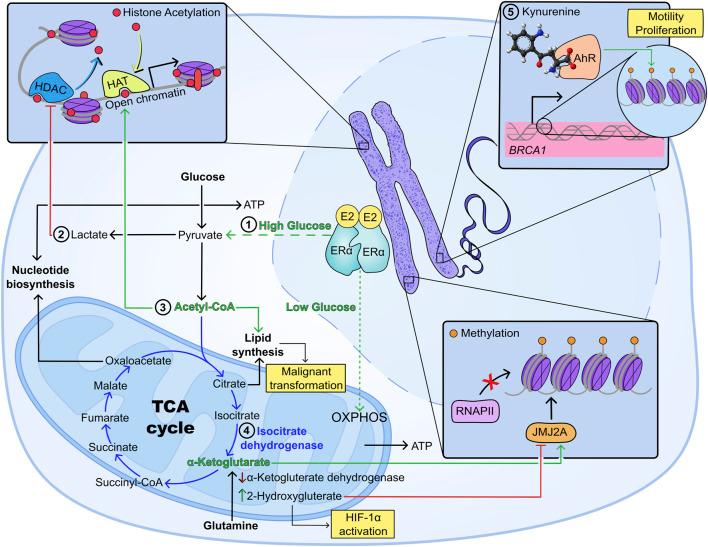
The events that control breast cancer progression and metastasis are complex and intertwined. Hypoxia plays a key role both in oncogenic transformation and in fueling the metastatic potential of breast cancer cells. Here we review the impact of hypoxia on epigenetic regulation of breast cancer, by interfering with multiple aspects of the tumour microenvironment. The co-dependent relationship between oxygen depletion and metabolic shift to aerobic glycolysis impacts on a range of enzymes and metabolites available in the cell, promoting posttranslational modifications of histones and chromatin, and changing the gene expression landscape to facilitate tumour development. Hormone signalling, particularly through ERα, is also tightly regulated by hypoxic exposure, with HIF-1α expression being a prognostic marker for therapeutic resistance in ER breast cancers. This highlights the strong need to understand the hypoxia-endocrine signalling axis and exploit it as a therapeutic target. Furthermore, hypoxia has been shown to enhance metastasis in TNBC cells, as well as promoting resistance to taxanes, radiotherapy and even immunotherapy through microRNA regulation and changes in histone packaging. Finally, several other mediators of the hypoxic response are discussed. We highlight a link between ionic dysregulation and hypoxia signalling, indicating a potential connection between HIF-1α and tumoural Na accumulation which would be worth further exploration; we present the role of Ca in mediating hypoxic adaptation via chromatin remodelling, transcription factor recruitment and changes in signalling pathways; and we briefly summarise some of the findings regarding vesicle secretion and paracrine induced epigenetic reprogramming upon hypoxic exposure in breast cancer. By summarising these observations, this article highlights the heterogeneity of breast cancers, presenting a series of pathways with potential for therapeutic applications.
控制乳腺癌进展和转移的事件复杂且相互交织。缺氧在致癌转化以及增强乳腺癌细胞的转移潜能方面均发挥着关键作用。在此,我们综述缺氧通过干扰肿瘤微环境的多个方面对乳腺癌表观遗传调控的影响。氧耗竭与向有氧糖酵解的代谢转变之间的相互依存关系影响细胞内一系列可用的酶和代谢物,促进组蛋白和染色质的翻译后修饰,并改变基因表达格局以促进肿瘤发展。激素信号传导,尤其是通过雌激素受体α(ERα)的信号传导,也受到缺氧暴露的严格调控,缺氧诱导因子-1α(HIF-1α)的表达是雌激素受体阳性乳腺癌治疗耐药性的一个预后标志物。这凸显了深入了解缺氧-内分泌信号轴并将其作为治疗靶点加以利用的迫切需求。此外,缺氧已被证明可增强三阴性乳腺癌(TNBC)细胞的转移能力,并通过微小RNA调控和组蛋白包装变化促进对紫杉烷类、放疗甚至免疫治疗的耐药性。最后,讨论了缺氧反应的其他几种介质。我们强调离子失调与缺氧信号传导之间的联系,表明HIF-1α与肿瘤细胞内钠积累之间可能存在关联,值得进一步探索;我们阐述了钙在通过染色质重塑、转录因子募集和信号通路变化介导缺氧适应中的作用;并且我们简要总结了一些关于缺氧暴露时乳腺癌中囊泡分泌和旁分泌诱导的表观遗传重编程的研究结果。通过总结这些观察结果,本文突出了乳腺癌的异质性,呈现了一系列具有治疗应用潜力的途径。



 Zotero 插件