
2017 年欧洲白血病网络定义的 NPM1/FLT3-ITD 基因型对急性髓系白血病患者的影响。
Impact of NPM1/FLT3-ITD genotypes defined by the 2017 European LeukemiaNet in patients with acute myeloid leukemia.
机构信息
Department of Internal Medicine III, University of Ulm, Ulm, Germany.
Department of Internal Medicine I, University Hospital Carl Gustav Carus, Dresden, Germany.
出版信息
Blood. 2020 Jan 30;135(5):371-380. doi: 10.1182/blood.2019002697.
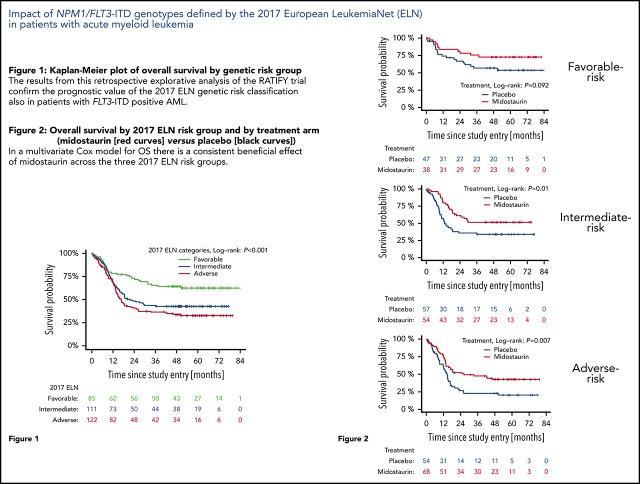
Patients with acute myeloid leukemia (AML) harboring FLT3 internal tandem duplications (ITDs) have poor outcomes, in particular AML with a high (≥0.5) mutant/wild-type allelic ratio (AR). The 2017 European LeukemiaNet (ELN) recommendations defined 4 distinct FLT3-ITD genotypes based on the ITD AR and the NPM1 mutational status. In this retrospective exploratory study, we investigated the prognostic and predictive impact of the NPM1/FLT3-ITD genotypes categorized according to the 2017 ELN risk groups in patients randomized within the RATIFY trial, which evaluated the addition of midostaurin to standard chemotherapy. The 4 NPM1/FLT3-ITD genotypes differed significantly with regard to clinical and concurrent genetic features. Complete ELN risk categorization could be done in 318 of 549 trial patients with FLT3-ITD AML. Significant factors for response after 1 or 2 induction cycles were ELN risk group and white blood cell (WBC) counts; treatment with midostaurin had no influence. Overall survival (OS) differed significantly among ELN risk groups, with estimated 5-year OS probabilities of 0.63, 0.43, and 0.33 for favorable-, intermediate-, and adverse-risk groups, respectively (P < .001). A multivariate Cox model for OS using allogeneic hematopoietic cell transplantation (HCT) in first complete remission as a time-dependent variable revealed treatment with midostaurin, allogeneic HCT, ELN favorable-risk group, and lower WBC counts as significant favorable factors. In this model, there was a consistent beneficial effect of midostaurin across ELN risk groups.
急性髓系白血病(AML)伴 FLT3 内部串联重复(ITD)的患者预后不良,尤其是高(≥0.5)突变/野生型等位基因比(AR)的 AML。2017 年欧洲白血病网络(ELN)建议根据 ITD AR 和 NPM1 突变状态,将 4 种不同的 FLT3-ITD 基因型定义为 4 种不同的 FLT3-ITD 基因型。在这项回顾性探索性研究中,我们根据 2017 年 ELN 风险组对 RATIFY 试验中随机分组的患者进行了 NPM1/FLT3-ITD 基因型的预后和预测影响的研究,该试验评估了米哚妥林联合标准化疗的疗效。根据 2017 年 ELN 风险组分类的 NPM1/FLT3-ITD 基因型在临床和并发遗传特征方面存在显著差异。在 549 例伴有 FLT3-ITD AML 的试验患者中,有 318 例可进行完整的 ELN 风险分类。1 或 2 个诱导周期后的反应的显著因素是 ELN 风险组和白细胞(WBC)计数;米哚妥林的治疗没有影响。总体生存率(OS)在 ELN 风险组之间有显著差异,分别为 0.63、0.43 和 0.33,风险组分别为低、中、高(P <.001)。使用异基因造血细胞移植(HCT)作为时间依赖性变量的 OS 的多变量 Cox 模型显示,米哚妥林治疗、异基因 HCT、ELN 低危组和较低的 WBC 计数是显著的有利因素。在该模型中,米哚妥林在 ELN 风险组之间具有一致的有益效果。
 Zotero 插件