
种族和民族在美国对基因研究和精准医学研究的看法和参与中的作用:定性和定量研究的系统评价。
The role of race and ethnicity in views toward and participation in genetic studies and precision medicine research in the United States: A systematic review of qualitative and quantitative studies.
机构信息
Department of Genetics, Cell Biology, and Development, University of Minnesota, Minneapolis, MN, USA.
Department of Family Medicine and Community Health, University of Minnesota, Minneapolis, MN, USA.
出版信息
Mol Genet Genomic Med. 2020 Feb;8(2):e1099. doi: 10.1002/mgg3.1099. Epub 2019 Dec 23.
BACKGROUND
Racial/ethnic minority populations in the United States are consistently underrepresented in genetic research. Large-scale public participation is required to ensure discoveries from precision medicine research are applicable to everyone. To evaluate views toward and facilitators of participation among minority populations in the United States, we conducted a systematic review of literature.
METHODS
Six databases were searched for articles published from 2005 to 2018 assessing minority populations' views and/or willingness to participate in genetic research. A thematic framework was applied to extracted data to synthesize findings, and the Socio-Ecological Model was used to evaluate papers.
RESULTS
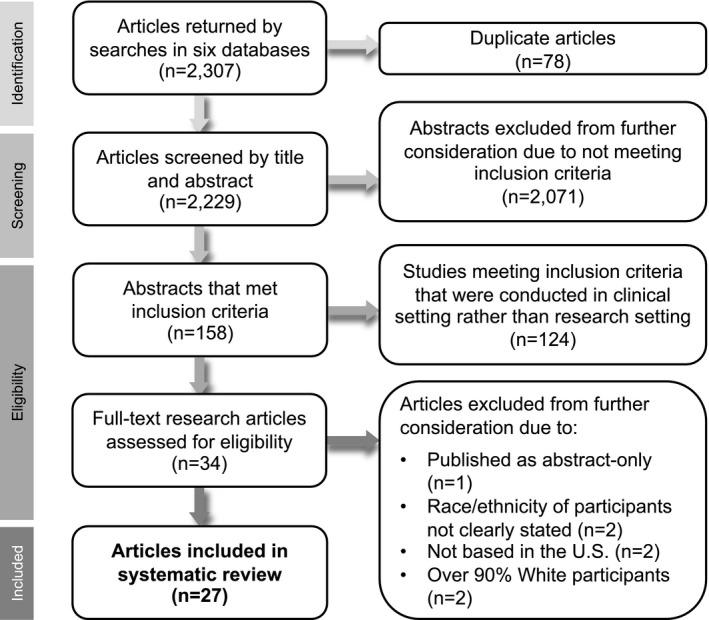
Review of 2,229 titles and abstracts identified 27 papers (n = 8 qualitative, n = 19 quantitative). Themes included knowledge of genetics, engagement in research, facilitators and barriers to participation, and cultural considerations. Understanding of genetics was low, yet the majority of participants were willing to participate in genetic research among all populations included in the literature (range: 57%-97%). Recommendations for research included utilizing community-based participatory approaches, evaluating participants' informational needs, incentivizing participation, and providing direct benefits (e.g., genetic test results).
CONCLUSION
Results could influence future study designs that incorporate all levels of the Socio-Ecological Model and better meet the needs of underrepresented groups, thereby ensuring precision medicine research findings are applicable to all.
背景
美国的少数族裔人群在基因研究中一直代表性不足。需要大规模的公众参与,以确保精准医学研究的发现能够适用于每个人。为了评估美国少数族裔人群对参与的看法和促进因素,我们对文献进行了系统综述。
方法
从 2005 年到 2018 年,我们在六个数据库中搜索了评估少数族裔人群对遗传研究的看法和/或参与意愿的文章。我们应用主题框架来提取数据以综合研究结果,并使用社会生态模型来评估论文。
结果
对 2229 篇标题和摘要进行审查,确定了 27 篇论文(n=8 篇定性研究,n=19 篇定量研究)。主题包括对遗传学的了解、参与研究、参与的促进因素和障碍,以及文化考虑因素。尽管所有纳入文献中的人群对遗传学的理解程度都较低,但大多数参与者都愿意参与遗传研究(范围:57%-97%)。对研究的建议包括利用基于社区的参与式方法、评估参与者的信息需求、激励参与以及提供直接利益(例如,遗传测试结果)。
结论
研究结果可能会影响未来的研究设计,这些设计将纳入社会生态模型的所有层次,并更好地满足代表性不足群体的需求,从而确保精准医学研究的发现能够适用于所有人。
 Zotero 插件