
人类癌症中 mA 修饰的表观遗传调控
Epigenetic Regulation of mA Modifications in Human Cancer.
作者信息
Zhao Wei, Qi Xiaoqian, Liu Lina, Ma Shiqing, Liu Jingwen, Wu Jie
机构信息
The School and Hospital of Stomatology, Tianjin Medical University, Tianjin 300070, P.R. China.
Department of Prosthodontics, Tianjin Stomatological Hospital, Hospital of Stomatology, NanKai University, Tianjin 300041, P.R. China.
出版信息
Mol Ther Nucleic Acids. 2020 Mar 6;19:405-412. doi: 10.1016/j.omtn.2019.11.022. Epub 2019 Nov 29.
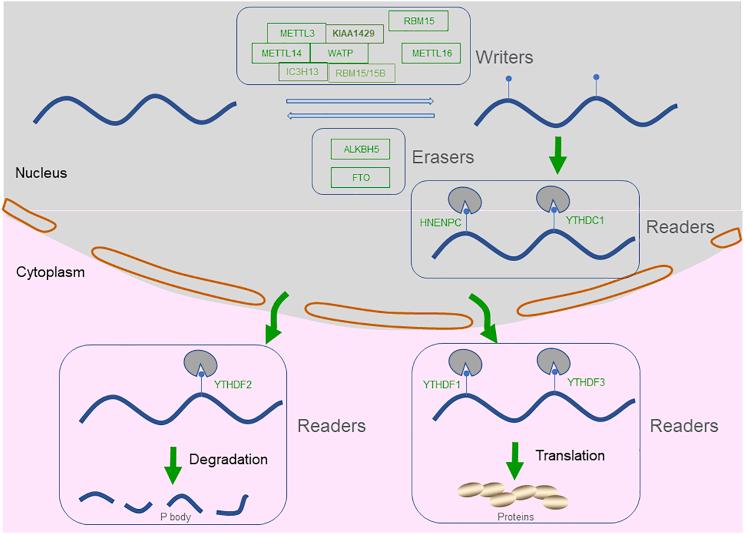
N6-methyladenosine (mA) is the most prevalent internal RNA modification, especially within eukaryotic messenger RNAs (mRNAs). mA modifications of RNA regulate splicing, translocation, stability, and translation into proteins. mA modifications are catalyzed by RNA methyltransferases, such as METTL3, METTL14, and WTAP (writers); the modifications are removed by the demethylases fat mass and obesity-associated protein (FTO) and ALKBH5 (ALKB homolog 5) (erasers); and the modifications are recognized by mA-binding proteins, such as YTHDF domain-containing proteins and IGF2BPs (readers). Abnormal changes in the mA levels of these genes are closely related to tumor occurrence and development. In this paper, we review the role of mA in human cancer and summarize its prospective applications in cancer.
N6-甲基腺嘌呤(mA)是最普遍的内部RNA修饰,尤其是在真核生物信使核糖核酸(mRNA)中。RNA的mA修饰调节剪接、转运、稳定性以及翻译成蛋白质的过程。mA修饰由RNA甲基转移酶催化,如METTL3、METTL14和WTAP(写入器);这些修饰由去甲基酶脂肪量和肥胖相关蛋白(FTO)和ALKBH5(ALKB同源物5)去除(擦除器);并且这些修饰由mA结合蛋白识别,如含YTHDF结构域的蛋白和胰岛素样生长因子2结合蛋白(读取器)。这些基因的mA水平异常变化与肿瘤的发生和发展密切相关。在本文中,我们综述了mA在人类癌症中的作用,并总结了其在癌症中的潜在应用。
 Zotero 插件