
在淡水生境中,传染性腺病毒和肠噬菌体的衰减受环境阳光和土著原生动物群落的存在的影响而不同。
Decay of infectious adenovirus and coliphages in freshwater habitats is differentially affected by ambient sunlight and the presence of indigenous protozoa communities.
机构信息
United States Environmental Protections Agency, Cincinnati, OH, 45268, USA.
出版信息
Virol J. 2020 Jan 6;17(1):1. doi: 10.1186/s12985-019-1274-x.
BACKGROUND
Sanitary quality of recreational waters worldwide is assessed using fecal indicator bacteria (FIB), such as Escherichia coli and enterococci. However, fate and transport characteristics of FIB in aquatic habitats can differ from those of viral pathogens which have been identified as main etiologic agents of recreational waterborne illness. Coliphages (bacteriophages infecting E. coli) are an attractive alternative to FIB because of their many morphological and structural similarities to viral pathogens.
METHODS
In this in situ field study, we used a submersible aquatic mesocosm to compare decay characteristics of somatic and F+ coliphages to those of infectious human adenovirus 2 in a freshwater lake. In addition, we also evaluated the effect of ambient sunlight (and associated UV irradiation) and indigenous protozoan communities on decay of somatic and F+ coliphage, as well as infectious adenovirus.
RESULTS
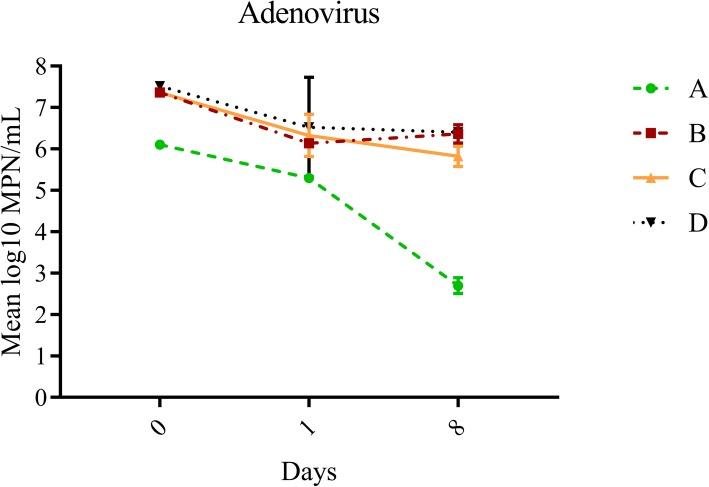
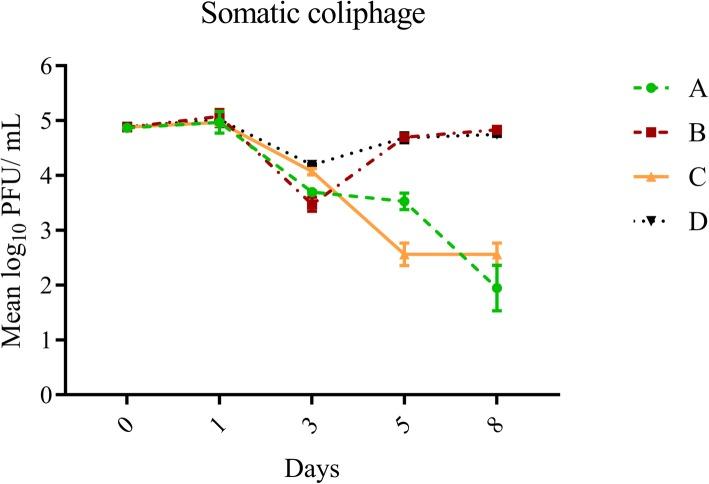
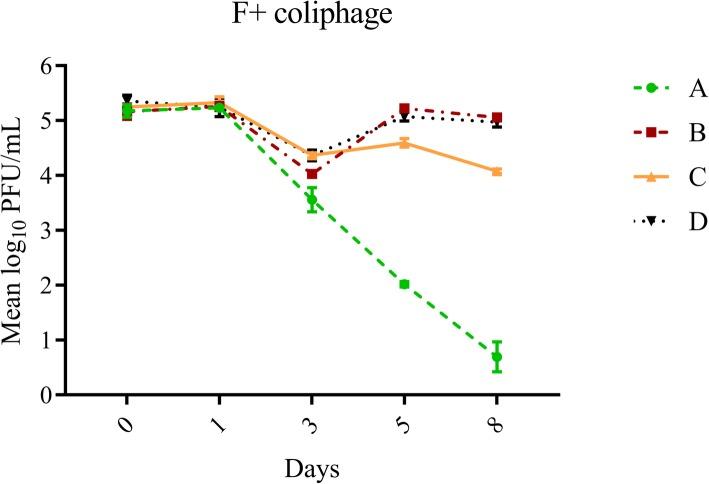
Our results show that decay of coliphages and adenovirus was similar (p = 0.0794), indicating that both of these bacteriophage groups are adequate surrogates for decay of human adenoviruses. Overall, after 8 days the greatest log reductions were observed when viruses were exposed to a combination of biotic and abiotic factors (2.92 ± 0.39, 4.48 ± 0.38, 3.40 ± 0.19 for somatic coliphages, F+ coliphages and adenovirus, respectively). Both, indigenous protozoa and ambient sunlight, were important contributors to decay of all three viruses, although the magnitude of that effect differed over time and across viral targets.
CONCLUSIONS
While all viruses studied decayed significantly faster (p < 0.0001) when exposed to ambient sunlight, somatic coliphages were particularly susceptible to sunlight irradiation suggesting a potentially different mechanism of UV damage compared to F+ coliphages and adenoviruses. Presence of indigenous protozoan communities was also a significant contributor (p value range: 0.0016 to < 0.0001) to decay of coliphages and adenovirus suggesting that this rarely studied biotic factor is an important driver of viral reductions in freshwater aquatic habitats.
背景
全球娱乐用水的卫生质量是通过粪大肠菌群(FIB)等粪便指示菌来评估的,如大肠杆菌和肠球菌。然而,FIB 在水生栖息地中的归宿和传输特性可能与已被确定为娱乐用水相关疾病主要病原体的病毒病原体不同。噬菌体(感染大肠杆菌的噬菌体)是 FIB 的一种有吸引力的替代物,因为它们在形态和结构上与病毒病原体有许多相似之处。
方法
在这项现场原位研究中,我们使用一个可浸入式水生中观系统来比较淡水湖中体噬菌体和 F+噬菌体与传染性人类腺病毒 2 的衰减特征。此外,我们还评估了环境阳光(和相关的紫外线辐射)和土著原生动物群落对体噬菌体和 F+噬菌体以及传染性腺病毒衰减的影响。
结果
我们的结果表明,噬菌体和腺病毒的衰减相似(p=0.0794),表明这两个噬菌体群都是人类腺病毒衰减的合适替代物。总的来说,在 8 天的时间里,当病毒暴露于生物和非生物因素的组合时,观察到最大的对数减少,分别为 2.92±0.39、4.48±0.38 和 3.40±0.19(体噬菌体、F+噬菌体和腺病毒)。土著原生动物和环境阳光都是所有三种病毒衰减的重要贡献者,尽管这种影响的程度随时间和病毒靶标而变化。
结论
虽然所有研究的病毒在暴露于环境阳光时都显著更快地衰减(p<0.0001),但体噬菌体特别容易受到阳光照射的影响,这表明与 F+噬菌体和腺病毒相比,紫外线损伤可能有不同的机制。土著原生动物群落的存在也是噬菌体和腺病毒衰减的一个重要贡献者(p 值范围:0.0016 至<0.0001),这表明这个很少被研究的生物因素是淡水水生栖息地中病毒减少的一个重要驱动因素。
 Zotero 插件