
改进的病毒浓缩方法,用于去污可渗透和不可渗透表面的洗涤水。
Improved virus concentration methods for wash waters from decontamination of permeable and non-permeable surfaces.
机构信息
Department of Environmental Health, University of Cincinnati College of Medicine, 3230 Eden Ave, Cincinnati, OH 45267, USA.
Office of Research and Development, United States Environmental Protection Laboratory, 26 West Martin Luther King Drive, Cincinnati, OH 45268 USA.
出版信息
J Virol Methods. 2023 Dec;322:114826. doi: 10.1016/j.jviromet.2023.114826. Epub 2023 Sep 29.
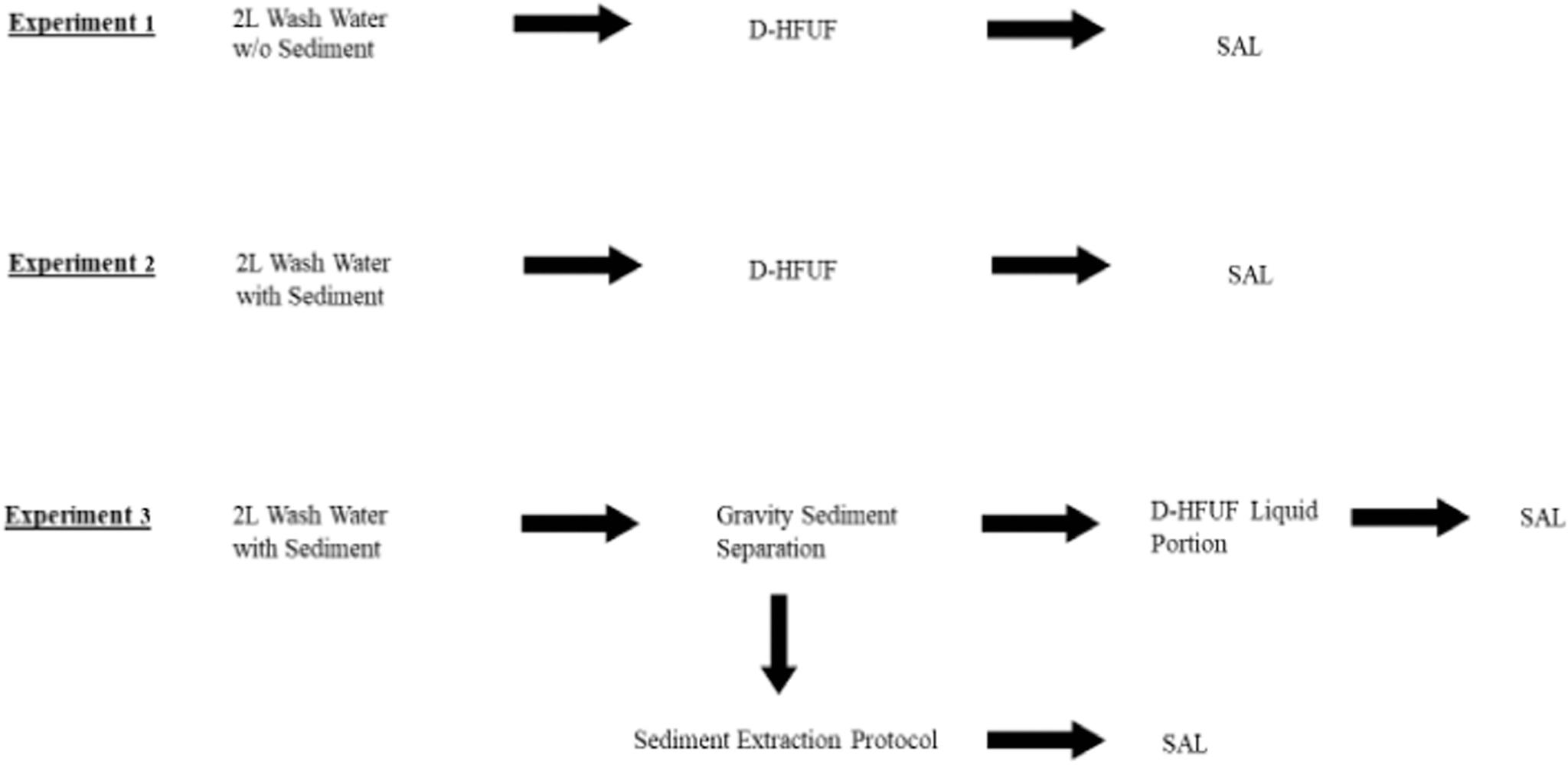
Surface decontamination is a method of using wash water to decontaminated surfaces preventing transmission of biological contaminants that can pose potential health risks to responders and the public. However, the risks associated with handling used wash water are largely unknown due to the lack of effective methodology to screen for pathogenic microorganisms present in these samples, especially viral pathogens. This study adapted the dead-end hollow-fiber ultrafiltration (D-HFUF) system to wash waters, including a separate procedure for recovering particle attached viruses. Simulated wash water was created using dechlorinated tap water containing a mild surfactant (0.05 % Tween 80). To determine virus recovery efficiencies, measured amounts of somatic and F+ coliphage were spiked into 2-liter volumes of wash water under the following scenarios: (1) wash water was amended with a measured amount of sterile river sediment with no sediment separation prior to filter concentration; or (2) sediment added to wash water was allowed to settle prior to filter concentrating clarified liquid portions, while precipitated sediment was subjected to viral extraction techniques to recover particle attached virus; and (3) the optimized method was deployed on non-porous and porous surfaces to simulate a decontamination clean-up event. Separation of sediment prior to D-HFUF significantly increased recovery of coliphages, (P = <0.0001) versus filtration of sediment and liquids simultaneously. A tryptic soy broth (TSB) elution solution was significantly more effective (P = ≤0.010) for recovery of both somatic and F+ coliphage, (108 ± 9 % and 92 ± 9 %, respectively), compared to elution buffers containing various surfactants (sodium hexametaphosphate, Tween 80) for recovering particle attached virus. Simulating a biocontaminate clean-up event (using the optimized sediment separation and elution protocol) resulted in coliphage recoveries of 75-96 % (permeable surface) and 71-92 % (non-permeable surface). This procedure can be used to effectively detect viruses in used wash waters aiding in reducing risks to human health during site decontamination.
表面去污是一种使用洗涤水对表面进行去污的方法,可防止传播对急救人员和公众构成潜在健康风险的生物污染物。然而,由于缺乏有效方法来筛选这些样品中存在的致病微生物,特别是病毒病原体,因此与处理用过的洗涤水相关的风险在很大程度上尚不清楚。本研究采用死端中空纤维超滤(D-HFUF)系统对洗涤水进行处理,其中包括一种单独的程序用于回收附着在颗粒上的病毒。使用经过脱氯的自来水模拟洗涤水,其中含有温和的表面活性剂(0.05%Tween 80)。为了确定病毒回收率,在以下情况下将一定量的体和 F+噬菌体掺入 2 升洗涤水中:(1)在过滤浓缩之前,用测量量的无菌河水沉积物对洗涤水进行添加,然后不进行沉积物分离;或(2)向洗涤水中添加沉积物,让其沉淀,然后对澄清液部分进行过滤浓缩,而沉淀的沉积物则采用病毒提取技术回收附着在颗粒上的病毒;(3)将优化后的方法应用于无孔和多孔表面,以模拟去污清洁事件。在 D-HFUF 之前进行沉积物分离显著提高了噬菌体的回收率(P<0.0001),与同时过滤沉积物和液体相比。与含有各种表面活性剂(六偏磷酸钠、Tween 80)的洗脱缓冲液相比,胰蛋白酶大豆肉汤(TSB)洗脱溶液对回收体和 F+噬菌体更为有效(分别为 108±9%和 92±9%)。模拟生物污染物清洁事件(使用优化的沉积物分离和洗脱方案)导致噬菌体回收率为 75-96%(可渗透表面)和 71-92%(不可渗透表面)。该程序可用于有效检测用过的洗涤水中的病毒,有助于降低现场去污过程中对人类健康的风险。


 Zotero 插件