
超急性心血管磁共振 T1 映射预测 ST 段抬高型心肌梗死患者的梗死特征。
Hyper-acute cardiovascular magnetic resonance T1 mapping predicts infarct characteristics in patients with ST elevation myocardial infarction.
机构信息
Acute Vascular Imaging Centre, Radcliffe Department of Medicine, University of Oxford, Oxford, UK.
Oxford Heart Centre, NIHR Biomedical Research Centre, Oxford University Hospitals, Oxford, UK.
出版信息
J Cardiovasc Magn Reson. 2020 Jan 9;22(1):3. doi: 10.1186/s12968-019-0593-9.
BACKGROUND
Myocardial recovery after primary percutaneous coronary intervention in acute myocardial infarction is variable and the extent and severity of injury are difficult to predict. We sought to investigate the role of cardiovascular magnetic resonance T1 mapping in the determination of myocardial injury very early after treatment of ST-segment elevation myocardial infarction (STEMI).
METHODS
STEMI patients underwent 3 T cardiovascular magnetic resonance (CMR), within 3 h of primary percutaneous intervention (PPCI). T1 mapping determined the extent (area-at-risk as %left ventricle, AAR) and severity (average T1 values of AAR) of acute myocardial injury, and related these to late gadolinium enhancement (LGE), and microvascular obstruction (MVO). The characteristics of myocardial injury within 3 h was compared with changes at 24-h to predict final infarct size.
RESULTS
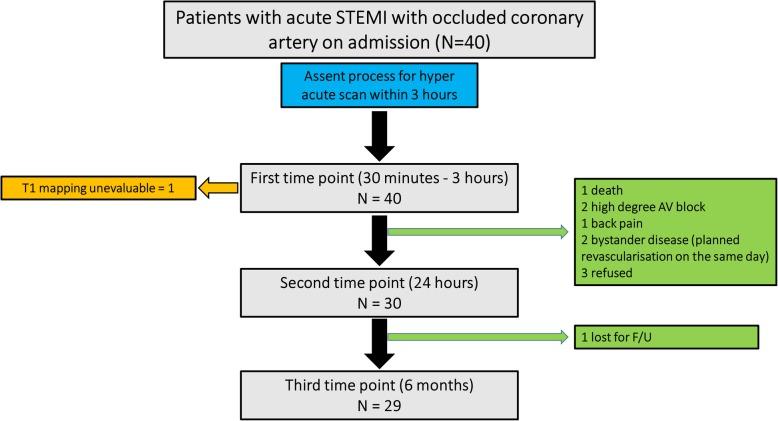
Forty patients were included in this study. Patients with average T1 values of AAR ≥1400 ms within 3 h of PPCI had larger LGE at 24-h (33% ±14 vs. 18% ±10, P = 0.003) and at 6-months (27% ±9 vs. 12% ±9; P < 0.001), higher incidence and larger extent of MVO (85% vs. 40%, P = 0.016) & [4.0 (0.5-9.5)% vs. 0 (0-3.0)%, P = 0.025]. The average T1 value was an independent predictor of acute LGE (β 0.61, 95%CI 0.13 to 1.09; P = 0.015), extent of MVO (β 0.22, 95%CI 0.03 to 0.41, P = 0.028) and final infarct size (β 0.63, 95%CI 0.21 to 1.05; P = 0.005). Receiver-operating-characteristic analysis showed that T1 value of AAR obtained within 3-h, but not at 24-h, predicted large infarct size (LGE > 9.5%) with 100% positive predictive value at the optimal cut-off of 1400 ms (area-under-the-curve, AUC 0.88, P = 0.006).
CONCLUSION
Hyper-acute T1 values of the AAR (within 3 h post PPCI, but not 24 h) predict a larger extent of MVO and infarct size at both 24 h and 6 months follow-up. Delayed CMR scanning for 24 h could not substitute the significant value of hyper-acute average T1 in determining infarct characteristics.
背景
急性心肌梗死经皮冠状动脉介入治疗后心肌的恢复情况各不相同,损伤的程度和范围也难以预测。我们旨在研究心血管磁共振 T1 映射在确定 ST 段抬高型心肌梗死(STEMI)治疗后极早期心肌损伤中的作用。
方法
STEMI 患者在经皮冠状动脉介入治疗(PPCI)后 3 小时内行 3T 心血管磁共振(CMR)检查。T1 映射确定了急性心肌损伤的范围(以左心室百分比表示的危险区面积,AAR)和严重程度(AAR 的平均 T1 值),并将其与晚期钆增强(LGE)和微血管阻塞(MVO)相关联。比较 3 小时内心肌损伤的特征与 24 小时的变化,以预测最终梗死面积。
结果
本研究共纳入 40 例患者。PPCI 后 3 小时内 AAR 的平均 T1 值≥1400ms 的患者,在 24 小时(33%±14 比 18%±10,P=0.003)和 6 个月(27%±9 比 12%±9,P<0.001)时 LGE 更大,MVO 的发生率和范围更高(85%比 40%,P=0.016)[4.0(0.5-9.5)%比 0(0-3.0)%,P=0.025]。平均 T1 值是急性 LGE 的独立预测因子(β 0.61,95%CI 0.13 至 1.09;P=0.015)、MVO 范围的独立预测因子(β 0.22,95%CI 0.03 至 0.41,P=0.028)和最终梗死面积的独立预测因子(β 0.63,95%CI 0.21 至 1.05;P=0.005)。受试者工作特征分析显示,3 小时内而非 24 小时内获得的 AAR T1 值可预测大面积梗死(LGE>9.5%),最佳截断值为 1400ms 时,其阳性预测值为 100%(曲线下面积,AUC 0.88,P=0.006)。
结论
急性心肌梗死经皮冠状动脉介入治疗后 3 小时内 AAR 的超急性 T1 值(而非 24 小时)可预测 MVO 和梗死面积在 24 小时和 6 个月随访时的更大程度。24 小时延迟 CMR 扫描不能替代超急性平均 T1 在确定梗死特征方面的重要价值。



 Zotero 插件