
支持医疗保健系统评价标题和摘要筛选的软件工具:评价。
Software tools to support title and abstract screening for systematic reviews in healthcare: an evaluation.
机构信息
The Primary Care Unit, Department of Public Health and Primary Care, University of Cambridge, Cambridge, UK.
MRC Epidemiology Unit, Institute of Metabolic Science, Cambridge, UK.
出版信息
BMC Med Res Methodol. 2020 Jan 13;20(1):7. doi: 10.1186/s12874-020-0897-3.
BACKGROUND
Systematic reviews are vital to the pursuit of evidence-based medicine within healthcare. Screening titles and abstracts (T&Ab) for inclusion in a systematic review is an intensive, and often collaborative, step. The use of appropriate tools is therefore important. In this study, we identified and evaluated the usability of software tools that support T&Ab screening for systematic reviews within healthcare research.
METHODS
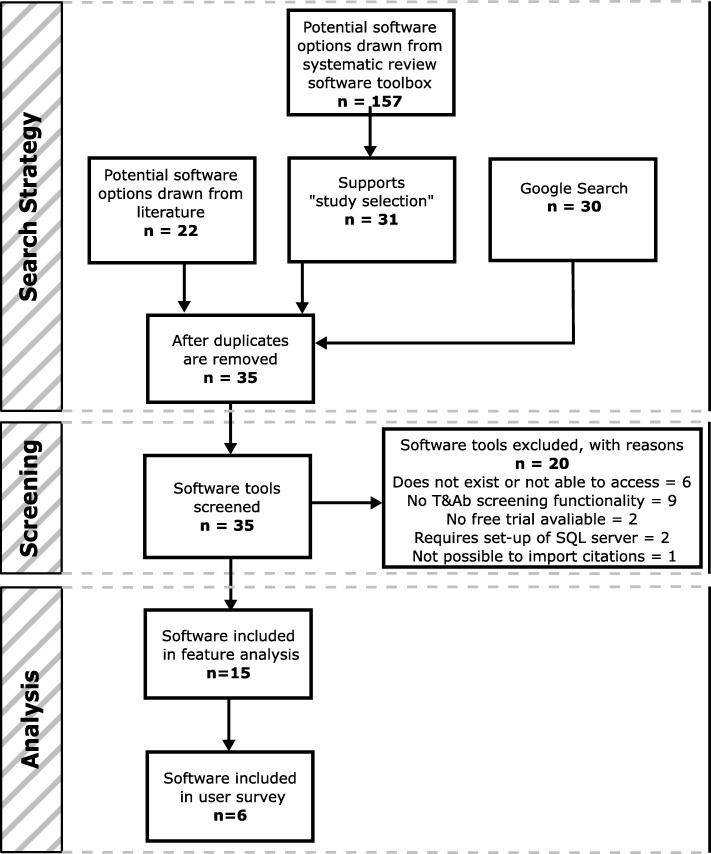
We identified software tools using three search methods: a web-based search; a search of the online "systematic review toolbox"; and screening of references in existing literature. We included tools that were accessible and available for testing at the time of the study (December 2018), do not require specific computing infrastructure and provide basic screening functionality for systematic reviews. Key properties of each software tool were identified using a feature analysis adapted for this purpose. This analysis included a weighting developed by a group of medical researchers, therefore prioritising the most relevant features. The highest scoring tools from the feature analysis were then included in a user survey, in which we further investigated the suitability of the tools for supporting T&Ab screening amongst systematic reviewers working in medical research.
RESULTS
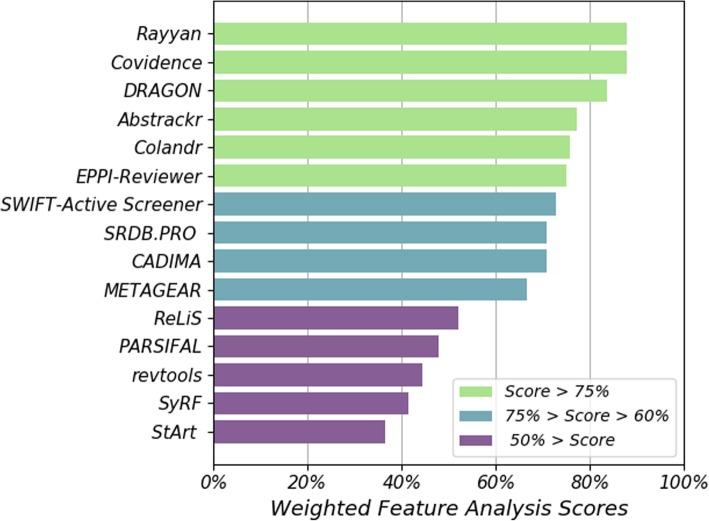
Fifteen tools met our inclusion criteria. They vary significantly in relation to cost, scope and intended user community. Six of the identified tools (Abstrackr, Colandr, Covidence, DRAGON, EPPI-Reviewer and Rayyan) scored higher than 75% in the feature analysis and were included in the user survey. Of these, Covidence and Rayyan were the most popular with the survey respondents. Their usability scored highly across a range of metrics, with all surveyed researchers (n = 6) stating that they would be likely (or very likely) to use these tools in the future.
CONCLUSIONS
Based on this study, we would recommend Covidence and Rayyan to systematic reviewers looking for suitable and easy to use tools to support T&Ab screening within healthcare research. These two tools consistently demonstrated good alignment with user requirements. We acknowledge, however, the role of some of the other tools we considered in providing more specialist features that may be of great importance to many researchers.
背景
系统评价对于医疗保健领域的循证医学至关重要。筛选标题和摘要(T&A)以纳入系统评价是一项密集且通常需要协作的步骤。因此,使用适当的工具非常重要。在这项研究中,我们确定并评估了支持医疗保健研究中 T&A 筛选的软件工具的可用性。
方法
我们使用三种搜索方法来识别软件工具:基于网络的搜索;在线“系统评价工具包”的搜索;以及现有文献中的参考文献筛选。我们纳入了在研究时(2018 年 12 月)可访问和可测试的工具,这些工具不需要特定的计算基础设施,并为系统评价提供基本的筛选功能。使用为此目的改编的特征分析确定了每个软件工具的关键属性。该分析包括由一组医学研究人员开发的加权,因此优先考虑最相关的特征。然后,在用户调查中纳入特征分析中得分最高的工具,在调查中,我们进一步研究了这些工具在支持从事医学研究的系统审查员进行 T&A 筛选方面的适用性。
结果
符合纳入标准的工具共有 15 个。它们在成本、范围和目标用户群体方面存在显著差异。在特征分析中得分超过 75%的 6 种确定的工具(Abstrackr、Colandr、Covidence、DRAGON、EPPIReviewer 和 Rayyan)被纳入用户调查。在这些工具中,Covidence 和 Rayyan 受到调查受访者的欢迎。它们在一系列指标上的可用性得分都很高,所有接受调查的研究人员(n=6)都表示他们将来很可能(或非常可能)使用这些工具。
结论
基于这项研究,我们建议医疗保健研究中寻找合适且易于使用的工具以支持 T&A 筛选的系统审查员使用 Covidence 和 Rayyan。这两个工具始终与用户需求保持良好的一致性。然而,我们承认我们考虑的其他一些工具在提供对许多研究人员非常重要的更专业功能方面发挥了作用。


 Zotero 插件