Lew Thomas E, Anderson Mary Ann, Lin Victor S, Handunnetti Sasanka M, Came Neil A, Blombery Piers, Westerman David A, Wall Meaghan, Tam Constantine S, Roberts Andrew W, Seymour John F
Department of Clinical Haematology, The Royal Melbourne Hospital and Peter MacCallum Cancer Centre, Parkville, Australia.
Blood Cells and Blood Cancer Division, Walter and Eliza Hall Institute of Medical Research, Parkville, Australia.
Blood Adv. 2020 Jan 14;4(1):165-173. doi: 10.1182/bloodadvances.2019000864.
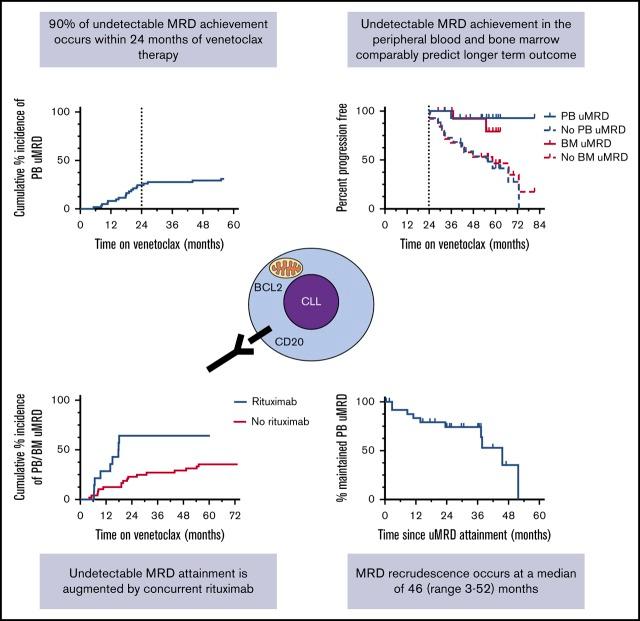
The highly selective BCL2 inhibitor venetoclax achieves deep responses in patients with relapsed or refractory (R/R) chronic lymphocytic leukemia (CLL), including undetectable minimal residual disease (uMRD). We retrospectively reviewed 62 patients with CLL treated with venetoclax to investigate the performance of peripheral blood (PB) compared with bone marrow (BM) assessment of MRD; the kinetics, clinicopathological associations, and longer-term outcomes of uMRD attainment and recrudescence; and the ability of venetoclax dose escalation to deepen responses. Among 16 patients who achieved PB uMRD and had contemporaneous BM assessments, 13 (81%) had confirmed BM uMRD, and patients with PB uMRD had outcomes at least as favorable as those with BM uMRD for time to progression, overall survival, and MRD recrudescence. Excluding 2 patients lacking earlier assessment, the median time to PB uMRD was 18 (range, 5-26) months, with 90% of instances achieved by 24 months. There was no new PB uMRD attainment after 24 months without treatment intensification. The dominant association with earlier attainment of uMRD was concurrent rituximab (P = .012). Complex karyotype was associated with inferior uMRD attainment after 12 months of therapy (P = .015), and patients attaining uMRD whose disease harbored TP53 abnormalities demonstrated a trend toward earlier recrudescence (P = .089). Of patients who received venetoclax dose escalations, 4 (27%) of 15 achieved improvements in response. For patients with R/R CLL receiving venetoclax, PB uMRD commonly correlates with BM uMRD and is associated with a comparable longer-term prognosis. Concurrent rituximab augments uMRD attainment, but dose escalation and further treatment beyond 24 months infrequently deepen responses.
高选择性BCL2抑制剂维奈克拉在复发或难治性(R/R)慢性淋巴细胞白血病(CLL)患者中可实现深度缓解,包括不可检测的微小残留病(uMRD)。我们回顾性分析了62例接受维奈克拉治疗的CLL患者,以研究外周血(PB)与骨髓(BM)MRD评估的性能;uMRD达到和复发的动力学、临床病理相关性及长期结局;以及维奈克拉剂量递增加深缓解的能力。在16例达到PB uMRD并同时进行BM评估的患者中,13例(81%)确诊为BM uMRD,PB uMRD患者在疾病进展时间、总生存期和MRD复发方面的结局至少与BM uMRD患者一样良好。排除2例缺乏早期评估的患者后,达到PB uMRD的中位时间为18(范围5 - 26)个月,90%的情况在24个月内实现。在未强化治疗的情况下,24个月后未出现新的PB uMRD达到情况。与较早达到uMRD的主要相关性是同时使用利妥昔单抗(P = 0.012)。复杂核型与治疗12个月后uMRD达到情况较差相关(P = 0.015),疾病存在TP53异常且达到uMRD的患者显示出较早复发的趋势(P = 0.089)。在接受维奈克拉剂量递增的患者中,15例中有4例(27%)缓解得到改善。对于接受维奈克拉治疗的R/R CLL患者,PB uMRD通常与BM uMRD相关,且与相当的长期预后相关。同时使用利妥昔单抗可提高uMRD达到率,但剂量递增和24个月后进一步治疗很少能加深缓解。

 Zotero 插件