
吗啡引起的呼吸抑制与β-arrestin2 信号无关。
Morphine-induced respiratory depression is independent of β-arrestin2 signalling.
机构信息
Institute of Pharmacology and Toxicology, Jena University Hospital, Friedrich-Schiller-University, Jena, Germany.
Discipline of Pharmacology, School of Medical Sciences, University of Sydney, Sydney, NSW, Australia.
出版信息
Br J Pharmacol. 2020 Jul;177(13):2923-2931. doi: 10.1111/bph.15004. Epub 2020 Feb 17.
BACKGROUND AND PURPOSE
GPCRs can signal through both G proteins and β-arrestin2. For the μ-opioid receptor, early experimental evidence from a single study suggested that G protein signalling mediates analgesia, whereas β-arrestin2 signalling mediates respiratory depression and constipation. Consequently, for more than a decade, much research effort has been focused on developing biased μ-opioid agonists that preferentially target G protein signalling over β-arrestin signalling, as it was believed that such drugs would be analgesics devoid of respiratory depressant activity. However, the prototypical compounds that have been developed based on this concept have so far failed in clinical and preclinical development.
EXPERIMENTAL APPROACH
The present study was set up to re-examine opioid-induced respiratory depression in β-arrestin2 knockout mice. To this end, a consortium was formed consisting of three different laboratories located in different countries to evaluate independently opioid-induced respiratory depression.
KEY RESULTS
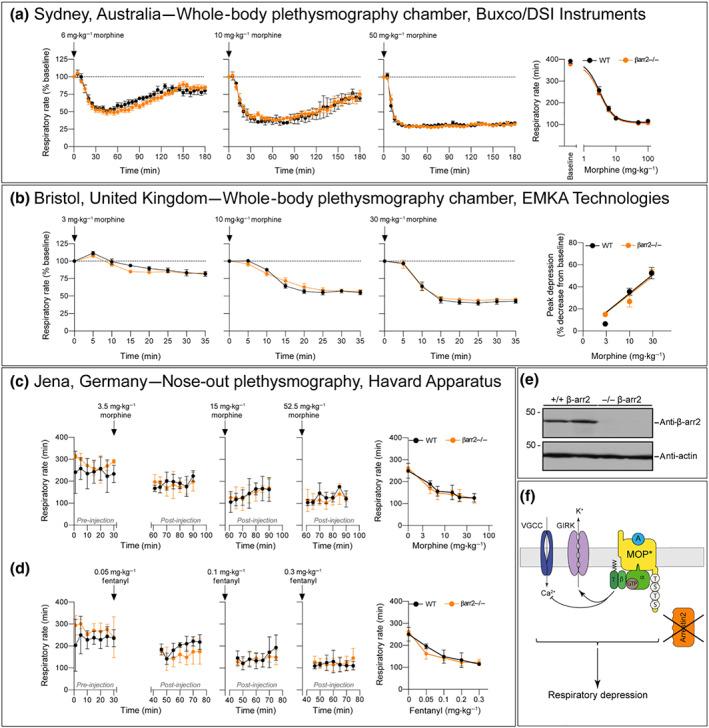
Our consensus results unequivocally demonstrate that the prototypical μ-opioid agonist morphine (3.75-100 mg·kg s.c. or 3-30 mg·kg i.p.) as well as the potent opioid fentanyl (0.05-0.35 mg·kg s.c.) do indeed induce respiratory depression and constipation in β-arrestin2 knockout mice in a dose-dependent manner indistinguishable from that observed in wild-type mice.
CONCLUSION AND IMPLICATIONS
Our findings do not support the original suggestion that β-arrestin2 signalling plays a key role in opioid-induced respiratory depression and call into question the concept of developing G protein-biased μ-opioid receptor agonists as a strategy for the development of safer opioid analgesic drugs.
背景与目的
G 蛋白偶联受体(GPCRs)可以通过 G 蛋白和β-arrestin2 两种方式发出信号。对于μ-阿片受体,来自单一研究的早期实验证据表明,G 蛋白信号转导介导镇痛,而β-arrestin2 信号转导则介导呼吸抑制和便秘。因此,在过去的十多年里,大量的研究工作集中在开发偏向性μ-阿片受体激动剂上,这些激动剂优先靶向 G 蛋白信号转导而不是β-arrestin2 信号转导,因为人们认为此类药物将是没有呼吸抑制活性的镇痛药。然而,迄今为止,基于这一概念开发的原型化合物在临床和临床前开发中都失败了。
实验方法
本研究旨在重新研究β-arrestin2 敲除小鼠中的阿片类药物诱导的呼吸抑制。为此,成立了一个由三个位于不同国家的不同实验室组成的联盟,独立评估阿片类药物诱导的呼吸抑制。
主要结果
我们的共识结果明确表明,原型μ-阿片受体激动剂吗啡(3.75-100mg·kg 皮下注射或 3-30mg·kg 腹腔注射)以及强效阿片类药物芬太尼(0.05-0.35mg·kg 皮下注射)确实会导致β-arrestin2 敲除小鼠的呼吸抑制和便秘,其剂量依赖性方式与在野生型小鼠中观察到的方式无法区分。
结论和意义
我们的发现不支持β-arrestin2 信号转导在阿片类药物诱导的呼吸抑制中起关键作用的原始假设,并对开发 G 蛋白偏向性μ-阿片受体激动剂作为开发更安全的阿片类镇痛药策略提出质疑。

 Zotero 插件