
NADPH 氧化酶过度活跃导致人类动脉粥样硬化中端粒缩短。
NADPH Oxidase Overactivity Underlies Telomere Shortening in Human Atherosclerosis.
机构信息
Department of Biochemistry and Genetics, University of Navarra, 31008 Pamplona, Spain.
Navarra Institute for Health Research (IdiSNA), 31008 Pamplona, Spain.
出版信息
Int J Mol Sci. 2020 Feb 20;21(4):1434. doi: 10.3390/ijms21041434.
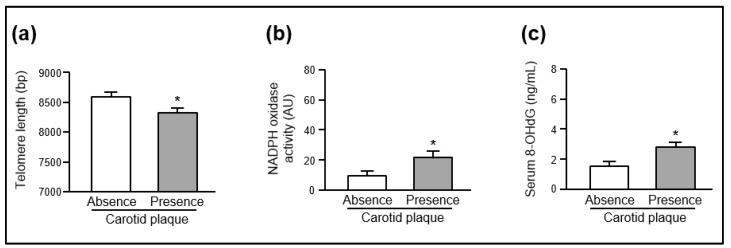
Telomere shortening and oxidative stress are involved in the pathogenesis of atherosclerosis. Different studies have shown that phagocytic NADPH oxidase is associated with this disease. This study aimed to investigate the association between phagocytic NADPH oxidase and telomere shortening in human atherosclerosis. To assess this potential association, telomere length and phagocytic NADPH oxidase activity were determined by PCR and chemiluminescence, respectively, in a population of asymptomatic subjects free of overt clinical atherosclerosis. We also measured serum 8-hydroxy-2-deoxyguanosine (8-OHdG) levels (an index of oxidative stress) and carotid intima-media thickness (IMT), a surrogate marker of atherosclerosis. After adjusting them for age and sex, telomere length inversely correlated ( < 0.05) with NADPH oxidase-mediated superoxide production, with 8-OHdG values, and with carotid IMT. Interestingly, the asymptomatic subjects with plaques have a lower telomere length ( < 0.05), and higher values of plasma 8-OHdG and superoxide production ( < 0.05). These data were confirmed in a second population in which patients with coronary artery disease showed lower telomere length and higher 8-OHdG and superoxide production than the asymptomatic subjects. In both studies, NADPH oxidase-dependent superoxide production in phagocytic cells was only due to the specific expression of the Nox2 isoform. In conclusion, these findings suggest that phagocytic NADPH oxidase may be involved in oxidative stress-mediated telomere shortening, and that this axis may be critically involved in human atherosclerosis.
端粒缩短和氧化应激与动脉粥样硬化的发病机制有关。不同的研究表明,吞噬细胞 NADPH 氧化酶与这种疾病有关。本研究旨在探讨吞噬细胞 NADPH 氧化酶与人类动脉粥样硬化中端粒缩短之间的关系。为了评估这种潜在的关联,我们通过 PCR 和化学发光法分别测定了无明显临床动脉粥样硬化的无症状受试者中吞噬细胞 NADPH 氧化酶和端粒长度。我们还测量了血清 8-羟基-2-脱氧鸟苷(8-OHdG)水平(氧化应激的一个指标)和颈动脉内膜中层厚度(IMT),这是动脉粥样硬化的替代标志物。在调整年龄和性别后,端粒长度与 NADPH 氧化酶介导的超氧化物产生、8-OHdG 值和颈动脉 IMT 呈负相关(<0.05)。有趣的是,有斑块的无症状受试者端粒长度较低(<0.05),血浆 8-OHdG 和超氧化物产生值较高(<0.05)。在第二项研究中,冠心病患者的端粒长度和 8-OHdG 和超氧化物产生均低于无症状患者,证实了这一数据。在这两项研究中,吞噬细胞中 NADPH 氧化酶依赖性超氧化物的产生仅归因于 Nox2 同工型的特异性表达。总之,这些发现表明吞噬细胞 NADPH 氧化酶可能参与氧化应激介导的端粒缩短,并且该轴可能在人类动脉粥样硬化中起关键作用。



 Zotero 插件