
高级别卵巢癌及其远处转移的遗传异质性和进化史。
Genetic heterogeneity and evolutionary history of high-grade ovarian carcinoma and matched distant metastases.
机构信息
Human Cancer Genomic Research, King Faisal Specialist Hospital and Research Centre, P.O. Box 3354, Riyadh, 11211, Saudi Arabia.
Department of Pathology, King Faisal Specialist Hospital and Research Centre, P.O. Box 3354, Riyadh, 11211, Saudi Arabia.
出版信息
Br J Cancer. 2020 Apr;122(8):1219-1230. doi: 10.1038/s41416-020-0763-4. Epub 2020 Feb 26.
BACKGROUND
High-grade serous ovarian carcinoma (HGSOC) is the most frequent type of ovarian carcinoma, associated with poor clinical outcome and metastatic disease. Although metastatic processes are becoming more understandable, the genomic landscape and metastatic progression in HGSOC has not been elucidated.
METHODS
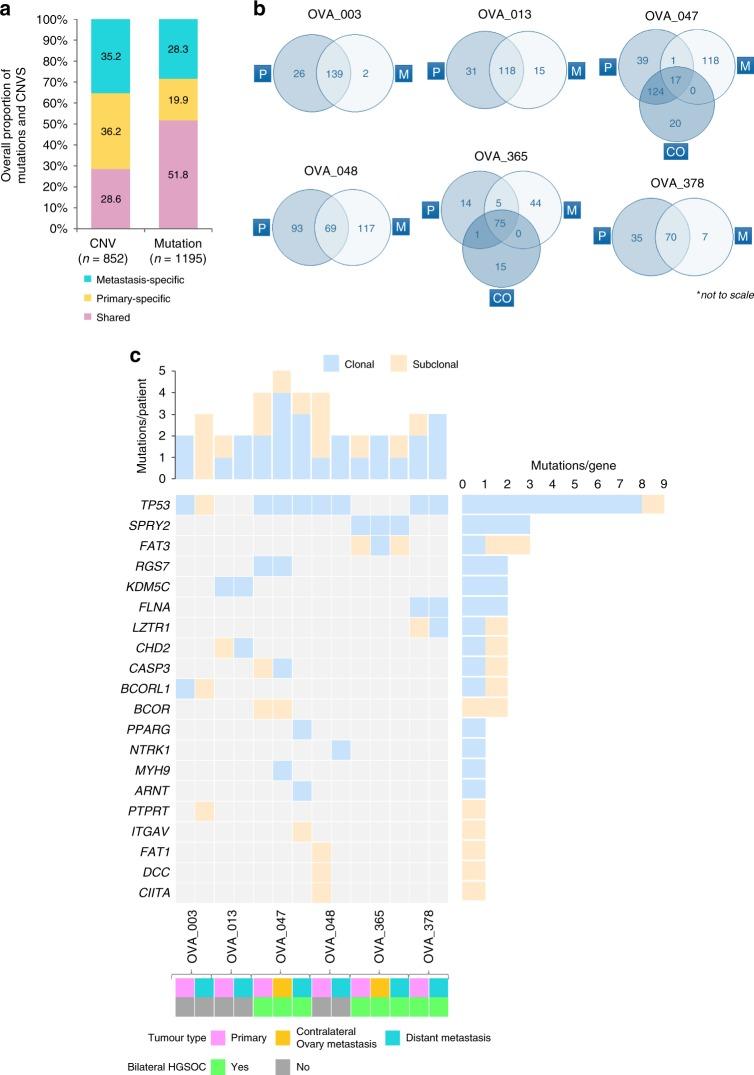
Multi-region whole-exome sequencing was performed on HGSOC primary tumours and their metastases (n = 33 tumour regions) from six patients. The resulting somatic variants were analysed to delineate tumour evolution and metastatic dissemination, and to compare the repertoire of events between primary HGSOC and metastasis.
RESULTS
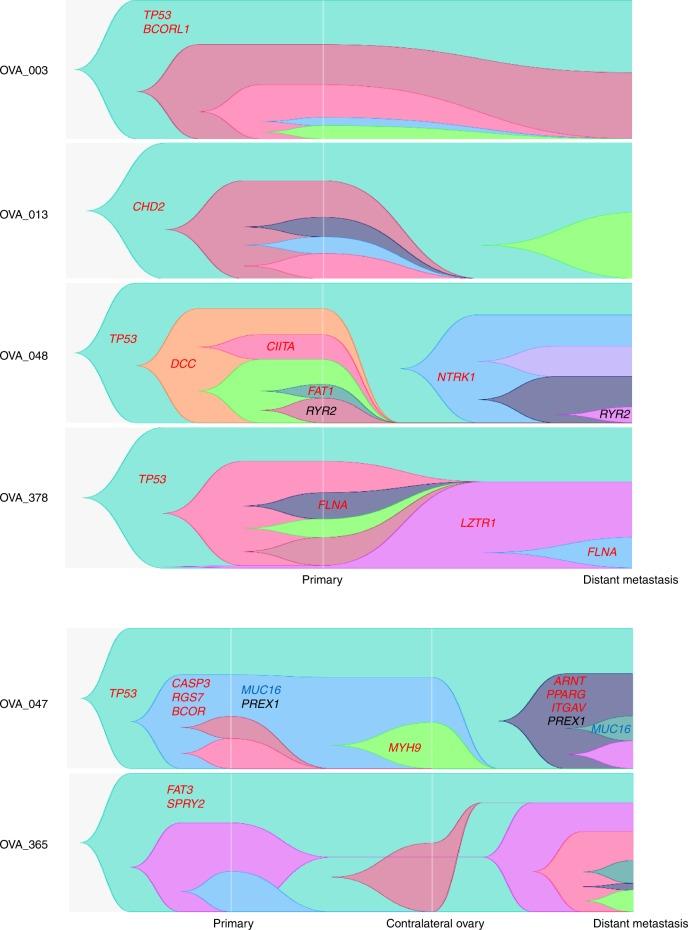
All cases presented branching evolution patterns in primary HGSOC, with three cases further showing parallel evolution in which different mutations on separate branches of a phylogenetic tree converge on the same gene. Furthermore, linear metastatic progression was observed in 67% of cases with late dissemination, in which the metastatic tumour mostly acquires the same mutational process active in primary tumour, and parallel metastatic progression, with early dissemination in the remaining 33.3% of cases. Metastatic-specific SNVs were further confirmed as late dissemination events. We also found the involvement of metastatic-specific driver events in the Wnt/β-catenin pathway, and identified potential clinically actionable events in individual patients of the metastatic HGSOC cohort.
CONCLUSIONS
This study provides deeper insights into clonal evolution and mutational processes that can pave the way to new therapeutic targets.
背景
高级别浆液性卵巢癌(HGSOC)是最常见的卵巢癌类型,与不良的临床结局和转移性疾病相关。尽管转移性过程变得越来越容易理解,但 HGSOC 的基因组景观和转移进展尚未阐明。
方法
对 6 名患者的 HGSOC 原发肿瘤及其转移灶(n=33 个肿瘤区域)进行了多区域全外显子组测序。分析所得的体细胞变异,以描绘肿瘤进化和转移扩散,并比较原发 HGSOC 和转移之间的事件谱。
结果
所有病例在原发 HGSOC 中均呈现分支进化模式,其中 3 例进一步显示出平行进化,即在系统发育树的不同分支上的不同突变集中在同一基因上。此外,在 67%具有晚期播散的病例中观察到线性转移进展,其中转移瘤主要获得原发肿瘤中活跃的相同突变过程,而在剩余 33.3%的病例中则为平行转移进展。转移特异性 SNV 进一步被确认为晚期播散事件。我们还发现转移性特异性驱动事件参与了 Wnt/β-catenin 通路,并在转移性 HGSOC 队列的个别患者中鉴定出潜在的临床可操作事件。
结论
本研究深入了解了克隆进化和突变过程,为新的治疗靶点铺平了道路。



 Zotero 插件