
白血病免疫逃逸的机制及其在单倍体造血细胞移植后复发中的作用。
Mechanisms of Leukemia Immune Evasion and Their Role in Relapse After Haploidentical Hematopoietic Cell Transplantation.
机构信息
Unit of Immunogenetics, Leukemia Genomics and Immunobiology, IRCCS San Raffaele Scientific Institute, Milan, Italy.
Hematology and Bone Marrow Transplantation Unit, IRCCS San Raffaele Scientific Institute, Milan, Italy.
出版信息
Front Immunol. 2020 Feb 25;11:147. doi: 10.3389/fimmu.2020.00147. eCollection 2020.
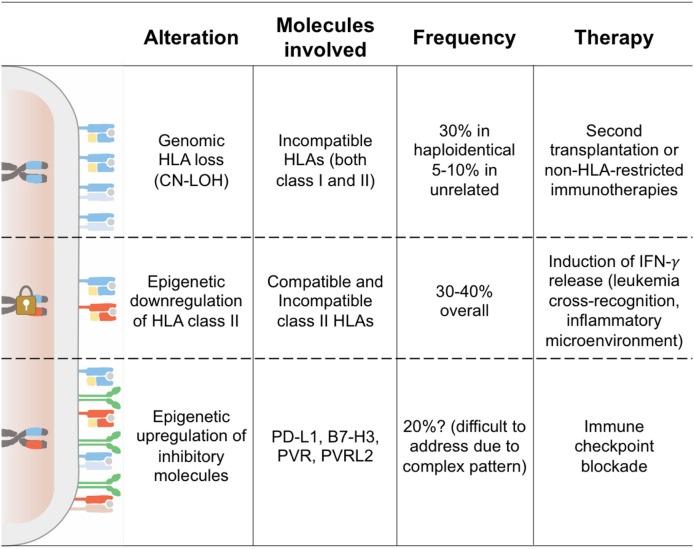
Over the last decade, the development of multiple strategies to allow the safe transfer from the donor to the patient of high numbers of partially HLA-incompatible T cells has dramatically reduced the toxicities of haploidentical hematopoietic cell transplantation (haplo-HCT), but this was not accompanied by a similar positive impact on the incidence of post-transplantation relapse. In the present review, we will elaborate on how the unique interplay between HLA-mismatched immune system and malignancy that characterizes haplo-HCT may impact relapse biology, shaping the selection of disease variants that are resistant to the "graft-vs.-leukemia" effect. In particular, we will present current knowledge on genomic loss of HLA, a relapse modality first described in haplo-HCT and accounting for a significant proportion of relapses in this setting, and discuss other more recently identified mechanisms of post-transplantation immune evasion and relapse, including the transcriptional downregulation of HLA class II molecules and the enforcement of inhibitory checkpoints between T cells and leukemia. Ultimately, we will review the available treatment options for patients who relapse after haplo-HCT and discuss on how a deeper insight into relapse immunobiology might inform the rational and personalized selection of therapies to improve the largely unsatisfactory clinical outcome of relapsing patients.
在过去的十年中,已经开发出多种策略来允许将大量部分 HLA 不相容的 T 细胞从供体安全转移到患者体内,这极大地降低了单倍体造血细胞移植(haplo-HCT)的毒性,但这并没有带来移植后复发率的类似积极影响。在本综述中,我们将详细阐述单倍体 HCT 中 HLA 错配免疫系统和恶性肿瘤之间的独特相互作用如何影响复发生物学,从而影响选择对“移植物抗白血病”效应有抗性的疾病变体。特别是,我们将介绍 HLA 基因组缺失的最新知识,这是在单倍体 HCT 中首次描述的一种复发模式,占该治疗方案中很大一部分复发病例,并讨论其他最近确定的移植后免疫逃逸和复发的机制,包括 HLA Ⅱ类分子的转录下调和 T 细胞与白血病之间抑制性检查点的建立。最终,我们将回顾haplo-HCT 后复发患者的可用治疗选择,并讨论深入了解复发免疫生物学如何为合理和个性化选择治疗方法提供信息,以改善复发患者的总体不满意临床结局。

 Zotero 插件