
肠道微生物群和环境因素在 1 型糖尿病发病机制中的作用。
The Role of Gut Microbiota and Environmental Factors in Type 1 Diabetes Pathogenesis.
机构信息
Biology Department, Boston College, Chestnut Hill, MA, United States.
Department of Clinical and Experimental Medicine, Linköping University, Linköping, Sweden.
出版信息
Front Endocrinol (Lausanne). 2020 Feb 26;11:78. doi: 10.3389/fendo.2020.00078. eCollection 2020.
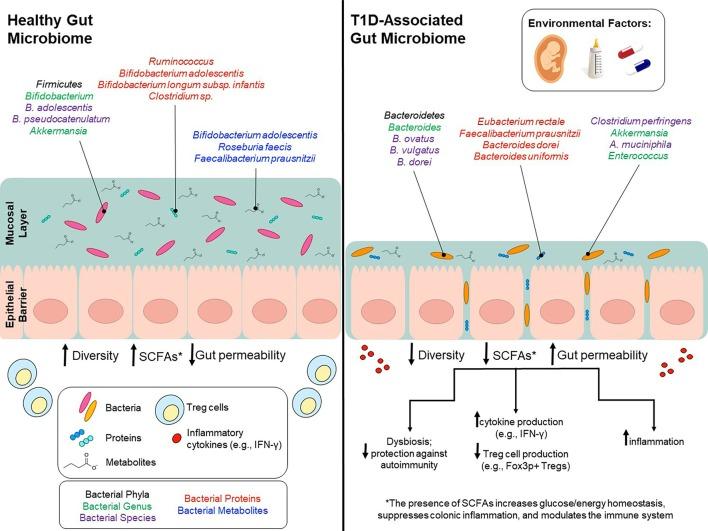
Type 1 Diabetes (T1D) is regarded as an autoimmune disease characterized by insulin deficiency resulting from destruction of pancreatic β-cells. The incidence rates of T1D have increased worldwide. Over the past decades, progress has been made in understanding the complexity of the immune response and its role in T1D pathogenesis, however, the trigger of T1D autoimmunity remains unclear. The increasing incidence rates, immigrant studies, and twin studies suggest that environmental factors play an important role and the trigger cannot simply be explained by genetic predisposition. Several research initiatives have identified environmental factors that potentially contribute to the onset of T1D autoimmunity and the progression of disease in children/young adults. More recently, the interplay between gut microbiota and the immune system has been implicated as an important factor in T1D pathogenesis. Although results often vary between studies, broad compositional and diversity patterns have emerged from both longitudinal and cross-sectional human studies. T1D patients have a less diverse gut microbiota, an increased prevalence of Bacteriodetes taxa and an aberrant metabolomic profile compared to healthy controls. In this comprehensive review, we present the data obtained from both animal and human studies focusing on the large longitudinal human studies. These studies are particularly valuable in elucidating the environmental factors that lead to aberrant gut microbiota composition and potentially contribute to T1D. We also discuss how environmental factors, such as birth mode, diet, and antibiotic use modulate gut microbiota and how this potentially contributes to T1D. In the final section, we focus on existing recent literature on microbiota-produced metabolites, proteins, and gut virome function as potential protectants or triggers of T1D onset. Overall, current results indicate that higher levels of diversity along with the presence of beneficial microbes and the resulting microbial-produced metabolites can act as protectors against T1D onset. However, the specifics of the interplay between host and microbes are yet to be discovered.
1 型糖尿病(T1D)被认为是一种自身免疫性疾病,其特征是由于胰腺β细胞破坏导致胰岛素缺乏。T1D 的发病率在全球范围内有所增加。在过去的几十年中,人们对免疫反应的复杂性及其在 T1D 发病机制中的作用有了更多的了解,然而,T1D 自身免疫的触发因素仍不清楚。发病率的增加、移民研究和双胞胎研究表明,环境因素起着重要作用,并且不能简单地用遗传易感性来解释触发因素。一些研究计划已经确定了可能导致 T1D 自身免疫和儿童/年轻人疾病进展的环境因素。最近,肠道微生物群和免疫系统之间的相互作用被认为是 T1D 发病机制中的一个重要因素。尽管研究结果在不同的研究中经常有所不同,但来自纵向和横断面人类研究的广泛组成和多样性模式已经出现。与健康对照组相比,T1D 患者的肠道微生物群多样性较低,厚壁菌门的丰度增加,代谢组学图谱异常。在这篇综述中,我们介绍了来自动物和人类研究的数据,重点介绍了大型纵向人类研究。这些研究对于阐明导致肠道微生物群组成异常的环境因素以及这些因素如何可能导致 T1D 特别有价值。我们还讨论了环境因素(如分娩方式、饮食和抗生素使用)如何调节肠道微生物群,以及这如何可能导致 T1D。在最后一节中,我们重点介绍了关于微生物群产生的代谢物、蛋白质和肠道病毒组功能作为 T1D 发病潜在保护剂或触发因素的最新文献。总的来说,目前的结果表明,更高的多样性水平以及有益微生物的存在和由此产生的微生物产生的代谢物可以作为预防 T1D 发病的保护剂。然而,宿主和微生物之间相互作用的具体细节仍有待发现。
 Zotero 插件