
全代谢组孟德尔随机化揭示了循环代谢物与1型糖尿病之间的因果关系。
Metabolome-wide Mendelian randomisation reveals causal links between circulating metabolites and type 1 diabetes.
作者信息
Jumentier Basile, Gamache Isabel, Michalek Dominika A, Chen Wei-Min, Onengut-Gumuscu Suna, Rich Stephen S, Polychronakos Constantin, Manousaki Despoina
机构信息
Research Center of the Sainte-Justine University Hospital, Université de Montreal, Montreal, Canada.
Department of Genome Sciences, University of Virginia, Charlottesville, United States.
出版信息
EBioMedicine. 2025 Jul;117:105807. doi: 10.1016/j.ebiom.2025.105807. Epub 2025 Jun 24.
BACKGROUND
Type 1 diabetes (T1D) is an autoimmune disease that causes destruction of the insulin-producing pancreatic beta cell, resulting in high levels of blood glucose and profound alterations in carbohydrate, lipid, and protein metabolism if untreated. We aimed to identify if circulating metabolites are causally linked to risk of T1D, using two-sample Mendelian Randomisation (MR).
METHODS
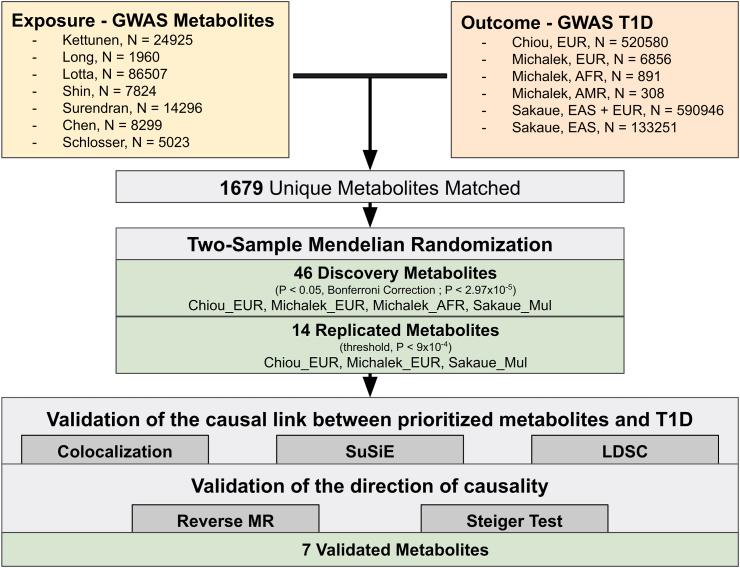
For our discovery and replication MR analyses, we used SNP-instruments for circulating metabolites measured in seven large GWAS in Europeans. The corresponding effects of the SNP-instruments on T1D were derived from GWAS in multiple ancestries. The MR effects were estimated using the Wald Ratio or the Inverse Weighted Variance method. We then tested the presence of shared causal variants between the candidate metabolites and T1D and performed sensitivity analyses for pleiotropy and direction of causality.
FINDINGS
Of the 1679 tested metabolite-T1D associations, 46 metabolites showed effects on T1D accounting for multiple testing. Among the 14 metabolites replicated using independent T1D GWAS, 7 of these metabolites shared a causal variant with T1D. The metabolite with the most important MR effect, vanillactate, showed a strong negative association with T1D risk in 3 T1D GWAS. The SNP-instrument of vanillactate is an eQTL of the TH gene which is itself coexpressed with the INS gene, a major T1D locus.
INTERPRETATION
Combining evidence from MR and various follow-up analyses, we identified causal circulating metabolites for T1D, highlighting the role of specific metabolic signatures in the pathogenesis of this disease.
FUNDING
Fonds de Recherche du Quebec-Santé (FRQS).
背景
1型糖尿病(T1D)是一种自身免疫性疾病,会导致产生胰岛素的胰腺β细胞遭到破坏,若不加以治疗,会导致血糖水平升高以及碳水化合物、脂质和蛋白质代谢的严重改变。我们旨在通过两样本孟德尔随机化(MR)确定循环代谢物是否与T1D风险存在因果关系。
方法
在我们的发现和重复MR分析中,我们使用了欧洲人七项大型全基因组关联研究(GWAS)中测量的循环代谢物的单核苷酸多态性(SNP)工具。SNP工具对T1D的相应影响来自多个祖先群体的GWAS。使用Wald比率或逆加权方差方法估计MR效应。然后,我们测试了候选代谢物与T1D之间共享因果变异的存在情况,并对多效性和因果关系方向进行了敏感性分析。
研究结果
在1679项测试的代谢物与T1D的关联中,46种代谢物显示出对T1D的影响,这一结果考虑了多重检验。在使用独立的T1D GWAS重复验证的14种代谢物中,其中7种代谢物与T1D共享一个因果变异。具有最重要MR效应的代谢物香草乳酸,在3项T1D GWAS中显示出与T1D风险呈强烈负相关。香草乳酸的SNP工具是TH基因的一个表达数量性状基因座(eQTL),而TH基因本身与主要的T1D基因座INS基因共表达。
解读
综合MR和各种后续分析的证据,我们确定了T1D的因果循环代谢物,突出了特定代谢特征在该疾病发病机制中的作用。
资金来源
魁北克卫生研究基金(FRQS)。


 Zotero 插件