
预期寿命趋势:健康人群和患病人群之间的差距扩大了还是缩小了?
Trends in life expectancy: did the gap between the healthy and the ill widen or close?
机构信息
Unit of Epidemiology, Institute of Environmental Medicine, Karolinska Institutet, PO Box 210, SE-171 77, Stockholm, Sweden.
Demography Unit, Stockholm University, SE-10691, Stockholm, Sweden.
出版信息
BMC Med. 2020 Mar 20;18(1):41. doi: 10.1186/s12916-020-01514-z.
BACKGROUND
During the past decades, life expectancy has continued to increase in most high-income countries. Previous research suggests that improvements in life expectancy have primarily been driven by advances at the upper end of the health distribution, while parts of the population have lagged behind. Using data from the entire Swedish population, this study aims to examine the life expectancy development among subgroups of individuals with a history of common diseases relative to that of the general population.
METHODS
The remaining life expectancy at age 65 was estimated for each year in 1998-2017 among individuals with a history of disease, and for the total Swedish population. We defined population subgroups as individuals with a history of myocardial infarction, ischemic or hemorrhagic stroke, hip fracture, or colon, breast, or lung cancer. We further distinguished between different educational levels and Charlson comorbidity index scores.
RESULTS
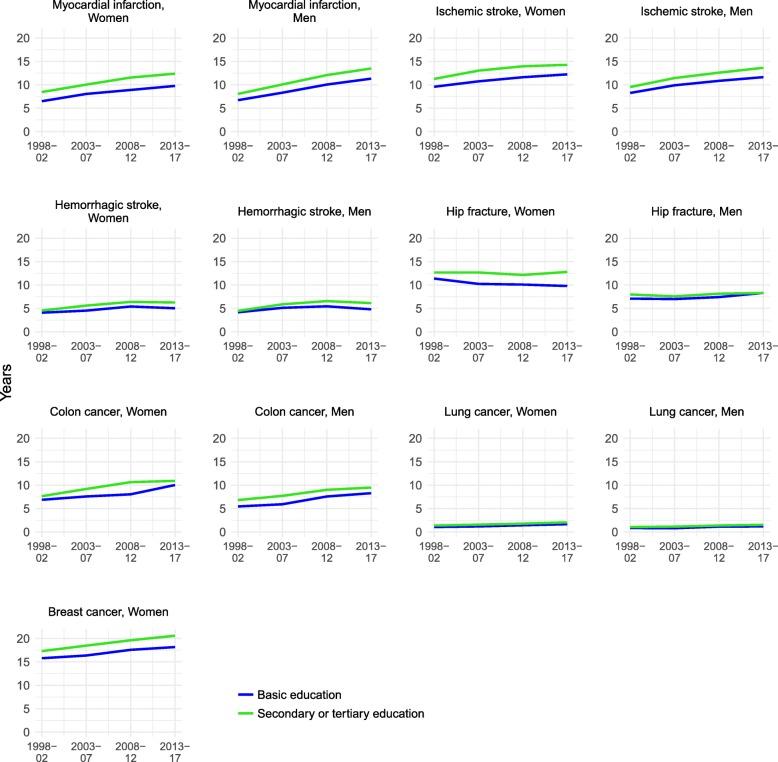
Life expectancy gains have been larger for men and women with a history of myocardial infarction, ischemic or hemorrhagic stroke, and colon or breast cancer than for the general population. The life expectancy gap between individuals with a history of hip fracture or lung cancer and the general population has, however, been growing. Education and comorbidity have affected mortality levels, but have not altered the rate of increase in life expectancy among individuals with disease history. The female advantage in life expectancy was less pronounced among individuals with disease history than among the general population.
CONCLUSIONS
Life expectancy has increased faster in many subpopulations with a history of disease than in the general population, while still remaining at lower levels. Improvements in life expectancy have been observed regardless of comorbidity or educational level. These findings suggest that the rise in overall life expectancy reflects more than just improved survival among the healthy or the delayed onset of disease.
背景
在过去几十年中,大多数高收入国家的预期寿命持续延长。先前的研究表明,预期寿命的提高主要归因于健康分布高端的进步,而某些人群则落后了。本研究利用来自整个瑞典人群的数据,旨在检查有常见疾病史的个体亚组的预期寿命发展情况,相对于一般人群。
方法
在 1998-2017 年期间,对于每一年,我们估计了有疾病史的个体和整个瑞典人群在 65 岁时的剩余预期寿命。我们将人群亚组定义为患有心肌梗死、缺血性或出血性中风、髋部骨折或结肠癌、乳腺癌或肺癌的个体。我们进一步区分了不同的教育水平和 Charlson 合并症指数评分。
结果
有心肌梗死、缺血性或出血性中风以及结肠癌或乳腺癌病史的男性和女性的预期寿命增长幅度大于一般人群。然而,有髋部骨折或肺癌病史的个体与一般人群之间的预期寿命差距一直在扩大。教育和合并症影响了死亡率水平,但并未改变有疾病史个体的预期寿命增长率。有疾病史的个体的女性预期寿命优势比一般人群小。
结论
有疾病史的许多亚人群的预期寿命增长速度快于一般人群,而仍处于较低水平。无论合并症或教育水平如何,都观察到了预期寿命的提高。这些发现表明,总体预期寿命的上升不仅仅反映了健康人群中生存率的提高或疾病发病的延迟。


 Zotero 插件