
长尾巴非传统 I 型肌球蛋白在健康与疾病中的作用。
Long-Tailed Unconventional Class I Myosins in Health and Disease.
机构信息
Biochemistry and Molecular Biology Unit, Biomedicine Department, Faculty of Medicine, University of Barcelona, 08036 Barcelona, Spain.
Laboratory of Clinic and Experimental Respiratory Immunoallergy, IDIBAPS, 08036 Barcelona, Spain.
出版信息
Int J Mol Sci. 2020 Apr 7;21(7):2555. doi: 10.3390/ijms21072555.
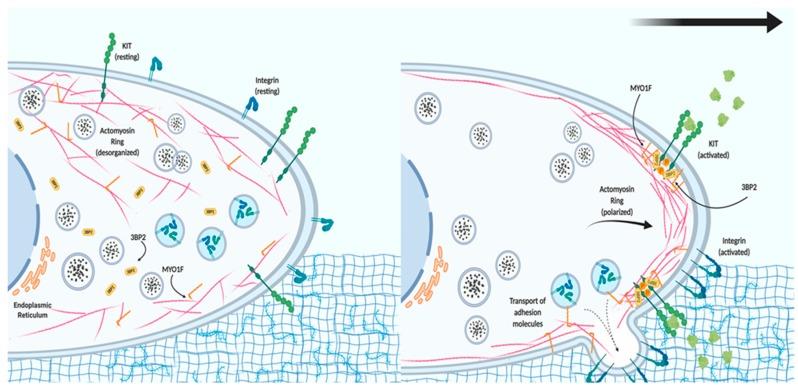
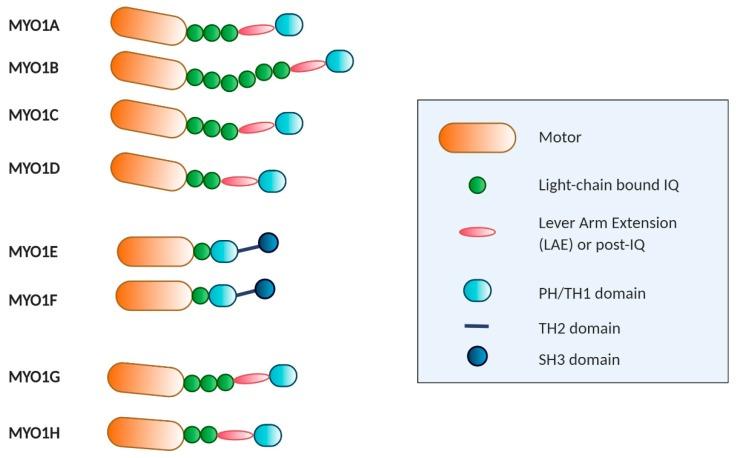
Long-tailed unconventional class I myosin, Myosin 1E (MYO1E) and Myosin 1F (MYO1F) are motor proteins that use chemical energy from the hydrolysis of adenosine triphosphate (ATP) to produce mechanical work along the actin cytoskeleton. On the basis of their motor properties and structural features, myosins perform a variety of essential roles in physiological processes such as endocytosis, exocytosis, cell adhesion, and migration. The long tailed unconventional class I myosins are characterized by having a conserved motor head domain, which binds actin and hydrolyzes ATP, followed by a short neck with an isoleucine-glutamine (IQ) motif, which binds calmodulin and is sensitive to calcium, and a tail that contains a pleckstrin homology domain (PH), a tail homology 1 domain (TH1), wherein these domains allow membrane binding, a tail homology 2 domain (TH2), an ATP-insensitive actin-binding site domain, and a single Src homology 3 domain (SH3) susceptible to binding proline rich regions in other proteins. Therefore, these motor proteins are able to bind actin, plasma membrane, and other molecules (adaptor, kinases, membrane proteins) that contribute to their function, ranging from increasing membrane tension to molecular trafficking and cellular adhesion. MYO1E and MYO1F function in host self-defense, with a better defined role in innate immunity in cell migration and phagocytosis. Impairments of their function have been identified in patients suffering pathologies ranging from tumoral processes to kidney diseases. In this review, we summarize our current knowledge of specific features and functions of MYO1E and MYO1F in various tissues, as well as their involvement in disease.
长尾巴非传统 I 类肌球蛋白,肌球蛋白 1E(MYO1E)和肌球蛋白 1F(MYO1F)是使用三磷酸腺苷(ATP)水解产生的化学能沿肌动蛋白细胞骨架产生机械功的马达蛋白。根据其运动特性和结构特征,肌球蛋白在生理过程中发挥着多种重要作用,如内吞作用、胞吐作用、细胞黏附和迁移。长尾巴非传统 I 类肌球蛋白的特征在于具有保守的马达头结构域,该结构域与肌动蛋白结合并水解 ATP,其后是短颈结构域,该结构域带有异亮氨酸-谷氨酰胺(IQ)基序,与钙调蛋白结合并对钙敏感,以及一条尾巴,其中包含pleckstrin 同源结构域(PH)、尾部同源结构域 1(TH1),这些结构域允许膜结合、尾部同源结构域 2(TH2)、一个对 ATP 不敏感的肌动蛋白结合位点结构域和一个单一的Src 同源结构域 3(SH3),易与其他蛋白质中的富含脯氨酸区域结合。因此,这些马达蛋白能够结合肌动蛋白、质膜和其他分子(衔接蛋白、激酶、膜蛋白),有助于其功能,从增加膜张力到分子运输和细胞黏附。MYO1E 和 MYO1F 在宿主自我防御中发挥作用,在细胞迁移和吞噬作用的固有免疫中具有更明确的作用。它们功能障碍已在患有从肿瘤过程到肾脏疾病等多种病理的患者中得到证实。在这篇综述中,我们总结了我们对 MYO1E 和 MYO1F 在各种组织中的特定特征和功能以及它们在疾病中的参与的现有认识。
 Zotero 插件