
甜叶菊苷 II 通过抑制氧化和炎症 TLR4 依赖的 PI3K/AKT/NF-B 信号通路和改善肠道微生物群来改善重症急性胰腺炎诱导的肠道屏障损伤。
Picroside II Improves Severe Acute Pancreatitis-Induced Intestinal Barrier Injury by Inactivating Oxidative and Inflammatory TLR4-Dependent PI3K/AKT/NF-B Signaling and Improving Gut Microbiota.
机构信息
Department of Traditional Chinese Medicine, The First affiliated Hospital, Jinzhou Medical University, Jinzhou 121001, China.
Department of Gastroenterology, The First affiliated Hospital, Jinzhou Medical University, Jinzhou 121001, China.
出版信息
Oxid Med Cell Longev. 2020 Apr 12;2020:3589497. doi: 10.1155/2020/3589497. eCollection 2020.
BACKGROUND
Picroside II exerts anti-inflammatory and antidiarrheal effects for treating the diseases associated with oxidative injury. However, its function on pancreatitis-induced intestinal barrier injury remains unclear. . We hypothesized that picroside II will have protective effects against pancreatitis-induced intestinal barrier injury by affecting oxidative and inflammatory signaling (Toll-like receptor 4- (TLR4-) dependent phosphatidylinositol 3-kinase (PI3K), protein kinase B (AKT), and nuclear factor kappa B (NF-B)). . A Sprague-Dawley (SD) rat model with severe acute pancreatitis (SAP) was induced via the injection of sodium taurocholate (4% wt/vol; 1 mL/kg). All rats were divided into 3 groups: sham (CG), SAP-induced intestinal barrier injury (MG), and picroside II (PG) groups. Intestinal barrier injury was assessed by scanning electron microscopy (SEM), hematoxylin and eosin staining, and pathological scores. We measured the levels of pancreatitis biomarkers (amylase and lipase), oxidative and inflammatory signaling (TLR4-dependent PI3K/AKT/NF-B), oxidative stress marker (superoxidase dismutase (SOD), catalase (CAT), glutathione peroxidases (GPx), and malondialdehyde), and inflammatory markers (tumor necrosis factor (TNF), interleukin- (IL-) 1, IL-6, and IL-10) in serum and/or gut tissues. Gut microbiota composition in feces was measured by using 16S rRNA sequencing.
RESULTS
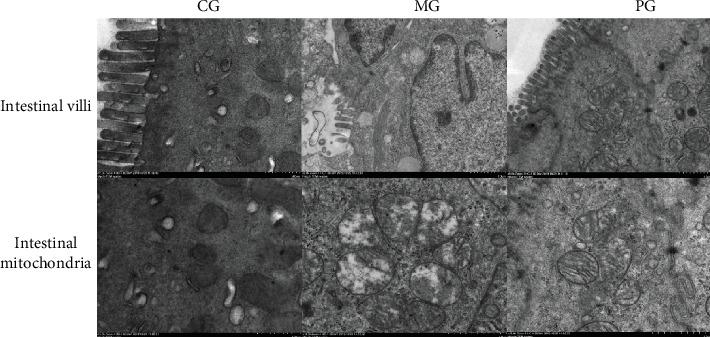
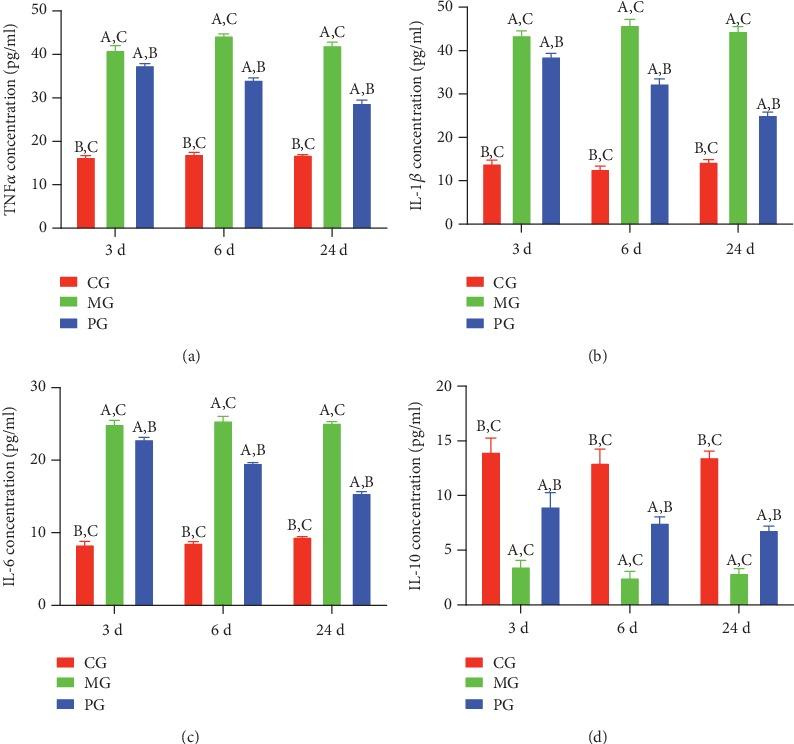
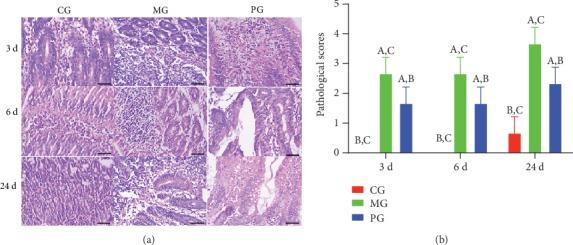
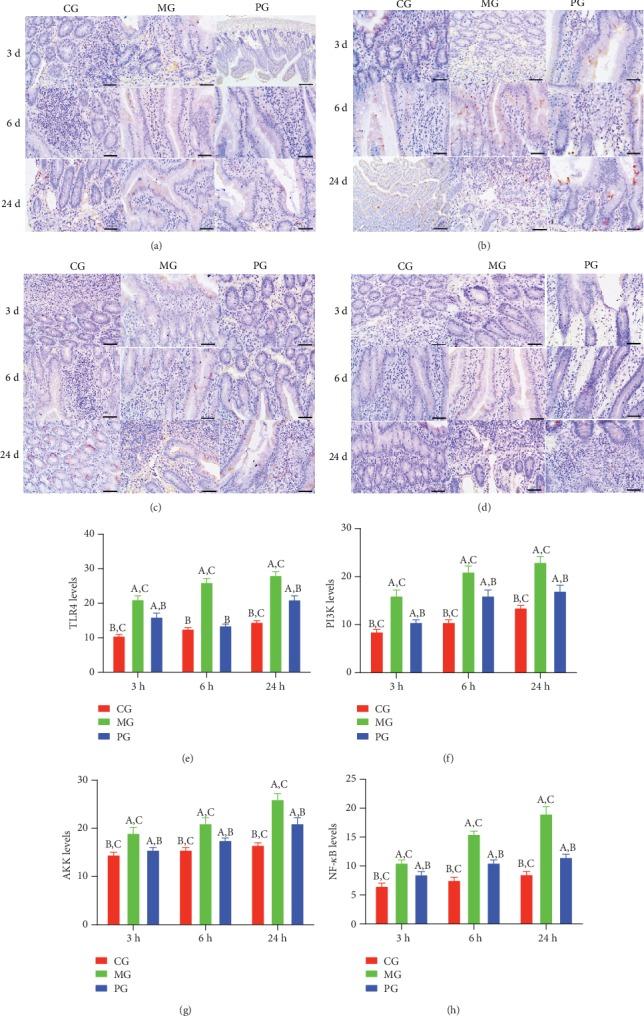
SEM showed that intestinal barrier injury was caused with the loss of intestinal villi and mitochondria destruction, and pathological scores were increased in the MG group. The levels of amylase, lipase, malondialdehyde, TNF, IL-1, IL-6, TLR4, PI3K, AKT, and NF-B were increased, and the levels of SOD, GPx, CAT, and IL-10 was reduced in the MG group when compared with CG group ( < 0.05). Picroside II treatment inhibited the symptoms in the MG group and showed antioxidant and anti-inflammatory activities. The serum levels of picroside II had strong correlation with the levels of inflammatory and oxidative stress biomarkers ( < 0.05). increased the proportion of and and decreased the proportion of and in the model.
CONCLUSIONS
Picroside II improved the SAP-induced intestinal barrier injury in the rat model by inactivating oxidant and inflammatory signaling and improving gut microbiota.
背景
甜叶菊苷 II 通过影响氧化和炎症信号(Toll 样受体 4-(TLR4-)依赖性磷脂酰肌醇 3-激酶(PI3K)、蛋白激酶 B(AKT)和核因子 kappa B(NF-B)),对治疗与氧化损伤相关的疾病具有抗炎和抗腹泻作用。然而,其对胰腺炎诱导的肠道屏障损伤的作用尚不清楚。我们假设甜叶菊苷 II 通过影响氧化和炎症信号(Toll 样受体 4-(TLR4-)依赖性磷脂酰肌醇 3-激酶(PI3K)、蛋白激酶 B(AKT)和核因子 kappa B(NF-B)),对胰腺炎诱导的肠道屏障损伤具有保护作用。通过注射牛磺胆酸钠(4%wt/vol;1mL/kg)诱导 Sprague-Dawley(SD)大鼠重症急性胰腺炎(SAP)模型。所有大鼠分为 3 组:假手术(CG)、SAP 诱导的肠道屏障损伤(MG)和甜叶菊苷 II(PG)组。通过扫描电子显微镜(SEM)、苏木精和伊红染色和病理评分评估肠道屏障损伤。我们测量了胰腺炎生物标志物(淀粉酶和脂肪酶)、氧化和炎症信号(TLR4 依赖性 PI3K/AKT/NF-B)、氧化应激标志物(超氧化物歧化酶(SOD)、过氧化氢酶(CAT)、谷胱甘肽过氧化物酶(GPx)和丙二醛)和炎症标志物(肿瘤坏死因子(TNF)、白细胞介素-(IL-)1、IL-6 和 IL-10)在血清和/或肠道组织中的水平。通过 16S rRNA 测序测量粪便中的肠道微生物群落组成。
结果
SEM 显示,肠道屏障损伤导致肠绒毛丢失和线粒体破坏,MG 组病理评分增加。与 CG 组相比,MG 组的淀粉酶、脂肪酶、丙二醛、TNF、IL-1、IL-6、TLR4、PI3K、AKT 和 NF-B 水平升高,SOD、GPx、CAT 和 IL-10 水平降低(<0.05)。甜叶菊苷 II 治疗抑制了 MG 组的症状,并表现出抗氧化和抗炎活性。血清中甜叶菊苷 II 的水平与炎症和氧化应激生物标志物的水平呈强相关性(<0.05)。增加了模型中 和 的比例,减少了 和 的比例。
结论
甜叶菊苷 II 通过抑制氧化和炎症信号,改善肠道微生物群,改善 SAP 诱导的大鼠肠道屏障损伤。





 Zotero 插件