
慢性代谢性疾病中与衰老相关的分子基础。
Molecular basis of ageing in chronic metabolic diseases.
机构信息
Department of Translation Medicine, Federico II University of Naples, 80131, Naples, Italy.
URT Genomic of Diabetes, Institute of Experimental Endocrinology and Oncology, National Research Council, 80131, Naples, Italy.
出版信息
J Endocrinol Invest. 2020 Oct;43(10):1373-1389. doi: 10.1007/s40618-020-01255-z. Epub 2020 May 1.
AIM
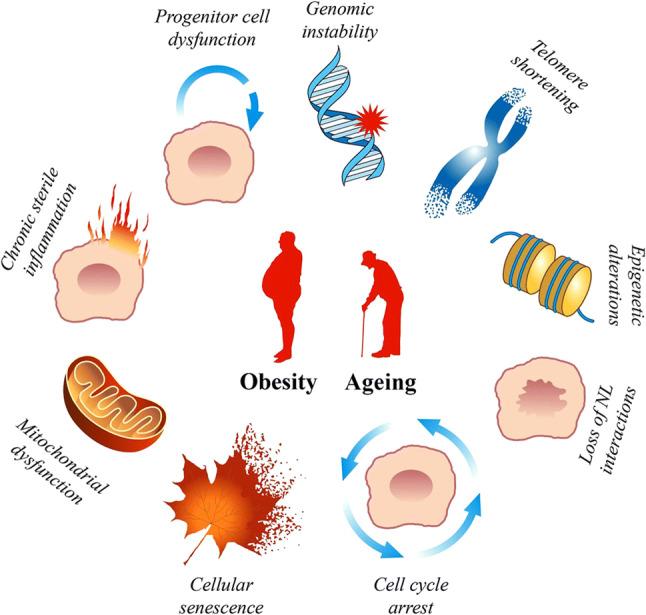
Over the last decades, the shift in age distribution towards older ages and the progressive ageing which has occurred in most populations have been paralleled by a global epidemic of obesity and its related metabolic disorders, primarily, type 2 diabetes (T2D). Dysfunction of the adipose tissue (AT) is widely recognized as a significant hallmark of the ageing process that, in turn, results in systemic metabolic alterations. These include insulin resistance, accumulation of ectopic lipids and chronic inflammation, which are responsible for an elevated risk of obesity and T2D onset associated to ageing. On the other hand, obesity and T2D, the paradigms of AT dysfunction, share many physiological characteristics with the ageing process, such as an increased burden of senescent cells and epigenetic alterations. Thus, these chronic metabolic disorders may represent a state of accelerated ageing.
MATERIALS AND METHODS
A more precise explanation of the fundamental ageing mechanisms that occur in AT and a deeper understanding of their role in the interplay between accelerated ageing and AT dysfunction can be a fundamental leap towards novel therapies that address the causes, not just the symptoms, of obesity and T2D, utilizing strategies that target either senescent cells or DNA methylation.
RESULTS
In this review, we summarize the current knowledge of the pathways that lead to AT dysfunction in the chronological ageing process as well as the pathophysiology of obesity and T2D, emphasizing the critical role of cellular senescence and DNA methylation.
CONCLUSION
Finally, we highlight the need for further research focused on targeting these mechanisms.
目的
在过去几十年中,人口老龄化的趋势以及大多数人群中发生的老龄化进程,与肥胖及其相关代谢紊乱的全球流行并行不悖,尤其是 2 型糖尿病(T2D)。脂肪组织(AT)功能障碍被广泛认为是衰老过程的一个重要标志,而衰老过程反过来又导致全身性代谢改变。这些改变包括胰岛素抵抗、异位脂质积累和慢性炎症,这是肥胖和 T2D 与衰老相关的发病风险增加的原因。另一方面,肥胖和 T2D 作为 AT 功能障碍的范例,与衰老过程具有许多生理特征,例如衰老细胞负担增加和表观遗传改变。因此,这些慢性代谢紊乱可能代表加速衰老的状态。
材料和方法
更精确地解释 AT 中发生的基本衰老机制,并深入了解它们在加速衰老和 AT 功能障碍之间相互作用中的作用,可能是朝着利用针对衰老细胞或 DNA 甲基化的策略来解决肥胖和 T2D 的根本原因(而不仅仅是症状)的新型治疗方法迈出的重要一步。
结果
在这篇综述中,我们总结了导致 AT 在正常衰老过程中功能障碍以及肥胖和 T2D 病理生理学的途径的现有知识,强调了细胞衰老和 DNA 甲基化的关键作用。
结论
最后,我们强调需要进一步研究针对这些机制的靶向治疗方法。


 Zotero 插件