
1 型和 2 型糖尿病患者中,与每年筛查相比,每两年筛查糖尿病相关视网膜病变的成本效益。
Cost-effectiveness of biennial screening for diabetes related retinopathy in people with type 1 and type 2 diabetes compared to annual screening.
机构信息
Diabetes Research Unit Cymru, Swansea University Medical School, Singleton Park, Swansea, SA2 8PP, UK.
Health Technology Wales, 3 Assembly Square, Cardiff, CF10 4PL, UK.
出版信息
Eur J Health Econ. 2020 Sep;21(7):993-1002. doi: 10.1007/s10198-020-01191-y. Epub 2020 May 8.
OBJECTIVE
Examine the health and economic impact of extending screening intervals in people with Type 2 diabetes (T2DM) and Type 1 diabetes (T1DM) without diabetes-related retinopathy (DR).
SETTING
Diabetic Eye Screening Wales (DESW).
STUDY DESIGN
Retrospective observational study with cost-utility analysis (CUA) and Decremental Cost-Effectiveness Ratios (DCER) study.
INTERVENTION
Biennial screening versus usual care (annual screening).
INPUTS
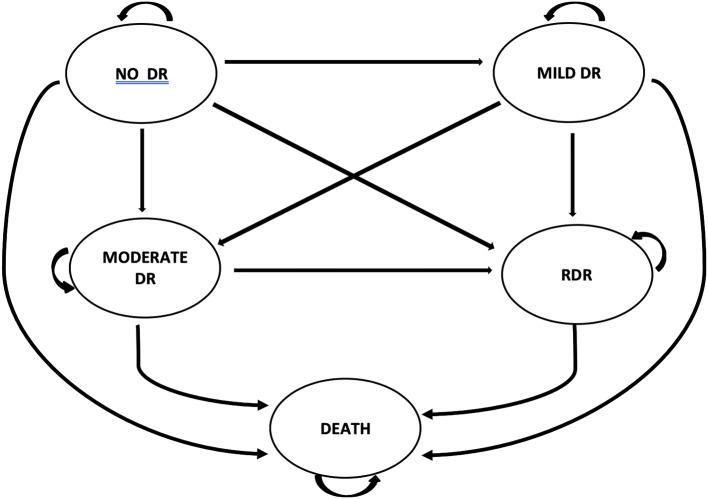
Anonymised data from DESW were linked to primary care data for people with two prior screening events with no DR. Transition probabilities for progression to DR were estimated based on a subset of 26,812 and 1232 people with T2DM and T1DM, respectively. DCER above £20,000 per QALY was considered cost-effective.
RESULTS
The base case analysis DCER results of £71,243 and £23,446 per QALY for T2DM and T1DM respectively at a 3.5% discount rate and £56,822 and £14,221 respectively when discounted at 1.5%. Diabetes management represented by the mean HbA was 7.5% for those with T2DM and 8.7% for T1DM.
SENSITIVITY ANALYSIS
Extending screening to biennial based on HbA, being the strongest predictor of progression of DR, at three levels of HbA 6.5%, 8.0% and 9.5% lost one QALY saving the NHS £106,075; £58,653 and £31,626 respectively for T2DM and £94,696, £37,646 and £11,089 respectively for T1DM. In addition, extending screening to biennial based on the duration of diabetes > 6 years for T2DM per QALY lost, saving the NHS £54,106 and for 6-12 and > 12 years for T1DM saving £83,856, £23,446 and £13,340 respectively.
CONCLUSIONS
Base case and sensitivity analyses indicate biennial screening to be cost-effective for T2DM irrespective of HbA and duration of diabetes. However, the uncertainty around the DCER indicates that annual screening should be maintained for those with T1DM especially when the HbA exceeds 80 mmol/mol (9.5%) and duration of diabetes is greater than 12 years.
目的
研究在没有糖尿病相关视网膜病变(DR)的 2 型糖尿病(T2DM)和 1 型糖尿病(T1DM)患者中延长筛查间隔对健康和经济的影响。
设置
威尔士糖尿病眼病筛查(DESW)。
研究设计
回顾性观察研究,包括成本效用分析(CUA)和增量成本效益比(DCER)研究。
干预
每两年筛查一次与常规护理(每年筛查一次)。
输入
从 DESW 获得的匿名数据与没有 DR 的两次筛查事件后的初级保健数据相关联。根据 T2DM 和 T1DM 分别为 26812 人和 1232 人的亚组,估计了进展为 DR 的概率。DCER 超过每 QALY 20000 英镑被认为具有成本效益。
结果
在 3.5%的贴现率下,T2DM 和 T1DM 的 DCER 结果分别为 71243 英镑和 23446 英镑/QALY,在 1.5%的贴现率下,分别为 56822 英镑和 14221 英镑/QALY。对于 T2DM 患者,糖尿病管理的平均 HbA 为 7.5%,对于 T1DM 患者为 8.7%。
敏感性分析
根据最强预测 DR 进展的 HbA,将筛查延长至每两年一次,在 HbA 为 6.5%、8.0%和 9.5%的三个水平下,每两年一次筛查可节省 NHS 106075 英镑;T2DM 分别为 58653 英镑和 31626 英镑,T1DM 分别为 94696 英镑、37646 英镑和 11089 英镑。此外,对于 T2DM,将筛查延长至每两年一次,基于糖尿病病程>6 年,每 QALY 损失 NHS 54106 英镑,对于 6-12 年和>12 年的患者,分别节省 NHS 23446 英镑和 13340 英镑。
结论
基于 HbA 和糖尿病病程的基本情况和敏感性分析表明,对于 T2DM,每两年一次的筛查具有成本效益。然而,DCER 的不确定性表明,对于 T1DM 患者,特别是当 HbA 超过 80mmol/mol(9.5%)且糖尿病病程超过 12 年时,应继续进行每年的筛查。
 Zotero 插件