
用于评估慢性阻塞性肺疾病(COPD)跌倒风险的平衡和活动能力筛查测试的有效性
Validity of balance and mobility screening tests for assessing fall risk in COPD.
作者信息
McLay Rachel, Kirkwood Renata Noce, Kuspinar Ayse, Richardson Julie, Wald Joshua, Raghavan Natya, Ellerton Cindy, Pugsley Stewart, Beauchamp Marla K
机构信息
School of Rehabilitation Science, McMaster University, Hamilton, Ontario, Canada.
Firestone Institute for Respiratory Health, St. Joseph's Healthcare Hamilton, Hamilton, Ontario, Canada.
出版信息
Chron Respir Dis. 2020 Jan-Dec;17:1479973120922538. doi: 10.1177/1479973120922538.
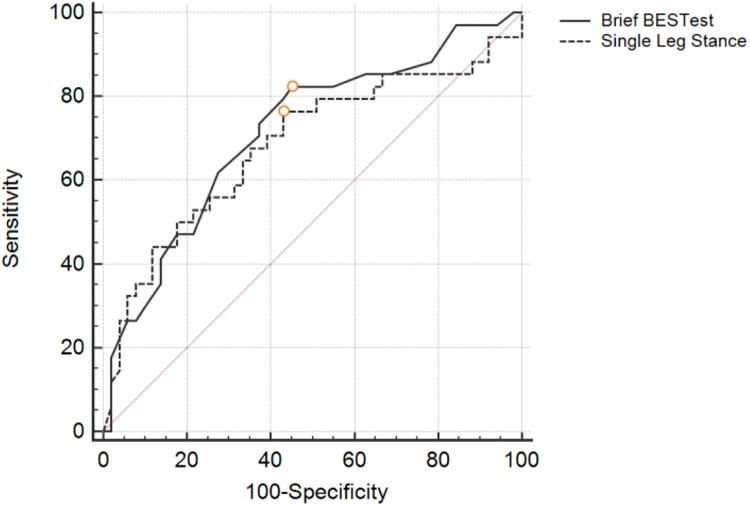
People with chronic obstructive pulmonary disease (COPD) have balance impairments and an increased risk of falls. The psychometric properties of short balance tests to inform fall risk assessment in COPD are unknown. Our objective was to determine the validity (concurrent, convergent, and known-groups) of short balance and mobility tests for fall risk screening. Participants with COPD aged ≥ 60 years attended a single assessment. Correlation coefficients described the relationships between the Brief Balance Evaluation Systems Test (Brief BESTest), Single-Leg Stance (SLS), Timed Up and Go (TUG), and Timed Up and Go Dual-Task (TUG-DT) tests, with the comprehensive Berg Balance Scale (BBS), chair-stand test, and measures of exercise tolerance, functional limitation, disability, and prognosis. Independent -tests or Mann-Whitney tests were used to examine differences between groups with respect to fall risk. Receiver operating characteristic curves examined the ability of the screening tests to identify individuals with previous falls. A total of 86 patients with COPD completed the study (72.9 ± 6.8 years; forced expiratory volume in 1 second: 47.3 ± 20.3% predicted). The Brief BESTest identified individuals who reported a previous fall (area under the curve (AUC) = 0.715, = 0.001), and the SLS showed borderline acceptable accuracy in identifying individuals with a fall history (AUC = 0.684, = 0.004). The strongest correlations were found for the Brief BESTest and SLS with the BBS ( = 0.80 and = 0.72, respectively) and between the TUG and TUG-DT with the chair-stands test ( = 0.73 and = 0.70, respectively). The Brief BESTest and SLS show the most promise as balance screening tools for fall risk assessment in older adults with COPD. These tests should be further evaluated prospectively.
慢性阻塞性肺疾病(COPD)患者存在平衡功能障碍且跌倒风险增加。用于指导COPD患者跌倒风险评估的简短平衡测试的心理测量特性尚不清楚。我们的目的是确定用于跌倒风险筛查的简短平衡和移动性测试的有效性(同时性、收敛性和已知组)。年龄≥60岁的COPD患者参加了一次评估。相关系数描述了简短平衡评估系统测试(Brief BESTest)、单腿站立(SLS)、计时起立行走测试(TUG)和计时起立行走双重任务测试(TUG-DT)与综合伯格平衡量表(BBS)、椅子站立测试以及运动耐力、功能受限、残疾和预后测量之间的关系。使用独立样本t检验或曼-惠特尼U检验来检查不同组在跌倒风险方面的差异。受试者工作特征曲线检验了筛查测试识别既往有跌倒史个体的能力。共有86例COPD患者完成了研究(年龄72.9±6.8岁;第1秒用力呼气量:预测值的47.3±20.3%)。Brief BESTest能够识别出报告有既往跌倒史的个体(曲线下面积(AUC)=0.715,P = 0.001),SLS在识别有跌倒史个体方面显示出临界可接受的准确性(AUC = 0.684,P = 0.004)。发现Brief BESTest和SLS与BBS的相关性最强(分别为r = 0.80和r = 0.72),TUG和TUG-DT与椅子站立测试的相关性最强(分别为r = 0.73和r = 0.70)。Brief BESTest和SLS作为评估老年COPD患者跌倒风险的平衡筛查工具最具前景。这些测试应进一步进行前瞻性评估。
 Zotero 插件