
泽布替尼治疗复发/难治性慢性淋巴细胞白血病/小淋巴细胞淋巴瘤的疗效:一项 2 期、单臂、多中心研究。
Treatment of relapsed/refractory chronic lymphocytic leukemia/small lymphocytic lymphoma with the BTK inhibitor zanubrutinib: phase 2, single-arm, multicenter study.
机构信息
Department of Hematology, Jiangsu Province Hospital, Collaborative Innovation Center for Cancer Personalized Medicine, The First Affiliated Hospital of Nanjing Medical University, 300 Guangzhou Road, Nanjing, 210029, Jiangsu, China.
Peking University Peoples Hospital, Peking University Institute of Hematology, Beijing, China.
出版信息
J Hematol Oncol. 2020 May 11;13(1):48. doi: 10.1186/s13045-020-00884-4.
BACKGROUND
Bruton tyrosine kinase (BTK) inhibitors have demonstrated a high degree of efficacy in the treatment of B cell malignancies characterized by constitutive B cell receptor activation, including chronic lymphocytic leukemia/small lymphocytic lymphoma (CLL/SLL).
METHODS
The efficacy and safety of zanubrutinib, an investigational highly selective BTK inhibitor, was evaluated in this single-arm, phase 2 study of Chinese patients with relapsed/refractory CLL/SLL. The primary endpoint was overall response rate as assessed by an independent review committee.
RESULTS
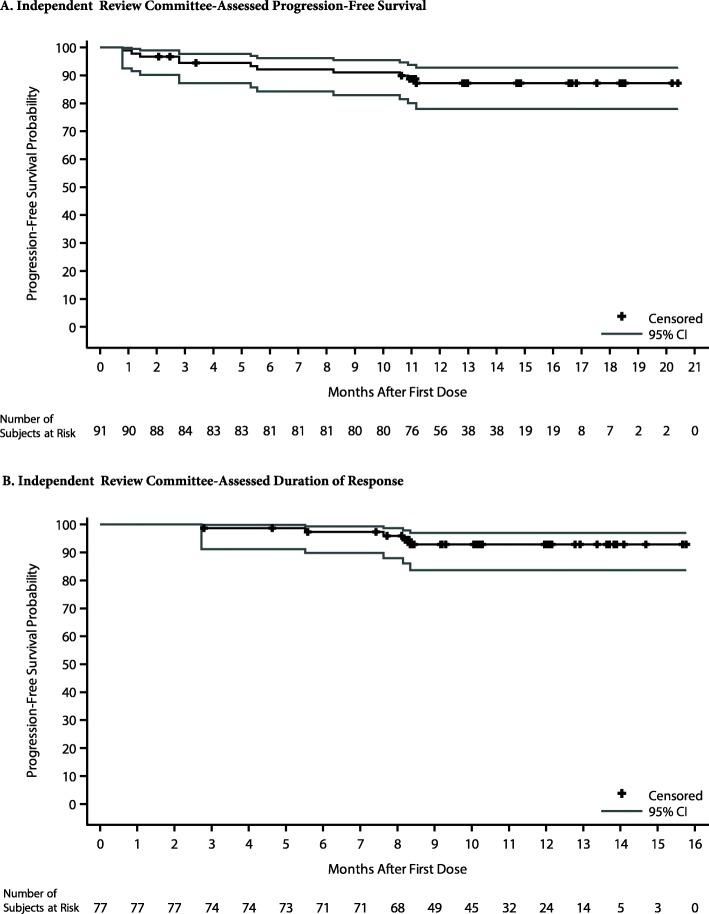
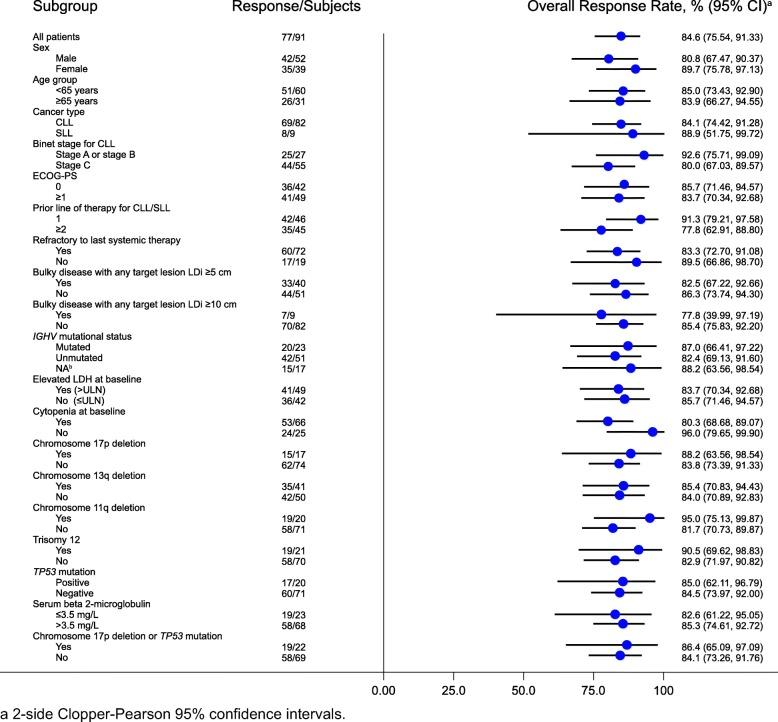
Of the 91 evaluable patients, 77 (84.6%) achieved a response, with three (3.3%), 54 (59.3%), and 20 (22%) patients achieving a complete response, partial response, and partial response with lymphocytosis, respectively, after a median follow-up of 15.1 months. The estimated 12-month event-free rate for duration of response was 92.9%. The most commonly reported grade ≥ 3 adverse events (AEs) were neutropenia (44%), thrombocytopenia (15.4%), lung infection/pneumonia (13.2%), upper respiratory tract infection (9.9%), and anemia (8.8%). The 12-month overall survival rate was 96%. Eight (9.0%) patients discontinued zanubrutinib due to AEs, and seven (8.0%) patients required at least one dose reduction.
CONCLUSION
Treatment of patients with relapsed/refractory CLL/SLL with zanubrutinib was generally well tolerated and resulted in a high overall response rate, thereby conferring a favorable benefit-risk profile.
TRIAL REGISTRATION
Prospectively registered in China public registry (CTR20160890) on December 7, 2016: http://www.chinadrugtrials.org.cn/. Retrospectively registered in ClinicalTrials.gov (NCT03206918) on July 2, 2017.
背景
布鲁顿酪氨酸激酶(BTK)抑制剂在治疗由组成性 B 细胞受体激活引起的 B 细胞恶性肿瘤方面显示出高度的疗效,包括慢性淋巴细胞白血病/小淋巴细胞淋巴瘤(CLL/SLL)。
方法
在这项针对中国复发/难治性 CLL/SLL 患者的单臂、2 期研究中,评估了zanubrutinib(一种研究性的高度选择性 BTK 抑制剂)的疗效和安全性。主要终点是由独立审查委员会评估的总体缓解率。
结果
在 91 例可评估的患者中,77 例(84.6%)达到缓解,其中 3 例(3.3%)、54 例(59.3%)和 20 例(22%)患者分别达到完全缓解、部分缓解和伴有淋巴细胞增多的部分缓解,中位随访 15.1 个月后。估计 12 个月时缓解持续时间的无事件生存率为 92.9%。最常见的≥3 级不良事件(AE)是中性粒细胞减少(44%)、血小板减少(15.4%)、肺部感染/肺炎(13.2%)、上呼吸道感染(9.9%)和贫血(8.8%)。12 个月的总生存率为 96%。8 例(9.0%)患者因 AE 停用 zanubrutinib,7 例(8.0%)患者需要至少一次剂量减少。
结论
zanubrutinib 治疗复发/难治性 CLL/SLL 患者通常耐受良好,总体缓解率高,从而具有良好的获益风险比。
试验注册
于 2016 年 12 月 7 日在中国公共注册处(CTR20160890)前瞻性注册:http://www.chinadrugtrials.org.cn/。于 2017 年 7 月 2 日在 ClinicalTrials.gov(NCT03206918)回顾性注册。

 Zotero 插件