
在多发性骨髓瘤中,通过 CD39 和 CD73 将 ATP 转化为腺苷,可以与腺苷受体 A2A 阻断一起成功靶向。
Conversion of ATP to adenosine by CD39 and CD73 in multiple myeloma can be successfully targeted together with adenosine receptor A2A blockade.
机构信息
Center for Myeloma Research, Department of Clinical and Molecular Medicine, Faculty of Medicine and Health Sciences, Norwegian University of Science and Technology (NTNU), Trondheim, Norway.
PROMEC, Department for Clinical and Molecular Medicine, NTNU, Trondheim, Norway.
出版信息
J Immunother Cancer. 2020 May;8(1). doi: 10.1136/jitc-2020-000610.
BACKGROUND
PD1/PDL1-directed therapies have been unsuccessful for multiple myeloma (MM), an incurable cancer of plasma cells in the bone marrow (BM). Therefore, other immune checkpoints such as extracellular adenosine and its immunosuppressive receptor should be considered. CD39 and CD73 convert extracellular ATP to adenosine, which inhibits T-cell effector functions via the adenosine receptor A2A (A2AR). We set out to investigate whether blocking the adenosine pathway could be a therapy for MM.
METHODS
Expression of CD39 and CD73 on BM cells from patients and T-cell proliferation were determined by flow cytometry and adenosine production by Liquid chromatograpy-mass spectrometry (HPCL/MS). ENTPD1 (CD39) mRNA expression was determined on myeloma cells from patients enrolled in the publicly available CoMMpass study. Transplantable 5T33MM myeloma cells were used to determine the effect of inhibiting CD39, CD73 and A2AR in mice in vivo.
RESULTS
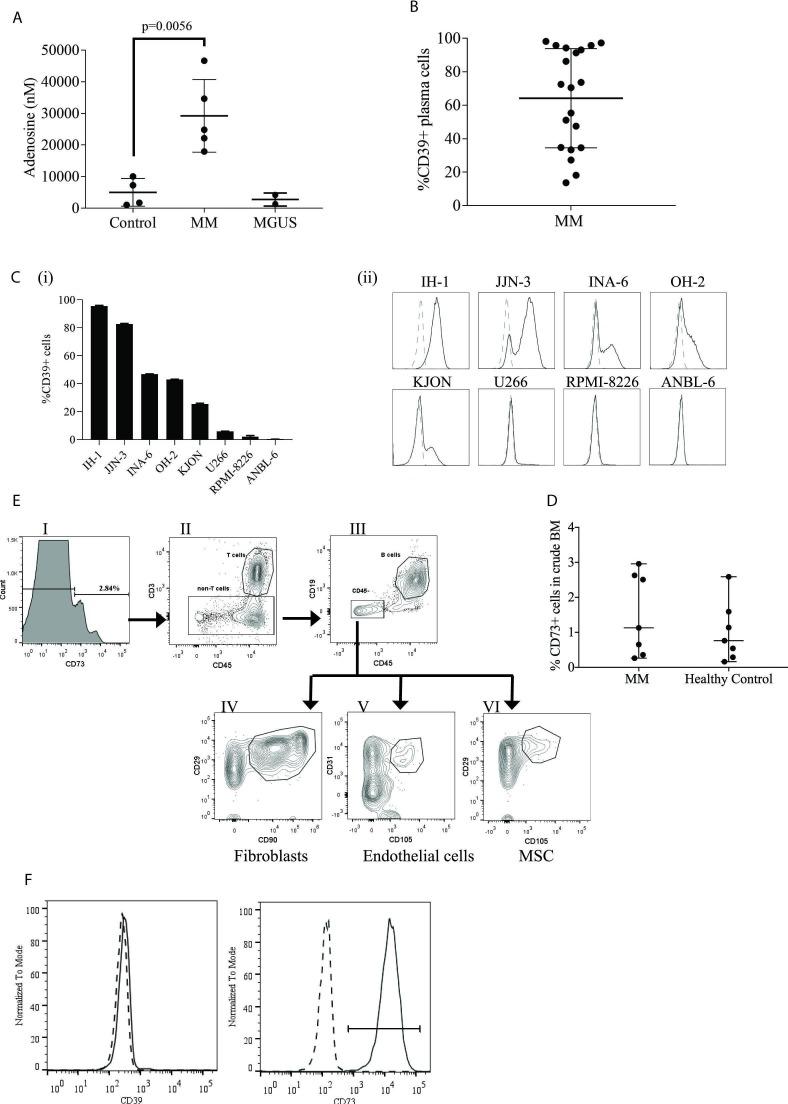
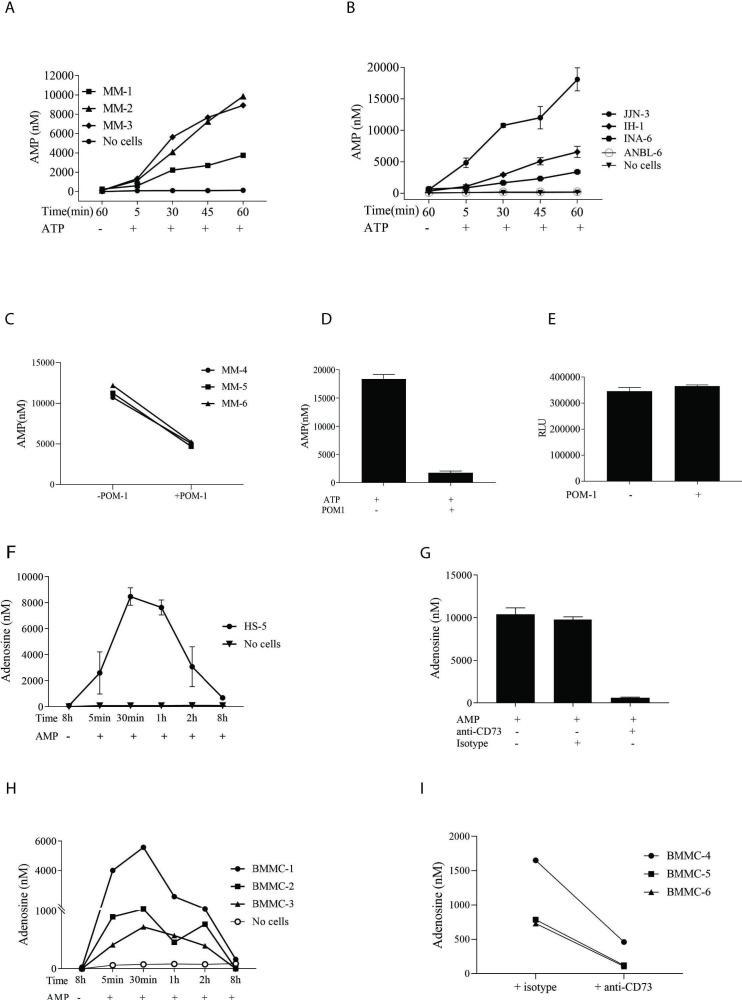
Elevated level of adenosine was found in BM plasma of MM patients. Myeloma cells from patients expressed CD39, and high gene expression indicated reduced survival. CD73 was found on leukocytes and stromal cells in the BM. A CD39 inhibitor, POM-1, and an anti-CD73 antibody inhibited adenosine production and reduced T-cell suppression in vitro in coculture of myeloma and stromal cells. Blocking the adenosine pathway in vivo with a combination of Sodium polyoxotungstate (POM-1), anti-CD73, and the A2AR antagonist AZD4635 activated immune cells, increased interferon gamma production, and reduced the tumor load in a murine model of MM.
CONCLUSIONS
Our data suggest that the adenosine pathway can be successfully targeted in MM and blocking this pathway could be an alternative to PD1/PDL1 inhibition for MM and other hematological cancers. Inhibitors of the adenosine pathway are available. Some are in clinical trials and they could thus reach MM patients fairly rapidly.
背景
程序性细胞死亡蛋白 1(PD1)/程序性死亡配体 1(PDL1)靶向治疗对多发性骨髓瘤(MM)无效,MM 是一种骨髓(BM)中浆细胞不可治愈的癌症。因此,应考虑其他免疫检查点,如细胞外腺苷及其免疫抑制受体。CD39 和 CD73 将细胞外 ATP 转化为腺苷,通过腺苷受体 A2A(A2AR)抑制 T 细胞效应功能。我们着手研究阻断腺苷途径是否可以成为 MM 的一种治疗方法。
方法
通过流式细胞术测定患者 BM 细胞中 CD39 和 CD73 的表达和 T 细胞增殖,通过液相色谱-质谱法(HPLC/MS)测定腺苷的产生。通过对公开的 CoMMpass 研究中入组的患者骨髓瘤细胞进行 ENTPD1(CD39)mRNA 表达的测定。使用可移植的 5T33MM 骨髓瘤细胞在体内确定抑制 CD39、CD73 和 A2AR 的效果。
结果
在 MM 患者的 BM 血浆中发现腺苷水平升高。患者的骨髓瘤细胞表达 CD39,高基因表达表明存活率降低。CD73 存在于 BM 中的白细胞和基质细胞上。CD39 抑制剂 POM-1 和抗 CD73 抗体可抑制骨髓瘤和基质细胞共培养中体外腺苷的产生和 T 细胞抑制。用 Sodium polyoxotungstate(POM-1)、抗 CD73 和 A2AR 拮抗剂 AZD4635 的组合阻断体内腺苷途径可激活免疫细胞,增加干扰素 γ 的产生,并减少 MM 小鼠模型中的肿瘤负荷。
结论
我们的数据表明,在 MM 中可以成功靶向腺苷途径,并且阻断该途径可能是 PD1/PDL1 抑制 MM 和其他血液系统癌症的替代方法。目前已有针对腺苷途径的抑制剂。其中一些正在临床试验中,因此它们可以很快用于 MM 患者。



 Zotero 插件