
卡瑞利珠单抗联合阿帕替尼治疗晚期三阴性乳腺癌的有效性和安全性:一项开放标签的 II 期临床试验。
Efficacy and safety of camrelizumab combined with apatinib in advanced triple-negative breast cancer: an open-label phase II trial.
机构信息
Guangdong Provincial Key Laboratory of Malignant Tumor Epigenetics and Gene Regulation, Breast Tumor Center, Sun Yat-sen Memorial Hospital, Sun Yat-sen University, Guangzhou, China.
Guangdong Provincial Key Laboratory of Malignant Tumor Epigenetics and Gene Regulation, Breast Tumor Center, Sun Yat-sen Memorial Hospital, Sun Yat-sen University, Guangzhou, China
出版信息
J Immunother Cancer. 2020 May;8(1). doi: 10.1136/jitc-2020-000696.
BACKGROUND
Previous trials showed that antiangiogenesis or anti-programmed death protein 1/programmed death ligand 1 (PD-1/PD-L1) monotherapy only showed marginal effect in triple-negative breast cancer (TNBC). Preclinical studies demonstrated that antiangiogenic therapy could sensitize breast cancer to PD-1/PD-L1 blockade via reprogramming tumor microenvironment. Combinational treatment of checkpoint blockade and antiangiogenesis for TNBC has not been reported.
METHODS
Patients with advanced TNBC with less than three lines of systemic therapy were enrolled in an open-label, non-comparative, two-arm, phase II trial at Sun Yat-sen Memorial Hospital. Camrelizumab (intravenously every 2 weeks) with apatinib orally at either continuous dosing (d1-d14) or intermittent dosing (d1-d7) was given until disease progression or unacceptable toxicities. Primary endpoint was objective response rate (ORR).
RESULTS
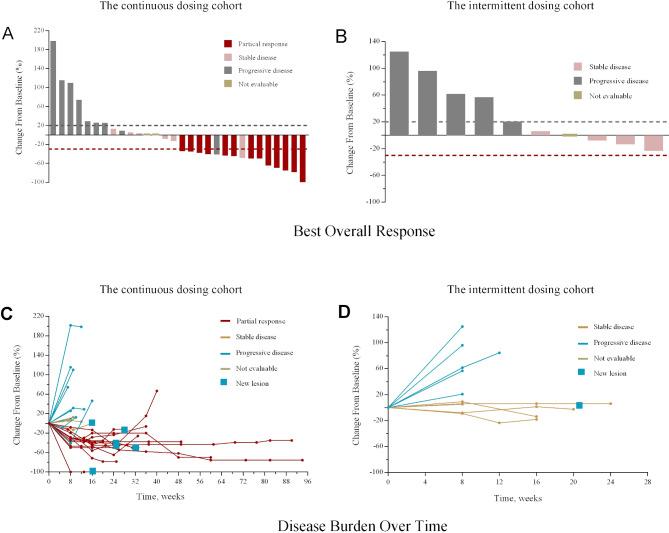
From January 2018 to April 2019, 40 patients were enrolled, including 10 in the apatinib intermittent dosing cohort and 30 in the apatinib continuous dosing cohort. The ORR was 43.3% (13 of 30) in the continuous dosing cohort, while no objective response was observed in the intermittent dosing cohort. The disease control rate was 63.3% (19 of 30) in the apatinib continuous dosing cohort, and 40.0% (4 of 10) in the apatinib intermittent dosing cohort, respectively. The median progression-free survival (PFS) was 3.7 (95% CI 2.0 to 6.4) months and 1.9 (95% CI 1.8 to 3.7) months in the continuous dosing and intermittent dosing cohort, respectively. In the continuous dosing cohort, the median PFS of patients with partial response (8.3 months, 95% CI 5.9 to not reached) was significantly longer than that of patients with stable disease/progressive disease/not evaluable (2.0 months, 95% CI 1.7 to 3.0). The most common adverse events (AEs) included elevated aspartate aminotransferase/alanine aminotransferase and hand-foot syndrome. Overall, 26.7% and 20.0% of patients experienced grade ≥3 AEs in the continuous dosing and intermittent dosing cohort, respectively. In the continuous dosing cohort, a high percentage of baseline tumor-infiltrating lymphocytes (>10%) was associated with higher ORR and favorable PFS (p=0.029, 0.054, respectively).
CONCLUSIONS
The ORR by this chemo-free regimen was dramatically higher than previously reported ORR by anti-PD-1/PD-L1 antibody or apatinib monotherapy. Camrelizumab combined with apatinib demonstrated favorable therapeutic effects and a manageable safety profile in patients with advanced TNBC.
TRIAL REGISTRATION NUMBER
NCT03394287.
背景
先前的试验表明,抗血管生成或抗程序性死亡蛋白 1/程序性死亡配体 1(PD-1/PD-L1)单药治疗仅在三阴性乳腺癌(TNBC)中显示出轻微的效果。临床前研究表明,抗血管生成治疗可以通过重塑肿瘤微环境使乳腺癌对 PD-1/PD-L1 阻断产生敏感性。针对 TNBC 的联合检查点阻断和抗血管生成治疗尚未有报道。
方法
在中山大学孙逸仙纪念医院进行了一项开放性、非对照、两臂、二期临床试验,招募了接受三线及以下系统治疗的晚期 TNBC 患者。卡瑞利珠单抗(每两周静脉注射一次)联合阿帕替尼口服,连续剂量(d1-d14)或间歇性剂量(d1-d7),直至疾病进展或出现不可接受的毒性。主要终点是客观缓解率(ORR)。
结果
从 2018 年 1 月至 2019 年 4 月,共纳入 40 例患者,其中 10 例接受阿帕替尼间歇性剂量治疗,30 例接受阿帕替尼连续剂量治疗。连续剂量组的 ORR 为 43.3%(13/30),而间歇性剂量组无客观缓解。阿帕替尼连续剂量组的疾病控制率为 63.3%(19/30),阿帕替尼间歇性剂量组为 40.0%(4/10)。连续剂量组的中位无进展生存期(PFS)为 3.7 个月(95%CI 2.0 至 6.4),间歇性剂量组为 1.9 个月(95%CI 1.8 至 3.7)。在连续剂量组中,部分缓解患者的中位 PFS(8.3 个月,95%CI 5.9 至未达到)明显长于疾病稳定/进展/不可评估患者(2.0 个月,95%CI 1.7 至 3.0)。最常见的不良反应(AE)包括天冬氨酸氨基转移酶/丙氨酸氨基转移酶升高和手足综合征。连续剂量组和间歇性剂量组分别有 26.7%和 20.0%的患者发生≥3 级 AE。在连续剂量组中,基线肿瘤浸润淋巴细胞(TILs)比例较高(>10%)与更高的 ORR 和有利的 PFS 相关(p=0.029,0.054)。
结论
与之前报道的抗 PD-1/PD-L1 抗体或阿帕替尼单药治疗相比,这种无化疗方案的 ORR 明显更高。卡瑞利珠单抗联合阿帕替尼在晚期 TNBC 患者中显示出良好的治疗效果和可管理的安全性。
临床试验注册号
NCT03394287。



 Zotero 插件