
基于手机的老年人步态评估应用程序:开发与评估。
A Mobile Phone-Based Gait Assessment App for the Elderly: Development and Evaluation.
机构信息
School of Business, Jiangnan University, Wuxi, China.
Department of Industrial Engineering, Tsinghua University, Beijing, China.
出版信息
JMIR Mhealth Uhealth. 2020 Feb 29;8(2):e14453. doi: 10.2196/14453.
BACKGROUND
Gait disorders are common among older adults. With an increase in the use of technology among older adults, a mobile phone app provides a solution for older adults to self-monitor their gait quality in daily life.
OBJECTIVE
This study aimed to develop a gait-monitoring mobile phone app (Pocket Gait) and evaluate its acceptability and usability among potential older users.
METHODS
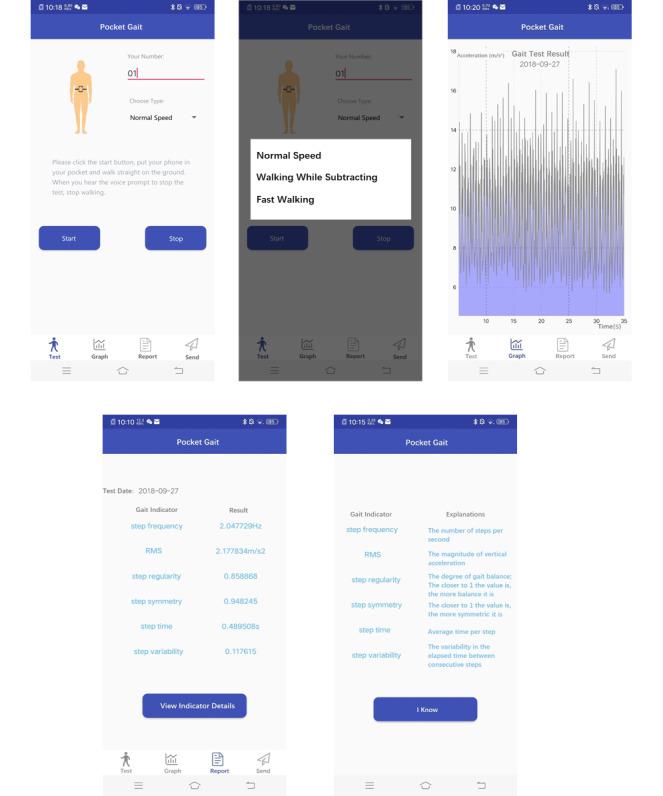
The app was developed to allow older adults to track their gait quality, including step frequency, acceleration root mean square (RMS), step regularity, step symmetry, and step variability. We recruited a total of 148 community-dwelling older adults aged 60 years and older from two cities in China: Beijing and Chongqing. They walked in three ways (single task, dual task, and fast walking) using a smartphone with the gait-monitoring app installed and completed an acceptability and usability survey after the walk test. User acceptability was measured by a questionnaire including four quantitative measures: perceived ease of use, perceived usefulness, ease of learning, and intention to use. Usability was measured using the System Usability Scale (SUS). Interviews were conducted with participants to collect open-ended feedback questions.
RESULTS
Task type had a significant effect on all gait parameters, namely, step frequency, RMS, step variability, step regularity, and step symmetry (all P values <.001). Age had a significant effect on step frequency (P=.01), and region had a significant effect on step regularity (P=.04). The acceptability of the gait-monitoring app was positive among older adults. Participants identified the usability of the system with an overall score of 59.7 (SD 10.7) out of 100. Older adults from Beijing scored significantly higher SUS compared with older adults from Chongqing (P<.001). The age of older adults was significantly associated with their SUS score (P=.048). Older adults identified improvements such as a larger font size, inclusion of reference values for gait parameters, and inclusion of heart rate and blood pressure monitoring.
CONCLUSIONS
This mobile phone app is a health management tool for older adults to self-manage their gait quality and prevent adverse outcomes. In the future, it will be important to take factors such as age and region into consideration while designing a mobile phone-based gait assessment app. The feedback of the participants would help to design more elderly-friendly products.
背景
步态障碍在老年人中很常见。随着老年人对技术的使用增加,手机应用程序为老年人提供了一种在日常生活中自我监测步态质量的解决方案。
目的
本研究旨在开发一种步态监测手机应用程序(Pocket Gait),并评估其在潜在老年用户中的可接受性和可用性。
方法
该应用程序旨在允许老年人跟踪他们的步态质量,包括步频、加速度均方根(RMS)、步幅规律性、步幅对称性和步幅可变性。我们从中国的两个城市北京和重庆招募了总共 148 名 60 岁及以上的社区居住老年人。他们在使用安装了步态监测应用程序的智能手机时以三种方式行走(单任务、双任务和快走),并在步行测试后完成了可接受性和可用性调查。用户可接受性通过包括四个定量指标的问卷进行衡量:感知易用性、感知有用性、易学性和使用意向。使用系统可用性量表(SUS)衡量可用性。对参与者进行了访谈,以收集开放式反馈问题。
结果
任务类型对所有步态参数均有显著影响,包括步频、RMS、步幅可变性、步幅规律性和步幅对称性(所有 P 值均<.001)。年龄对步频有显著影响(P=.01),地区对步幅规律性有显著影响(P=.04)。老年人对步态监测应用程序的可接受性呈积极态度。参与者对系统的可用性评价总分为 59.7(SD 10.7),满分 100 分。来自北京的老年人的 SUS 得分明显高于来自重庆的老年人(P<.001)。老年人的年龄与他们的 SUS 得分显著相关(P=.048)。老年人认为可以改进的地方包括更大的字体大小、包括步态参数的参考值以及包括心率和血压监测。
结论
这款手机应用程序是老年人管理自己步态质量和预防不良后果的健康管理工具。未来,在设计基于手机的步态评估应用程序时,需要考虑年龄和地区等因素。参与者的反馈将有助于设计更适合老年人的产品。
 Zotero 插件