
泰国农村社区成年人肥胖的趋势、流行率及相关因素:2012 年和 2018 年的连续横断面调查。
Trends, prevalence and associated factors of obesity among adults in a rural community in Thailand: serial cross-sectional surveys, 2012 and 2018.
机构信息
Department of Military and Community Medicine, Phramongkutklao College of Medicine, Bangkok, 10400, Thailand.
Phramongkutklao College of Medicine, Bangkok, 10400, Thailand.
出版信息
BMC Public Health. 2020 Jun 3;20(1):850. doi: 10.1186/s12889-020-09004-w.
BACKGROUND
Obesity is one principle risk factor increasing the risk of noncommunicable diseases including diabetes, hypertension and atherosclerosis. In Thailand, a 2014 study reported obesity (BMI ≥25 kg/m) in a Thai population aged ≥15 years was 37.5, 32.9 and 41.8% overall and among males and females, respectively. The study aimed to determine trends in the prevalence of obesity among adults residing in a Thai rural community between 2012 and 2018 and investigate the associations between obesity and behavioral factors.
METHODS
Serial cross-sectional studies were conducted in 2012 and 2018 among adults in Na-Ngam rural community. In 2012 and 2018, all 635 and 627 individuals, respectively, were interviewed using structured questionnaires related to demographics, risk behaviors, comorbidities and arthrometric measurement. Spot urine was collected by participants and obesity was defined as BMI ≥25 kg/m. The risk factors for obesity were analyzed in the 2018 survey.
RESULTS
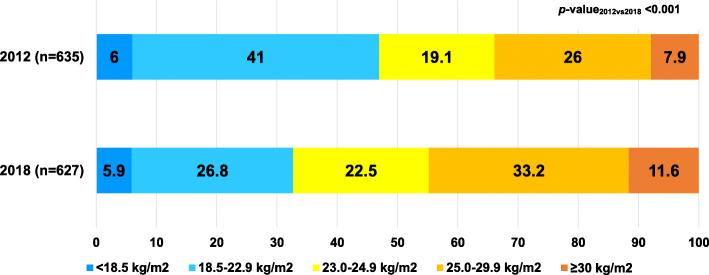
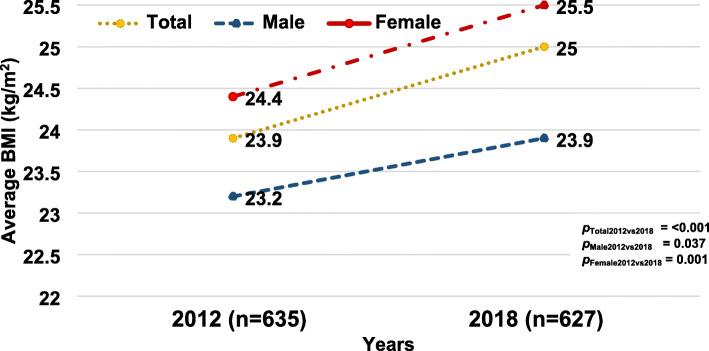
A total of 1262 adults in Na-Ngam rural community were included in the study. The prevalence of obesity was 33.9% in 2012 and 44.8% in 2018 (P < 0.001). The average BMI increased from 23.9 ± 4.2 kg/m in 2012 to 25.0 ± 4.52 kg/m in 2018 (P < 0.001). Obesity was associated with higher age (AOR 0.99; 95%CI 0.97-0.99), smoking (AOR 0.52; 95%CI 0.28-0.94), instant coffee-mix consumption > 1 cup/week (AOR 1.44; 95%CI 1.02-2.04), higher number of chronic diseases (≥1 disease AOR 1.82; 95%CI 1.01-2.68, > 2 diseases AOR 2.15; 95%CI 1.32-3.50), and higher spot urine sodium level (AOR 1.002; 95%CI 0.99-1.01).
CONCLUSION
Our data emphasized that obesity constituted a serious problem among adults residing in a rural community. A trend in significant increase was found regarding the prevalence of obesity and average BMI in the rural community over 6 years. Effective public health interventions should be provided at the community level to reduce BMI. Moreover, modifiable risk factors for obesity should be attenuated to inhibit the progression of metabolic syndrome, noncommunicable diseases and their complications.
背景
肥胖是增加非传染性疾病风险的主要因素之一,包括糖尿病、高血压和动脉粥样硬化。在泰国,2014 年的一项研究报告称,泰国≥15 岁人群的肥胖(BMI≥25kg/m)总体为 37.5%、32.9%和 41.8%,男性和女性分别为 37.5%、32.9%和 41.8%。本研究旨在确定泰国农村社区成年人肥胖患病率在 2012 年至 2018 年间的变化趋势,并探讨肥胖与行为因素之间的关系。
方法
2012 年和 2018 年,在 Na-Ngam 农村社区对成年人进行了连续横断面研究。2012 年和 2018 年,分别对所有 635 人和 627 人进行了访谈,访谈内容与人口统计学、风险行为、合并症和关节测量有关。参与者采集了点尿样,肥胖定义为 BMI≥25kg/m。2018 年的调查分析了肥胖的危险因素。
结果
共有 1262 名 Na-Ngam 农村社区的成年人参与了这项研究。2012 年肥胖的患病率为 33.9%,2018 年为 44.8%(P<0.001)。2012 年至 2018 年,平均 BMI 从 23.9±4.2kg/m 增加到 25.0±4.52kg/m(P<0.001)。肥胖与较高的年龄(OR 0.99;95%CI 0.97-0.99)、吸烟(OR 0.52;95%CI 0.28-0.94)、每周饮用≥1 杯速溶咖啡(OR 1.44;95%CI 1.02-2.04)、患有更多慢性疾病(≥1 种疾病 OR 1.82;95%CI 1.01-2.68,>2 种疾病 OR 2.15;95%CI 1.32-3.50)和更高的尿钠水平(OR 1.002;95%CI 0.99-1.01)相关。
结论
我们的数据强调,肥胖是农村社区成年人面临的一个严重问题。在过去 6 年中,农村社区肥胖和平均 BMI 的流行率呈显著上升趋势。应在社区层面提供有效的公共卫生干预措施,以降低 BMI。此外,应减轻肥胖的可改变风险因素,以抑制代谢综合征、非传染性疾病及其并发症的进展。


 Zotero 插件