
炎热和潮湿的程度变得过于严重,超出了人类的耐受范围。
The emergence of heat and humidity too severe for human tolerance.
作者信息
Raymond Colin, Matthews Tom, Horton Radley M
机构信息
Jet Propulsion Laboratory/California Institute of Technology, Pasadena, CA, USA.
Department of Earth and Environmental Sciences, Columbia University, New York, NY, USA.
出版信息
Sci Adv. 2020 May 8;6(19):eaaw1838. doi: 10.1126/sciadv.aaw1838. eCollection 2020 May.
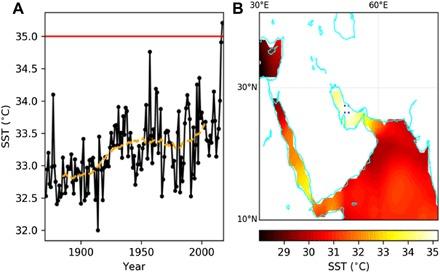
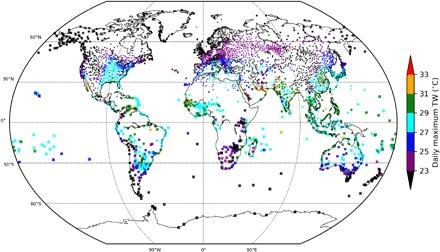
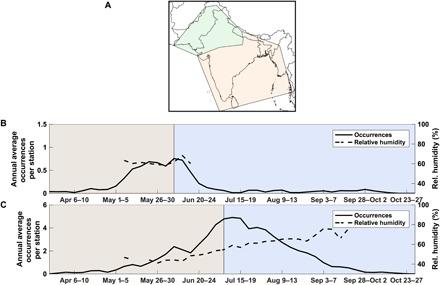
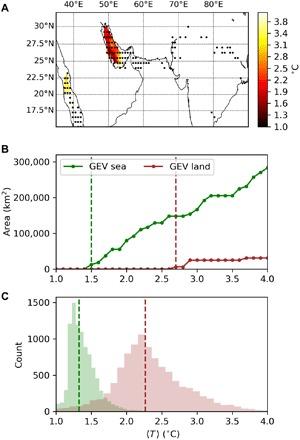
Humans' ability to efficiently shed heat has enabled us to range over every continent, but a wet-bulb temperature (TW) of 35°C marks our upper physiological limit, and much lower values have serious health and productivity impacts. Climate models project the first 35°C TW occurrences by the mid-21st century. However, a comprehensive evaluation of weather station data shows that some coastal subtropical locations have already reported a TW of 35°C and that extreme humid heat overall has more than doubled in frequency since 1979. Recent exceedances of 35°C in global maximum sea surface temperature provide further support for the validity of these dangerously high TW values. We find the most extreme humid heat is highly localized in both space and time and is correspondingly substantially underestimated in reanalysis products. Our findings thus underscore the serious challenge posed by humid heat that is more intense than previously reported and increasingly severe.
人类有效散热的能力使我们能够遍布各大洲,但湿球温度(TW)达到35°C标志着我们生理上的上限,更低的数值也会对健康和生产力产生严重影响。气候模型预测,到21世纪中叶将首次出现35°C的湿球温度。然而,对气象站数据的全面评估表明,一些沿海亚热带地区已经报告了35°C的湿球温度,而且自1979年以来,极端湿热天气的频率总体增加了一倍多。近期全球最高海表温度超过35°C,进一步支持了这些危险的高湿球温度值的有效性。我们发现,最极端的湿热天气在空间和时间上都高度集中,因此在再分析产品中被大幅低估。我们的研究结果因此凸显了比先前报告的更强烈、日益严重的湿热天气带来的严峻挑战。

 Zotero 插件