
采用高效液相色谱-二极管阵列检测法对西班牙成年人粪便中的类胡萝卜素进行提取与分析。
Extraction and Analysis by HPLC-DAD of Carotenoids in Human Faeces from Spanish Adults.
作者信息
Rodríguez-Rodríguez Elena, Beltrán-de-Miguel Beatriz, Samaniego-Aguilar Kerly X, Sánchez-Prieto Milagros, Estévez-Santiago Rocío, Olmedilla-Alonso Begoña
机构信息
Facultad de Farmacia, Universidad Complutense de Madrid, 28040 Madrid, Spain.
Institute of Food Science, Technology and Nutrition (ICTAN-CSIC), 28040 Madrid, Spain.
出版信息
Antioxidants (Basel). 2020 Jun 3;9(6):484. doi: 10.3390/antiox9060484.
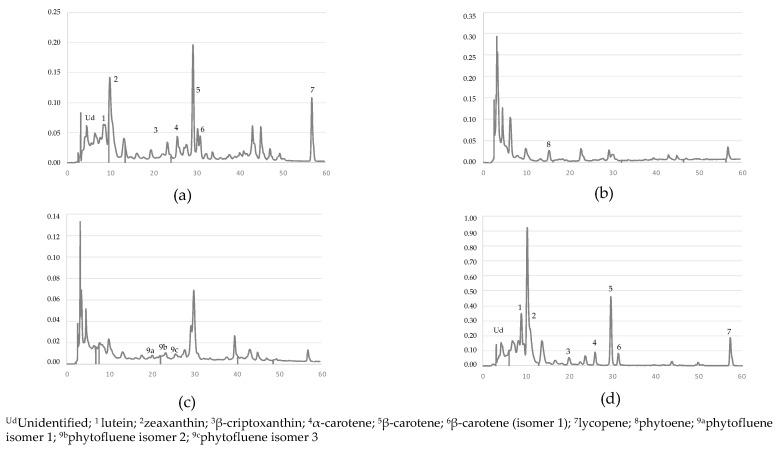
Carotenoids are bioactive compounds with widely accepted health benefits. Their quantification in human faeces can be a useful non-invasive approach to assess their bioavailability. Identification and quantification of major dietary carotenoids in human faeces was the aim of the present study. Faeces and dietary intake were obtained from 101 healthy adults (45-65 years). Carotenoid concentrations were determined by HPLC in faeces and by 3-day food records in dietary intake. Carotenoids quantified in faeces (µg/g dry weight, median) were: β-carotene (39.5), lycopene (20), lutein (17.5), phytoene (11.4), zeaxanthin (6.3), β-cryptoxanthin (4.5), phytofluene (2.9). α-carotene (5.3) and violaxanthin were found 75.5% and 7.1% of the faeces. The carotenoids found in the highest concentrations corresponded to the ones consumed in the greatest amounts (µg/d): lycopene (13,146), phytoene (2697), β-carotene (1812), lutein+zeaxanthin (1148). Carotenoid concentration in faeces and in dietary intake showed correlation for the total non-provitamin A carotenoids (r = 0.302; = 0.003), phytoene (r = 0.339; = 0.001), phytofluene (r = 0.279; = 0.005), lycopene (0.223; = 0.027), lutein+zeaxanthin (r = 0.291; = 0.04) and β-cryptoxanthin (r = 0.323; = 0.001). A high proportion of dietary carotenoids, especially those with provitamin A activity and some of their isomers, reach the large intestine, suggesting a low bioavailability of their intact forms.
类胡萝卜素是具有广泛公认的健康益处的生物活性化合物。对其在人体粪便中的定量分析可能是评估其生物利用度的一种有用的非侵入性方法。本研究的目的是鉴定和定量人体粪便中的主要膳食类胡萝卜素。从101名健康成年人(45 - 65岁)获取粪便和膳食摄入量。通过高效液相色谱法测定粪便中的类胡萝卜素浓度,并通过3天的食物记录来确定膳食摄入量。粪便中定量的类胡萝卜素(微克/克干重,中位数)为:β-胡萝卜素(39.5)、番茄红素(20)、叶黄素(17.5)、八氢番茄红素(11.4)、玉米黄质(6.3)、β-隐黄质(4.5)、六氢番茄红素(2.9)。α-胡萝卜素(5.3)和紫黄质在75.5%和7.1%的粪便中被发现。浓度最高的类胡萝卜素与摄入量最大的类胡萝卜素(微克/天)相对应:番茄红素(13146)、八氢番茄红素(2697)、β-胡萝卜素(1812)、叶黄素 + 玉米黄质(1148)。粪便和膳食摄入量中的类胡萝卜素浓度在总非维生素A类胡萝卜素(r = 0.302;P = 0.003)、八氢番茄红素(r = 0.339;P = 0.001)、六氢番茄红素(r = 0.279;P = 0.005)、番茄红素(0.223;P = 0.027)、叶黄素 + 玉米黄质(r = 0.291;P = 0.04)和β-隐黄质(r = 0.323;P = 0.001)方面显示出相关性。很大一部分膳食类胡萝卜素,尤其是那些具有维生素A原活性的类胡萝卜素及其一些异构体,会到达大肠,这表明它们完整形式的生物利用度较低。
 Zotero 插件