
溴结构域抑制剂作为疱疹病毒相关疾病的治疗药物:所有的溴结构域和额外末端结构域蛋白(BET)抑制剂都无效吗?
Bromodomain Inhibitors as Therapeutics for Herpesvirus-Related Disease: All BETs Are Off?
作者信息
Groves Ian J, Sinclair John H, Wills Mark R
机构信息
Department of Medicine, Addenbrooke's Hospital, University of Cambridge, Cambridge, United Kingdom.
出版信息
Front Cell Infect Microbiol. 2020 Jul 2;10:329. doi: 10.3389/fcimb.2020.00329. eCollection 2020.
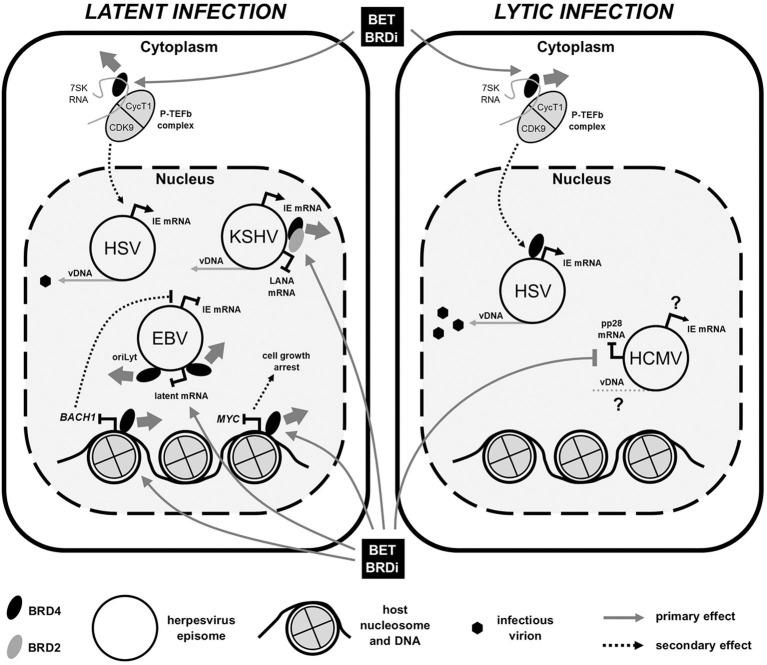
Although the ubiquitous human herpesviruses (HHVs) are rarely associated with serious disease of the healthy host, primary infection and reactivation in immunocompromised individuals can lead to significant morbidity and, in some cases, mortality. Effective drugs are available for clinical treatment, however resistance is on the rise such that new anti-viral targets, as well as novel clinical treatment strategies, are required. A promising area of development and pre-clinical research is that of inhibitors of epigenetic modifying proteins that control both cellular functions and the viral life cycle. Here, we briefly outline the interaction of the host bromo- and extra-terminal domain (BET) proteins during different stages of the HHVs' life cycles while giving a full overview of the published work using BET bromodomain inhibitors (BRDis) during HHV infections. Furthermore, we provide evidence that small molecule inhibitors targeting the host BET proteins, and BRD4 in particular, have the potential for therapeutic intervention of HHV-associated disease.
虽然普遍存在的人类疱疹病毒(HHVs)很少与健康宿主的严重疾病相关,但免疫功能低下个体的原发性感染和再激活可导致显著的发病率,在某些情况下还会导致死亡。临床上有有效的药物可用于治疗,然而耐药性正在上升,因此需要新的抗病毒靶点以及新的临床治疗策略。一个有前景的开发和临床前研究领域是控制细胞功能和病毒生命周期的表观遗传修饰蛋白抑制剂。在这里,我们简要概述宿主溴结构域和额外末端结构域(BET)蛋白在HHVs生命周期不同阶段的相互作用,同时全面概述在HHV感染期间使用BET溴结构域抑制剂(BRDis)的已发表工作。此外,我们提供证据表明,靶向宿主BET蛋白,特别是BRD4的小分子抑制剂具有治疗HHV相关疾病的潜力。
 Zotero 插件