
一项随机 3 期临床试验,比较 zanubrutinib 与 ibrutinib 在有症状的华氏巨球蛋白血症中的疗效:ASPEN 研究。
A randomized phase 3 trial of zanubrutinib vs ibrutinib in symptomatic Waldenström macroglobulinemia: the ASPEN study.
机构信息
Peter MacCallum Cancer Centre, Melbourne, VIC, Australia.
St Vincent's Hospital, Fitzroy, VIC, Australia.
出版信息
Blood. 2020 Oct 29;136(18):2038-2050. doi: 10.1182/blood.2020006844.
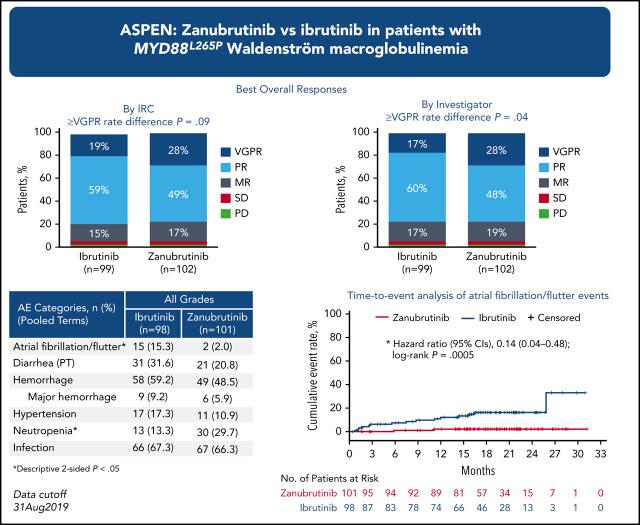
Bruton tyrosine kinase (BTK) inhibition is an effective treatment approach for patients with Waldenström macroglobulinemia (WM). The phase 3 ASPEN study compared the efficacy and safety of ibrutinib, a first-generation BTK inhibitor, with zanubrutinib, a novel highly selective BTK inhibitor, in patients with WM. Patients with MYD88L265P disease were randomly assigned 1:1 to treatment with ibrutinib or zanubrutinib. The primary end point was the proportion of patients achieving a complete response (CR) or a very good partial response (VGPR) by independent review. Key secondary end points included major response rate (MRR), progression-free survival (PFS), duration of response (DOR), disease burden, and safety. A total of 201 patients were randomized, and 199 received ≥1 dose of study treatment. No patient achieved a CR. Twenty-nine (28%) zanubrutinib patients and 19 (19%) ibrutinib patients achieved a VGPR, a nonstatistically significant difference (P = .09). MRRs were 77% and 78%, respectively. Median DOR and PFS were not reached; 84% and 85% of ibrutinib and zanubrutinib patients were progression free at 18 months. Atrial fibrillation, contusion, diarrhea, peripheral edema, hemorrhage, muscle spasms, and pneumonia, as well as adverse events leading to treatment discontinuation, were less common among zanubrutinib recipients. Incidence of neutropenia was higher with zanubrutinib, although grade ≥3 infection rates were similar in both arms (1.2 and 1.1 events per 100 person-months). These results demonstrate that zanubrutinib and ibrutinib are highly effective in the treatment of WM, but zanubrutinib treatment was associated with a trend toward better response quality and less toxicity, particularly cardiovascular toxicity.
布鲁顿酪氨酸激酶(BTK)抑制是治疗华氏巨球蛋白血症(WM)患者的有效方法。ASPEN 是一项 3 期研究,比较了第一代 BTK 抑制剂伊布替尼和新型高选择性 BTK 抑制剂泽布替尼在 WM 患者中的疗效和安全性。MYD88L265P 疾病患者按 1:1 随机分组,接受伊布替尼或泽布替尼治疗。主要终点是独立评估的完全缓解(CR)或非常好的部分缓解(VGPR)患者比例。关键次要终点包括主要缓解率(MRR)、无进展生存期(PFS)、缓解持续时间(DOR)、疾病负担和安全性。共随机分配了 201 例患者,199 例患者接受了至少 1 剂研究治疗。无患者达到 CR。29 例(28%)泽布替尼患者和 19 例(19%)伊布替尼患者达到 VGPR,差异无统计学意义(P=0.09)。MRR 分别为 77%和 78%。中位 DOR 和 PFS 未达到;伊布替尼和泽布替尼组分别有 84%和 85%的患者在 18 个月时无进展。心房颤动、瘀伤、腹泻、外周水肿、出血、肌肉痉挛和肺炎,以及导致治疗中断的不良事件,在泽布替尼组中较少见。泽布替尼组中性粒细胞减少发生率较高,但两组的 3 级感染率相似(每 100 人-月分别为 1.2 和 1.1 例)。这些结果表明,泽布替尼和伊布替尼在 WM 治疗中均非常有效,但泽布替尼治疗与更好的反应质量和更低的毒性相关,特别是心血管毒性。
 Zotero 插件