
双肺移植后第一年最佳肺量测定的意义:与 3 年结果的关系。
Significance of Best Spirometry in the First Year After Bilateral Lung Transplantation: Association With 3-Year Outcomes.
机构信息
Division of Pulmonary and Critical Care Medicine, Department of Medicine, University of Texas Southwestern, Dallas, TX.
Department of Clinical Sciences, University of Texas Southwestern, Dallas, TX.
出版信息
Transplantation. 2020 Aug;104(8):1712-1719. doi: 10.1097/TP.0000000000003046.
BACKGROUND
Spirometry is the cornerstone of monitoring allograft function after lung transplantation (LT). We sought to determine the association of variables on best spirometry during the first year after bilateral LT with 3-year posttransplant survival.
METHODS
We reviewed charts of patients who survived at least 3 months after bilateral LT (n = 157; age ± SD: 54 ± 13 y, male:female = 91:66). Best spirometry was calculated as the average of 2 highest measurements at least 3 weeks apart during the first year. Airway obstruction was defined as forced expiratory volume in 1-second (FEV1)/forced vital capacity (FVC) ratio <0.7. Survival was compared based on the ventilatory defect and among groups based on the best FEV1 and FVC measurements (>80%, 60%-80%, and <60% predicted). Primary outcome was 3-year survival.
RESULTS
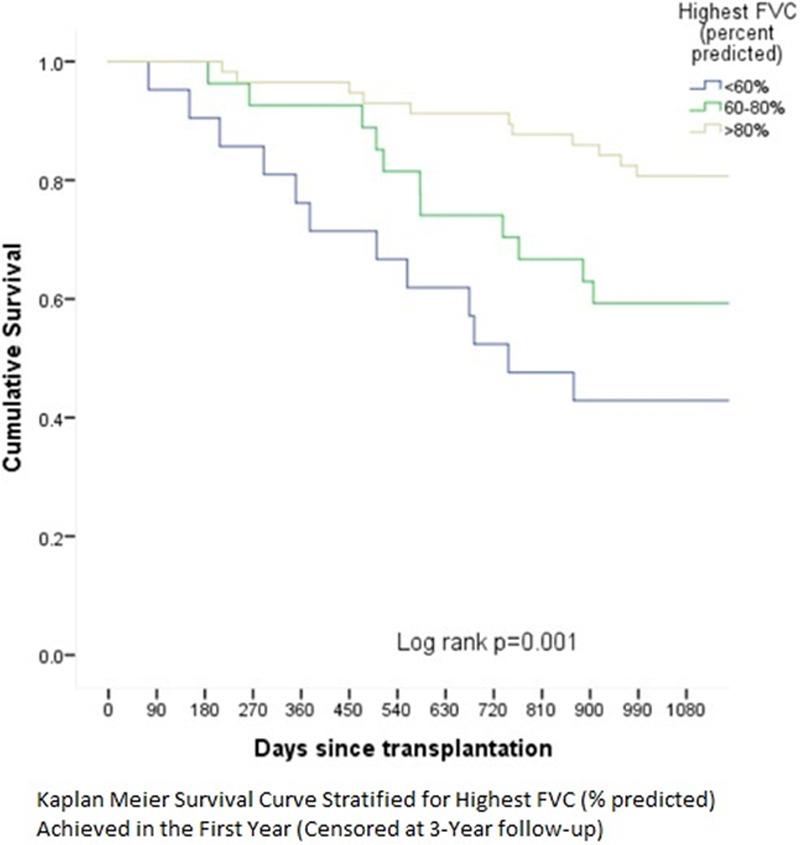
Overall, 3-year survival was 67% (n = 106). Obstructive defect was uncommon (7%) and did not have an association with 3-year survival (72% versus 67%, P = 0.7). Although one-half patients achieved an FVC>80% predicted (49%), 1 in 5 (19%) remained below 60% predicted. Irrespective of the type of ventilatory defect, survival worsened as the best FVC (% predicted) got lower (>80: 80.8%; 60-80: 63.3%; <60: 40%; P < 0.001). On multivariate logistic regression analysis, after adjusting for age, gender, transplant indication, and annual bronchoscopy findings, best FVC (% predicted) during the first year after LT was independently associated with 3-year survival.
CONCLUSIONS
A significant proportion of bilateral LT patients do not achieve FVC>80% predicted. Although the type of ventilatory defect on best spirometry does not predict survival, failure to achieve FVC>80% predicted during the first year was independently associated with 3-year mortality.
背景
肺移植(LT)后监测移植物功能的基石是肺量测定。我们旨在确定在 LT 后 1 年内最佳肺量测定中各变量与移植后 3 年生存的关系。
方法
我们回顾了至少存活 3 个月的双侧 LT 患者的图表(n = 157;年龄 ± 标准差:54 ± 13 岁,男女比例:91:66)。最佳肺量测定值是在第 1 年内至少相隔 3 周的 2 次最高测量值的平均值。气道阻塞定义为 1 秒用力呼气量(FEV1)/用力肺活量(FVC)比值 <0.7。根据通气缺陷和最佳 FEV1 和 FVC 测量值(>80%、60%-80%和 <60%预计值)进行生存比较。主要结局是 3 年生存率。
结果
总体而言,3 年生存率为 67%(n = 106)。阻塞性缺陷并不常见(7%),与 3 年生存率无相关性(72%与 67%,P = 0.7)。尽管一半的患者 FVC 超过 80%预计值(49%),但仍有 1/5(19%)的患者低于 60%预计值。无论通气缺陷类型如何,最佳 FVC(%预计值)越低,生存率越差(>80:80.8%;60-80:63.3%;<60:40%;P < 0.001)。在多变量逻辑回归分析中,在校正年龄、性别、移植适应证和年度支气管镜检查结果后,LT 后 1 年内的最佳 FVC(%预计值)与 3 年生存率独立相关。
结论
相当一部分双侧 LT 患者的 FVC 未超过 80%预计值。尽管最佳肺量测定中的通气缺陷类型不能预测生存率,但在第 1 年内未能达到 FVC>80%预计值与 3 年死亡率独立相关。

 Zotero 插件