
双侧肺移植后基线期肺移植功能障碍与死亡风险增加相关:一项多中心队列研究的结果
Baseline Lung Allograft Dysfunction After Bilateral Lung Transplantation Is Associated With an Increased Risk of Death: Results From a Multicenter Cohort Study.
作者信息
Keller Michael B, Sun Junfeng, Alnababteh Muhtadi, Ponor Lucia, D Shah Pali, Mathew Joby, Kong Hyesik, Charya Ananth, Luikart Helen, Aryal Shambhu, Nathan Steven D, Orens Jonathan B, Khush Kiran K, Kyoo Jang Moon, Agbor-Enoh Sean
机构信息
Laborarory of Applied Precision Omics (APO), National Institutes of Health, Bethesda, MD.
Laboratory of Transplantation Genomics, National Heart, Lung and Blood Institute (NHLBI), National Institutes of Health, Bethesda, MD.
出版信息
Transplant Direct. 2024 Jun 26;10(7):e1669. doi: 10.1097/TXD.0000000000001669. eCollection 2024 Jul.
BACKGROUND
A prior single-center, retrospective cohort study identified baseline lung allograft dysfunction (BLAD) as a risk factor for death in bilateral lung transplant recipients. In this multicenter prospective cohort study, we test the association of BLAD with death in bilateral lung transplant recipients, identify clinical risk factors for BLAD, and assess its association with allograft injury on the molecular level.
METHODS
This multicenter, prospective cohort study included 173 bilateral lung transplant recipients that underwent serial pulmonary function testing and plasma collection for donor-derived cell-free DNA at prespecified time points. BLAD was defined as failure to achieve ≥80% predicted for both forced expiratory volume in 1 s and forced vital capacity after lung transplant, on 2 consecutive measurements at least 3 mo apart.
RESULTS
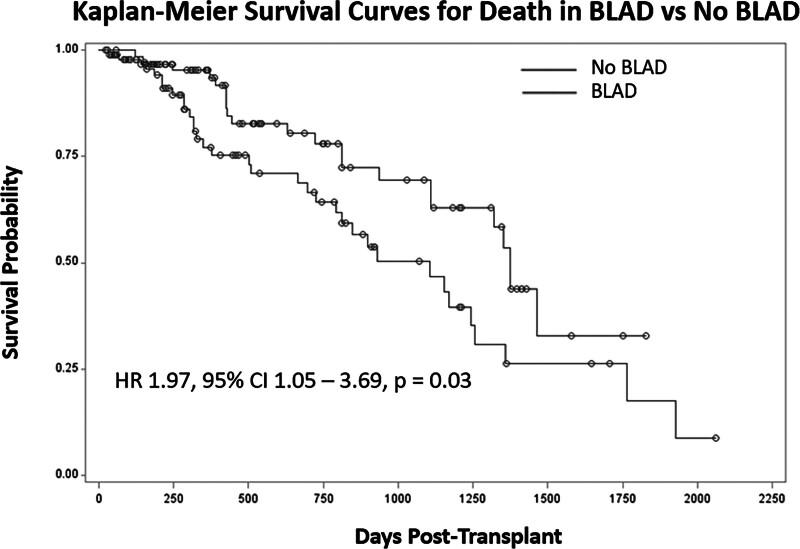
BLAD was associated with increased risk of death (hazard ratio, 1.97; 95% confidence interval [CI], 1.05-3.69; = 0.03) but not chronic lung allograft dysfunction alone (hazard ratio, 1.60; 95% CI, 0.87-2.95; = 0.13). Recipient obesity (odds ratio, 1.69; 95% CI, 1.15-2.80; = 0.04) and donor age (odds ratio, 1.03; 95% CI, 1.02-1.05; = 0.004) increased the risk of developing BLAD. Patients with BLAD did not demonstrate higher log(donor-derived cell-free DNA) levels compared with no BLAD (slope [SE]: -0.0095 [0.0007] versus -0.0109 [0.0007]; = 0.15).
CONCLUSIONS
BLAD is associated with an increased risk of death following lung transplantation, representing an important posttransplant outcome with valuable prognostic significance; however, early allograft specific injury on the molecular level does not increase the risk of BLAD, supporting further mechanistic insight into disease pathophysiology.
背景
一项先前的单中心回顾性队列研究确定,基线肺移植功能障碍(BLAD)是双侧肺移植受者死亡的危险因素。在这项多中心前瞻性队列研究中,我们检验了BLAD与双侧肺移植受者死亡之间的关联,确定了BLAD的临床危险因素,并在分子水平评估了其与移植肺损伤的关联。
方法
这项多中心前瞻性队列研究纳入了173例双侧肺移植受者,这些受者在预定时间点接受了系列肺功能测试并采集了血浆用于检测供体来源的游离DNA。BLAD定义为肺移植后1秒用力呼气量和用力肺活量均未达到预测值的≥80%,且在至少间隔3个月的连续两次测量中均如此。
结果
BLAD与死亡风险增加相关(风险比,1.97;95%置信区间[CI],1.05 - 3.69;P = 0.03),但与单纯慢性肺移植功能障碍无关(风险比,1.60;95%CI,0.87 - 2.95;P = 0.13)。受者肥胖(比值比,1.69;95%CI,1.15 - 2.80;P = 0.04)和供体年龄(比值比,1.03;95%CI,1.02 - 1.05;P = 0.004)增加了发生BLAD的风险。与无BLAD的患者相比,有BLAD的患者未表现出更高的log(供体来源的游离DNA)水平(斜率[标准误]:-0.0095[0.0007]对-0.0109[0.0007];P = 0.15)。
结论
BLAD与肺移植后死亡风险增加相关,是具有重要预后意义的重要移植后结局;然而,分子水平的早期移植肺特异性损伤并未增加BLAD的风险,这支持对疾病病理生理学进行进一步的机制研究。

 Zotero 插件