
胰高血糖素样肽 1 输注可克服老年人体肌肉对摄食的合成代谢抵抗。
Glucagon-like peptide 1 infusions overcome anabolic resistance to feeding in older human muscle.
机构信息
MRC-Versus Arthritis Centre for Musculoskeletal Ageing Research, Clinical, Metabolic and Molecular Physiology, Royal Derby Hospital Centre, University of Nottingham, Derby, UK.
Diabetes and Endocrinology Centre, University Hospitals Birmingham NHS Foundation Trust, Heartlands Hospital, Birmingham, UK.
出版信息
Aging Cell. 2020 Sep;19(9):e13202. doi: 10.1111/acel.13202. Epub 2020 Aug 3.
BACKGROUND
Despite its known insulin-independent effects, glucagon-like peptide-1 (GLP-1) role in muscle protein turnover has not been explored under fed-state conditions or in the context of older age, when declines in insulin sensitivity and protein anabolism, as well as losses of muscle mass and function, occur.
METHODS
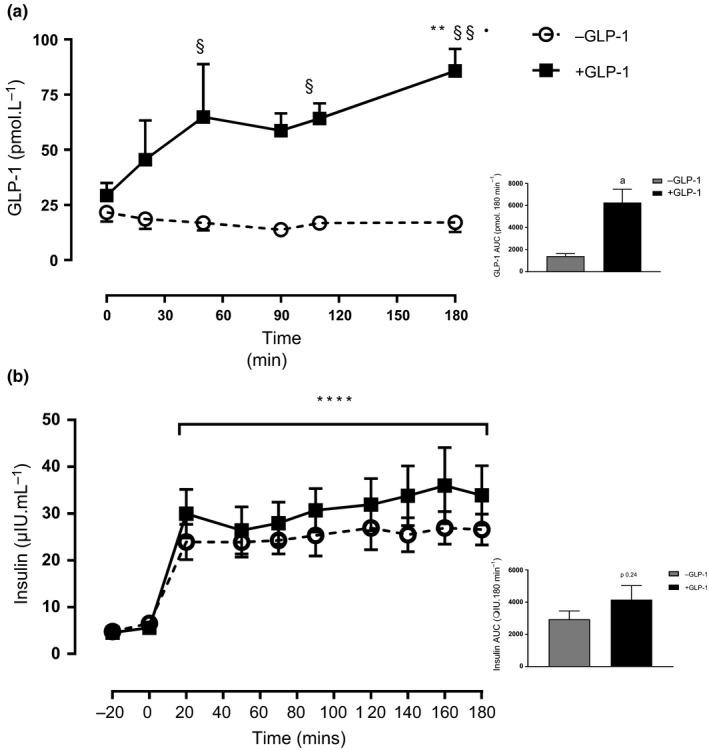
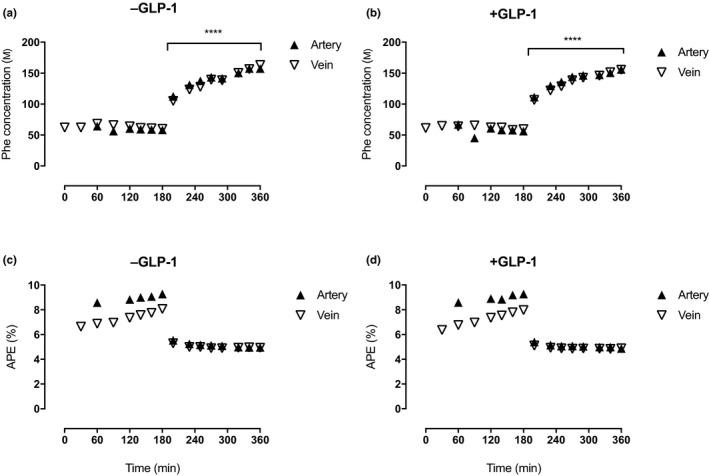
Eight older-aged men (71 ± 1 year, mean ± SEM) were studied in a crossover trial. Baseline measures were taken over 3 hr, prior to a 3 hr postprandial insulin (~30 mIU ml ) and glucose (7-7.5 mM) clamp, alongside I.V. infusions of octreotide and Vamin 14 (±infusions of GLP-1). Four muscle biopsies were taken, and muscle protein turnover was quantified via incorporation of C phenylalanine and arteriovenous balance kinetics, using mass spectrometry. Leg macro- and microvascular flow was assessed via ultrasound and anabolic signalling by immunoblotting. GLP-1 and insulin were measured by ELISA.
RESULTS
GLP-1 augmented muscle protein synthesis (MPS; fasted: 0.058 ± 0.004% hr vs. postprandial: 0.102 ± 0.005% hr , p < 0.01), in comparison with non-GLP-1 trials. Muscle protein breakdown (MPB) was reduced throughout clamp period, while net protein balance across the leg became positive in both groups. Total femoral leg blood flow was unchanged by the clamp; however, muscle microvascular blood flow (MBF) was significantly elevated in both groups, and to a significantly greater extent in the GLP-1 group (MBF: 5 ± 2 vs. 1.9 ± 1 fold change +GLP-1 and -GLP-1, respectively, p < 0.01). Activation of the Akt-mTOR signalling was similar across both trials.
CONCLUSION
GLP-1 infusion markedly enhanced postprandial microvascular perfusion and further stimulated muscle protein metabolism, primarily through increased MPS, during a postprandial insulin hyperaminoacidaemic clamp.
背景
尽管胰高血糖素样肽-1(GLP-1)具有已知的胰岛素非依赖性作用,但在进食状态下或在老年时,当胰岛素敏感性和蛋白质合成下降以及肌肉质量和功能丧失时,它在肌肉蛋白质周转中的作用尚未得到探索。
方法
在一项交叉试验中,研究了 8 名老年男性(71±1 岁,平均值±SEM)。在进行 3 小时的餐后胰岛素(~30mIU/ml)和葡萄糖(7-7.5mM)钳夹以及静脉内奥曲肽和 Vamin 14(±GLP-1 输注)之前,进行了 3 小时的基线测量。取 4 块肌肉活检,通过 C 苯丙氨酸掺入和动静脉平衡动力学,使用质谱法定量肌肉蛋白质周转。通过超声评估腿部大血管和微血管流量,并通过免疫印迹评估合成代谢信号。通过 ELISA 测量 GLP-1 和胰岛素。
结果
与非 GLP-1 试验相比,GLP-1 可增加肌肉蛋白质合成(MPS;禁食:0.058±0.004%/hr 与餐后:0.102±0.005%/hr,p<0.01)。在整个钳夹期间,肌肉蛋白质分解(MPB)减少,而腿部净蛋白平衡在两组中均变为正值。钳夹对总股腿部血流没有影响;然而,两组的肌肉微血管血流(MBF)均显着升高,并且在 GLP-1 组中升高幅度更大(MBF:5±2 与+GLP-1 和 -GLP-1 分别增加 1.9±1 倍,p<0.01)。两种试验中 Akt-mTOR 信号的激活均相似。
结论
GLP-1 输注在进食后胰岛素高氨基酸血症钳夹期间显着增加餐后微血管灌注,并通过增加 MPS 进一步刺激肌肉蛋白质代谢。



 Zotero 插件