
全球 1990 年至 2017 年食管癌发病率和死亡率的变化趋势。
Global trends in the incidence and mortality of esophageal cancer from 1990 to 2017.
机构信息
State Key Laboratory of Genetic Engineering and Collaborative Innovation Center for Genetics and Development, School of Life Sciences, Fudan University, Shanghai, China.
Department of Epidemiology & Ministry of Education Key Laboratory of Public Health Safety, School of Public Health, Fudan University, Shanghai, China.
出版信息
Cancer Med. 2020 Sep;9(18):6875-6887. doi: 10.1002/cam4.3338. Epub 2020 Aug 4.
BACKGROUND
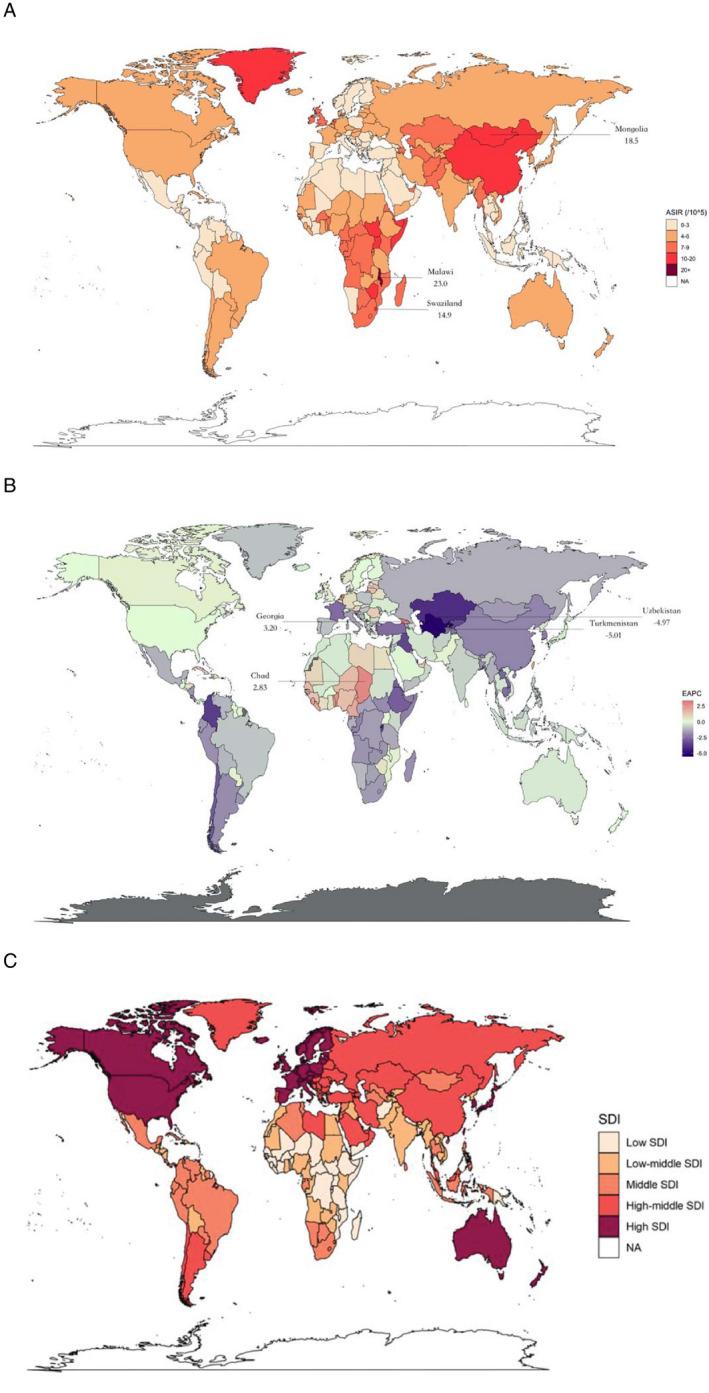
The incidence and mortality of esophageal cancer are high, with 5.90 new cases and 5.48 deaths per 100 000 people worldwide in 2017. The prognosis of esophageal cancer is poor, with an overall 5-year survival rate of less than 20%. Esophageal cancer in different geographical locations has different etiologies, and the incidence and mortality of esophageal cancer continue to rise in some regions.
METHODS
We collected incidence and mortality data by age and gender for 195 countries and territories from 1990 to 2017 in the Global Burden of Disease (GBD) database. And we used these data to calculate the estimated annual percentage change (EAPC) to quantify trends in morbidity and mortality. Then we analyzed the gender- and age-specific incidence and mortality in esophageal cancer to targeted high-risk populations. Finally, we analyzed the correlation between the age-standardized mortality rate (ASMR) and both the EAPC and social-demographic index (SDI), and we calculated the Pearson correlation coefficient.
RESULTS
We found that Malawi, East Asia, and high-middle SDI regions had the highest age-standardized incidence rate (ASIR) and ASMR, and the ASIR and ASMR in western Sub-Saharan Africa showed an upward trend. Our study also showed that the incidence and mortality in esophageal cancer were highest in men and in the 70+ years age group, and they presented a decreasing trend in most regions, but the 15-49 years age groups in Australasia, Caribbean, and Oceania and the 70+ years age group in High-Income North America, Oceania and high-SDI regions presented an increasing trend. There were significant negative associations between ASMR at baseline and EAPC and between ASMR and SDI in 2017.
CONCLUSION
By analyzing the global distribution of incidence and mortality in esophageal cancer, trends over time, and gender and age specificity, we can understand the heterogeneity of its global trends. This heterogeneity can help us to identify high-risk groupsand to provide clues for the exploration of the etiology and early prevention of the disease.
背景
食管癌的发病率和死亡率较高,2017 年全球每 10 万人中有 5.90 例新发病例和 5.48 例死亡。食管癌预后较差,总体 5 年生存率低于 20%。不同地理位置的食管癌有不同的病因,一些地区的食管癌发病率和死亡率仍在持续上升。
方法
我们从全球疾病负担(GBD)数据库中收集了 1990 年至 2017 年 195 个国家和地区按年龄和性别划分的发病率和死亡率数据。我们使用这些数据计算了发病率和死亡率的估计年变化百分比(EAPC),以量化发病率和死亡率的趋势。然后,我们分析了食管癌的性别和年龄特异性发病率和死亡率,以确定高危人群。最后,我们分析了年龄标准化死亡率(ASMR)与 EAPC 和社会人口指数(SDI)的相关性,并计算了 Pearson 相关系数。
结果
我们发现马拉维、东亚和中高 SDI 地区的年龄标准化发病率(ASIR)和 ASMR 最高,而撒哈拉以南非洲西部的 ASIR 和 ASMR 呈上升趋势。我们的研究还表明,食管癌的发病率和死亡率在男性和 70 岁以上人群中最高,在大多数地区呈下降趋势,但在澳大拉西亚、加勒比和大洋洲以及高收入北美、大洋洲和高 SDI 地区的 15-49 岁年龄组和 70 岁以上年龄组呈上升趋势。2017 年 ASMR 基线值与 EAPC 之间以及 ASMR 与 SDI 之间呈显著负相关。
结论
通过分析食管癌的全球发病率和死亡率分布、时间趋势以及性别和年龄特异性,我们可以了解其全球趋势的异质性。这种异质性有助于我们确定高危人群,并为探索疾病的病因和早期预防提供线索。



 Zotero 插件