
胎盘屏障对 COVID-19 的阻隔作用。
Placental barrier against COVID-19.
机构信息
Division of Microbiology, Department of Pathology and Microbiology, Nihon University School of Medicine, Tokyo, Japan.
Division of Microbiology, Department of Pathology and Microbiology, Nihon University School of Medicine, Tokyo, Japan.
出版信息
Placenta. 2020 Sep 15;99:45-49. doi: 10.1016/j.placenta.2020.07.022. Epub 2020 Jul 25.
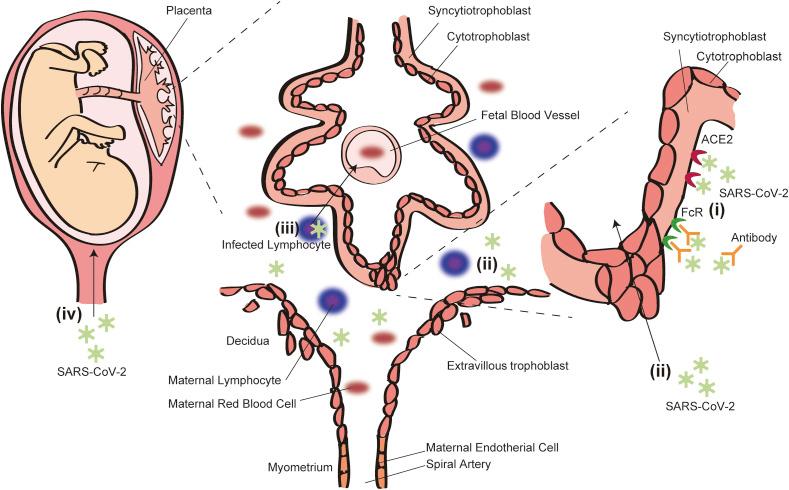
Vertical transmission of severe acute respiratory syndrome coronavirus 2 (SARS-CoV-2) and possible induction of pregnancy complications, including miscarriage, fetal malformations, fetal growth restriction and/or stillbirth, are serious concerns for pregnant individuals with COVID-19. According to clinical information, the incidence of vertical transmission of SARS-CoV-2 is limited to date. However, even if a neonate tests negative for SARS-CoV-2, frequent abnormal findings, including fetal and maternal vascular malperfusion, have been reported in cases of COVID-19-positive mothers. Primary receptor of SARS-CoV-2 is estimated as angiotensin-converting enzyme 2 (ACE2). It is highly expressed in maternal-fetal interface cells, such as syncytiotrophoblasts, cytotrophoblasts, endothelial cells, and the vascular smooth muscle cells of primary and secondary villi. However other route of transplacental infection cannot be ruled out. Pathological examinations have demonstrated that syncytiotrophoblasts are often infected with SARS-CoV-2, but fetuses are not always infected. These findings suggest the presence of a placental barrier, even if it is not completely effective. As the frequency and molecular mechanisms of intrauterine vertical transmission of SARS-CoV-2 have not been determined to date, intensive clinical examinations by repeated ultrasound and fetal heart rate monitoring are strongly recommended for pregnant women infected with COVID-19. In addition, careful investigation of placental samples after delivery by both morphological and molecular methods is also strongly recommended.
严重急性呼吸综合征冠状病毒 2(SARS-CoV-2)的垂直传播,以及可能导致妊娠并发症,包括流产、胎儿畸形、胎儿生长受限和/或死产,是 COVID-19 感染孕妇的严重关切。根据临床资料,SARS-CoV-2 的垂直传播发生率目前有限。然而,即使新生儿 SARS-CoV-2 检测为阴性,在 COVID-19 阳性母亲的病例中,也经常报告胎儿和产妇血管灌注不良等异常发现。SARS-CoV-2 的主要受体估计为血管紧张素转换酶 2(ACE2)。它在母胎界面细胞中高度表达,如合体滋养层细胞、细胞滋养层细胞、内皮细胞以及初级和次级绒毛的血管平滑肌细胞。然而,不能排除其他胎盘感染途径。病理学检查表明,合体滋养层细胞经常感染 SARS-CoV-2,但胎儿并不总是感染。这些发现表明存在胎盘屏障,即使它不是完全有效的。由于迄今为止尚未确定 SARS-CoV-2 宫内垂直传播的频率和分子机制,强烈建议感染 COVID-19 的孕妇进行重复超声和胎儿心率监测的强化临床检查。此外,还强烈建议通过形态学和分子方法对分娩后的胎盘样本进行仔细调查。
 Zotero 插件