
比较鼻咽拭子和清晨唾液用于鉴定严重急性呼吸综合征冠状病毒 2 (SARS-CoV-2)。
Comparing Nasopharyngeal Swab and Early Morning Saliva for the Identification of Severe Acute Respiratory Syndrome Coronavirus 2 (SARS-CoV-2).
机构信息
Infectious Disease Research Centre, Institute for Medical Research, Ministry of Health Malaysia, Jalan Pahang, Kuala Lumpur, Malaysia.
Low Risk COVID-19 Quarantine and Treatment Centre, MAEPS, Selangor, Malaysia.
出版信息
Clin Infect Dis. 2021 May 4;72(9):e352-e356. doi: 10.1093/cid/ciaa1156.
BACKGROUND
The ideal severe acute respiratory syndrome coronavirus 2 (SARs-CoV-2) testing method would be accurate and also be patient-performed to reduce exposure to healthcare workers. The aim of this study was to compare patient-performed testing based on a morning saliva sample with the current standard testing method, healthcare worker-collected sampling via a nasopharyngeal swab (NPS).
METHODS
This was a prospective single center study which recruited 217 asymptomatic adult male participants in a coronavirus disease 2019 (COVID-19) quarantine center who had tested positive for SARS-CoV-2 8-10 days prior to isolation. Paired NPS and saliva specimens were collected and processed within 5 hours of sample collection. Real time reverse transcription polymerase chain reaction (RT-PCR) targeting Envelope (E) and RNA-dependent RNA polymerase (RdRp) genes was performed and the results were compared.
RESULTS
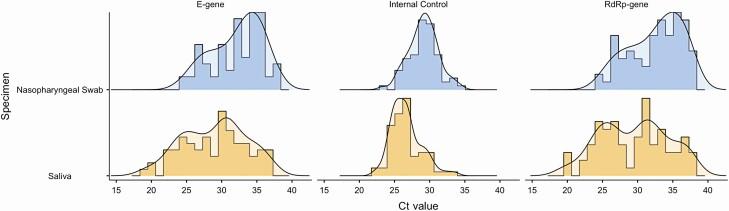
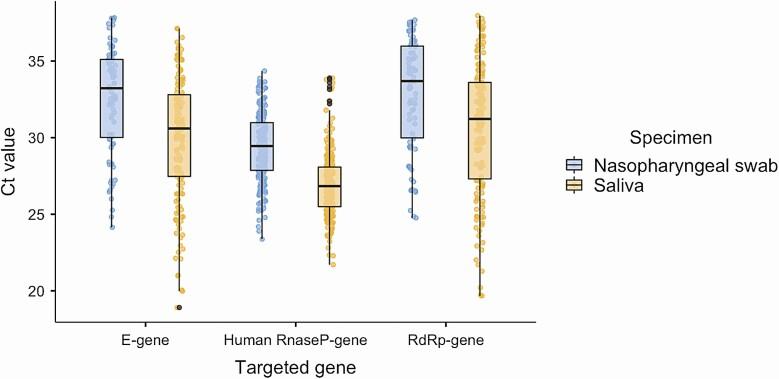
Overall, 160 of the 217 (74%) participants tested positive for COVID-19 based on saliva, NPS, or both testing methods. The detection rate for SARS-CoV-2 was higher in saliva compared to NPS testing (93.1%, 149/160 vs 52.5%, 84/160, P < .001). The concordance between the 2 tests was 45.6% (virus was detected in both saliva and NPS in 73/160), whereas 47.5% were discordant (87/160 tested positive for 1 whereas negative for the other). The cycle threshold (Ct) values for E and RdRp genes were significantly lower in saliva specimens compared to NP swab specimens.
CONCLUSIONS
Our findings demonstrate that saliva is a better alternative specimen for detection of SARS-CoV-2. Taking into consideration, the simplicity of specimen collection, shortage of PPE and the transmissibility of the virus, saliva could enable self-collection for an accurate SARS-CoV-2 surveillance testing.
背景
理想的严重急性呼吸综合征冠状病毒 2(SARS-CoV-2)检测方法应该既准确又能由患者自行进行,以减少医护人员接触。本研究旨在比较基于早晨唾液样本的患者自行检测与当前的医护人员采集鼻咽拭子(NPS)样本的标准检测方法。
方法
这是一项前瞻性单中心研究,招募了 217 名在 COVID-19 隔离中心的无症状成年男性参与者,他们在隔离前 8-10 天 SARS-CoV-2 检测呈阳性。采集 NPS 和唾液样本后,在采集后 5 小时内进行针对包膜(E)和 RNA 依赖性 RNA 聚合酶(RdRp)基因的实时逆转录聚合酶链反应(RT-PCR)检测,并对结果进行比较。
结果
总体而言,根据唾液、NPS 或两种检测方法,217 名参与者中有 160 名(74%)COVID-19 检测呈阳性。与 NPS 检测相比,唾液中 SARS-CoV-2 的检测率更高(93.1%,149/160 比 52.5%,84/160,P<.001)。两种检测方法的一致性为 45.6%(73/160 种病毒在唾液和 NPS 中均被检测到),而 47.5%为不一致(87/160 种病毒在一种检测中呈阳性而在另一种检测中呈阴性)。E 和 RdRp 基因的 Ct 值在唾液标本中明显低于 NPS 拭子标本。
结论
我们的研究结果表明,唾液是检测 SARS-CoV-2 的更好替代样本。考虑到标本采集的简便性、个人防护装备的短缺以及病毒的传染性,唾液可以实现自我采集,以进行准确的 SARS-CoV-2 监测检测。
 Zotero 插件