
唾液样本作为 2019 年冠状病毒病诊断的非侵入性标本:一项横断面研究。
Saliva sample as a non-invasive specimen for the diagnosis of coronavirus disease 2019: a cross-sectional study.
机构信息
Department of Pathology, Faculty of Medicine Ramathibodi Hospital, Mahidol University, Bangkok, Thailand.
Department of Medicine, Faculty of Medicine Ramathibodi Hospital, Mahidol University, Bangkok, Thailand.
出版信息
Clin Microbiol Infect. 2021 Feb;27(2):285.e1-285.e4. doi: 10.1016/j.cmi.2020.05.001. Epub 2020 May 15.
OBJECTIVES
Amid the increasing number of pandemic coronavirus disease 2019 (COVID-19) cases, there is a need for a quick and easy method to obtain a non-invasive sample for the detection of this novel coronavirus (severe acute respiratory syndrome coronavirus 2; SARS-CoV-2). We aimed to investigate the potential use of saliva samples as a non-invasive tool for the diagnosis of COVID-19.
METHODS
From 27 March to 4 April 2020, we prospectively collected saliva samples and a standard nasopharyngeal and throat swab in persons seeking care at an acute respiratory infection clinic in a university hospital during the outbreak of COVID-19. Real-time polymerase chain reaction (RT-PCR) was performed, and the results of the two specimens were compared.
RESULTS
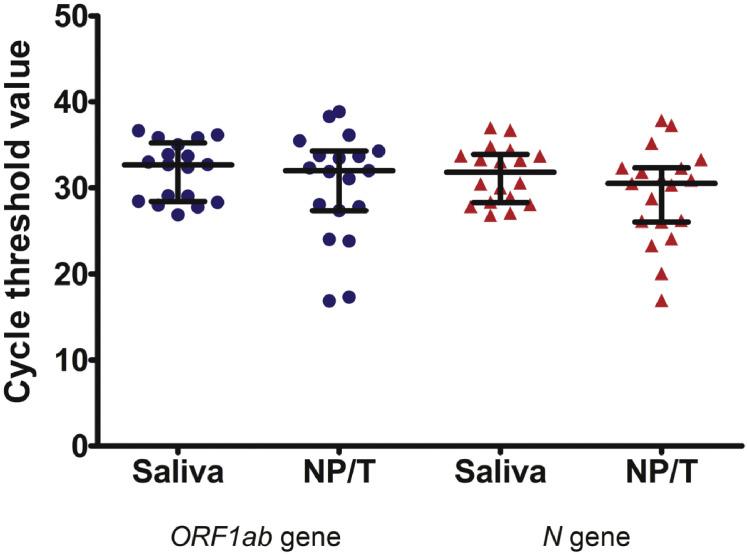
Two-hundred pairs of samples were collected. Sixty-nine (34.5%) individuals were male, and the median (interquartile) age was 36 (28-48) years. Using nasopharyngeal and throat swab RT-PCR as the reference standard, the prevalence of COVID-19 diagnosed by nasopharyngeal and throat swab RT-PCR was 9.5%. The sensitivity and specificity of the saliva sample RT-PCR were 84.2% (95% CI 60.4%-96.6%), and 98.9% (95% CI 96.1%-99.9%), respectively. An analysis of the agreement between the two specimens demonstrated 97.5% observed agreement (κ coefficient 0.851, 95% CI 0.723-0.979; p < 0.001).
CONCLUSIONS
Saliva might be an alternative specimen for the diagnosis of COVID-19. The collection is non-invasive, and non-aerosol generating. This method could facilitate the diagnosis of the disease, given the simplicity of specimen collection and good diagnostic performance.
目的
在不断增加的 2019 年冠状病毒病(COVID-19)病例中,需要一种快速简便的方法来获取非侵入性样本,以检测这种新型冠状病毒(严重急性呼吸系统综合征冠状病毒 2;SARS-CoV-2)。我们旨在研究唾液样本作为 COVID-19 诊断的非侵入性工具的潜在用途。
方法
2020 年 3 月 27 日至 4 月 4 日,我们前瞻性地收集了在 COVID-19 爆发期间在一家大学医院的急性呼吸道感染诊所就诊的人群的唾液样本和标准鼻咽和咽喉拭子。进行实时聚合酶链反应(RT-PCR),并比较两种标本的结果。
结果
共采集了 200 对样本。69 例(34.5%)为男性,中位(四分位间距)年龄为 36(28-48)岁。以鼻咽和咽喉拭子 RT-PCR 为参考标准,鼻咽和咽喉拭子 RT-PCR 诊断 COVID-19 的患病率为 9.5%。唾液样本 RT-PCR 的灵敏度和特异性分别为 84.2%(95%CI 60.4%-96.6%)和 98.9%(95%CI 96.1%-99.9%)。两种标本之间的一致性分析显示,观察一致性为 97.5%(κ系数 0.851,95%CI 0.723-0.979;p<0.001)。
结论
唾液可能是 COVID-19 诊断的替代标本。采集是非侵入性的,不会产生气溶胶。鉴于标本采集简单且诊断性能良好,这种方法可能有助于疾病的诊断。
 Zotero 插件