
现代循环游离 DNA 诊断工具在临床实践中检测特定肿瘤细胞的潜力。
Potential of modern circulating cell-free DNA diagnostic tools for detection of specific tumour cells in clinical practice.
机构信息
Medical Centre for Molecular Biology, Institute of Biochemistry, Faculty of Medicine, University of Ljubljana, Ljubljana, Slovenia.
出版信息
Biochem Med (Zagreb). 2020 Oct 15;30(3):030504. doi: 10.11613/BM.2020.030504. Epub 2020 Aug 5.
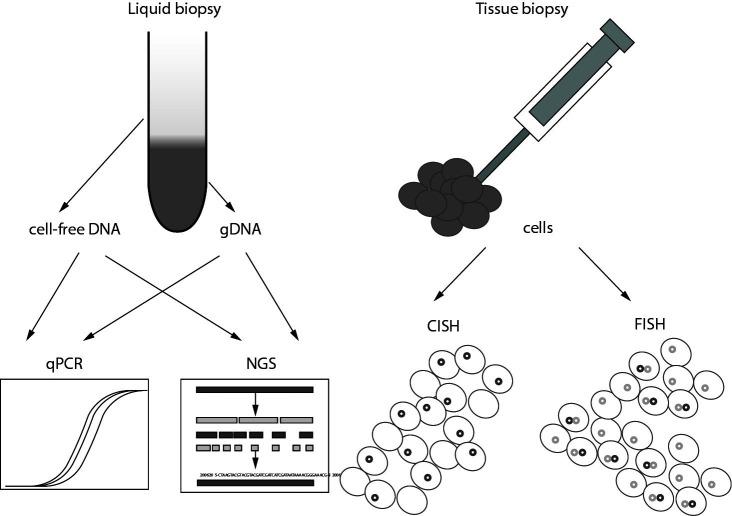
Personalized medicine is a developing field of medicine that has gained in importance in recent decades. New diagnostic tests based on the analysis of circulating cell-free DNA (cfDNA) were developed as a tool of diagnosing different cancer types. By detecting the subpopulation of mutated DNA from cancer cells, it is possible to detect the presence of a specific tumour in early stages of the disease. Mutation analysis is performed by quantitative polymerase chain reaction (qPCR) or the next generation sequencing (NGS), however, cfDNA protocols need to be modified carefully in preanalytical, analytical, and postanalytical stages. To further improve treatment of cancer the Food and Drug Administration approved more than 20 companion diagnostic tests that combine cancer drugs with highly efficient genetic diagnostic tools. Tools detect mutations in the DNA originating from cancer cells directly through the subpopulation of cfDNA, the circular tumour DNA (ctDNA) analysis or with visualization of cells through intracellular DNA probes. A large number of ctDNA tests in clinical studies demonstrate the importance of new findings in the field of cancer diagnosis. We describe the innovations in personalized medicine: techniques for detecting ctDNA and genomic DNA (gDNA) mutations approved Food and Drug Administration companion genetic diagnostics, candidate genes for assembling the cancer NGS panels, and a brief mention of the multitude of cfDNA currently in clinical trials. Additionally, an overview of the development steps of the diagnostic tools will refresh and expand the knowledge of clinics and geneticists for research opportunities beyond the development phases.
个体化医学是医学领域的一个新兴分支,近年来越来越受到重视。基于循环游离 DNA(cfDNA)分析的新诊断测试已作为诊断不同癌症类型的工具得到发展。通过检测来自癌细胞的突变 DNA 亚群,可以在疾病的早期阶段检测到特定肿瘤的存在。突变分析通过定量聚合酶链反应(qPCR)或下一代测序(NGS)进行,但在分析前、分析中和分析后阶段,cfDNA 方案需要谨慎修改。为了进一步改善癌症治疗,美国食品和药物管理局批准了 20 多种伴随诊断测试,将癌症药物与高效的遗传诊断工具结合使用。这些工具通过 cfDNA 中直接源自癌细胞的亚群、环状肿瘤 DNA(ctDNA)分析或通过细胞内 DNA 探针可视化来检测 DNA 中的突变。大量的 ctDNA 临床研究证明了该领域癌症诊断新发现的重要性。我们描述了个体化医学的创新:经美国食品和药物管理局批准的用于检测 ctDNA 和基因组 DNA(gDNA)突变的技术、用于组装癌症 NGS 面板的候选基因,以及目前正在临床试验中的大量 cfDNA 的简要说明。此外,诊断工具的开发步骤概述将为临床医生和遗传学家提供知识更新和扩展,以发现开发阶段以外的研究机会。

 Zotero 插件