
使用生物活性自纳米乳化药物递送系统(Bio-SNEDDS)提高芹菜素的口服生物利用度:体外、体内及稳定性评价
Enhancing Oral Bioavailability of Apigenin Using a Bioactive Self-Nanoemulsifying Drug Delivery System (Bio-SNEDDS): In Vitro, In Vivo and Stability Evaluations.
作者信息
Kazi Mohsin, Alhajri Abdullah, Alshehri Sultan M, Elzayat Ehab M, Al Meanazel Osaid T, Shakeel Faiyaz, Noman Omar, Altamimi Mohammad A, Alanazi Fars K
机构信息
Department of Pharmaceutics, College of Pharmacy, King Saud University, Riyadh 11451, Saudi Arabia.
Kayyali Chair for Pharmaceutical Industries, College of Pharmacy, King Saud University, Riyadh 11451, Saudi Arabia.
出版信息
Pharmaceutics. 2020 Aug 10;12(8):749. doi: 10.3390/pharmaceutics12080749.
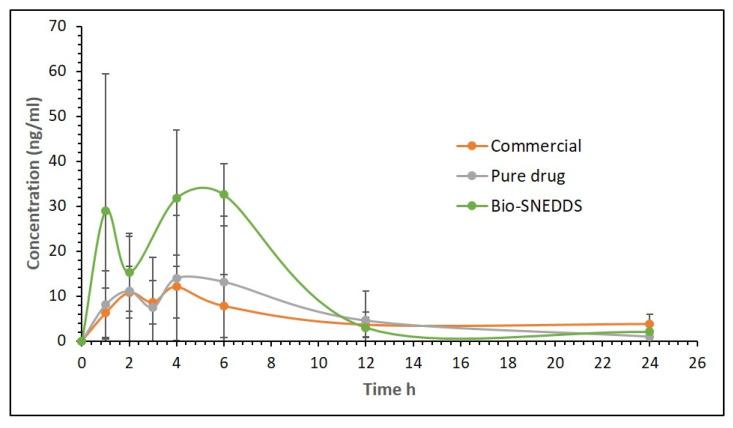
Apigenin (APG) is a very well-known flavonoid for its anti-inflammatory and anticancer properties. The purpose of this study is to improve the solubility and bioavailability of APG using a stable bioactive self-nanoemulsifying drug delivery system (Bio-SNEDDS). APG was incorporated in an oil phase comprising coconut oil fatty acid, Imwitor 988, Transcutol P, and HCO30 to form a Bio-SNEDDS. This preparation was characterized for morphology, particle size, and transmission electron microscopy (TEM). The APG performance was investigated in terms of loading, precipitation, release and stability tests from the optimal Bio-SNEDDS. An antimicrobial test was performed to investigate the activity of the Bio-SNEDDS against the selected strains. Bioavailability of the Bio-SNEDDS was evaluated using Wister rats against the commercial oral product and the pure drug. The results demonstrated the formation of an efficient nanosized (57 nm) Bio-SNEDDS with a drug loading of 12.50 mg/gm which is around 500-fold higher than free APG. TEM analysis revealed the formation of spherical and homogeneous nanodroplets of less than 60 nm. The dissolution rate was faster than the commercial product and was able to maintain 90% APG in gastro intestinal solution for more than 4 h. A stability study demonstrated that the Bio-SNEDDS is stable at a harsh condition. The in vivo pharmacokinetics parameters of the Bio-SNEDDS formulation in comparison to the pure drug showed a significant increase in maximum concentration (C) and area under the curve (AUC ) of 105.05% and 91.32%, respectively. Moreover, the antimicrobial study revealed moderate inhibition in the bacterial growth rate. The APG-Bio-SNEDDS could serve as potential carrier aimed at improving the clinical application of APG.
芹菜素(APG)是一种因具有抗炎和抗癌特性而广为人知的黄酮类化合物。本研究的目的是使用稳定的生物活性自纳米乳化药物递送系统(Bio-SNEDDS)来提高APG的溶解度和生物利用度。将APG掺入由椰子油脂肪酸、Imwitor 988、Transcutol P和HCO30组成的油相中,以形成Bio-SNEDDS。对该制剂进行了形态、粒径和透射电子显微镜(TEM)表征。从最佳Bio-SNEDDS对APG的载药量、沉淀、释放和稳定性测试方面研究了其性能。进行了抗菌测试,以研究Bio-SNEDDS对所选菌株的活性。使用Wistar大鼠针对市售口服产品和纯药物评估了Bio-SNEDDS的生物利用度。结果表明形成了高效的纳米级(57 nm)Bio-SNEDDS,载药量为12.50 mg/g,比游离APG高约500倍。TEM分析显示形成了小于60 nm的球形且均匀的纳米液滴。溶解速率比市售产品快,并且能够在胃肠溶液中保持90%的APG超过4小时。稳定性研究表明Bio-SNEDDS在苛刻条件下稳定。与纯药物相比,Bio-SNEDDS制剂的体内药代动力学参数显示最大浓度(Cmax)和曲线下面积(AUC)分别显著增加了105.05%和91.32%。此外,抗菌研究显示细菌生长速率受到中度抑制。APG-Bio-SNEDDS可作为潜在载体,旨在改善APG的临床应用。




 Zotero 插件