
基于荧光寿命的细胞术测量和相分析评估细胞凋亡过程中的 Caspase-3 活性。
Evaluation of Caspase-3 Activity During Apoptosis with Fluorescence Lifetime-Based Cytometry Measurements and Phasor Analyses.
机构信息
Department of Chemical & Materials Engineering, New Mexico State University, Las Cruces, New Mexico, USA.
Department of Functional Materials and Science, Graduate School of Science and Engineering, Saitama University, Saitama, 338-8570, Japan.
出版信息
Cytometry A. 2020 Dec;97(12):1265-1275. doi: 10.1002/cyto.a.24207. Epub 2020 Aug 25.
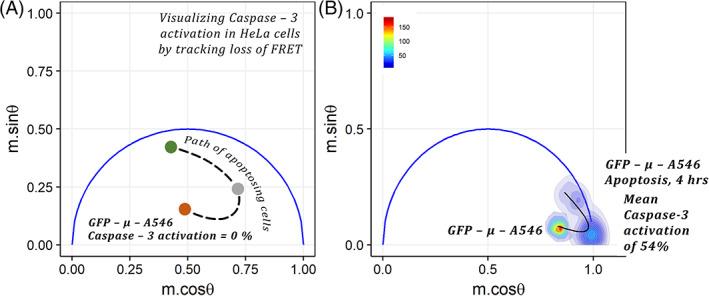
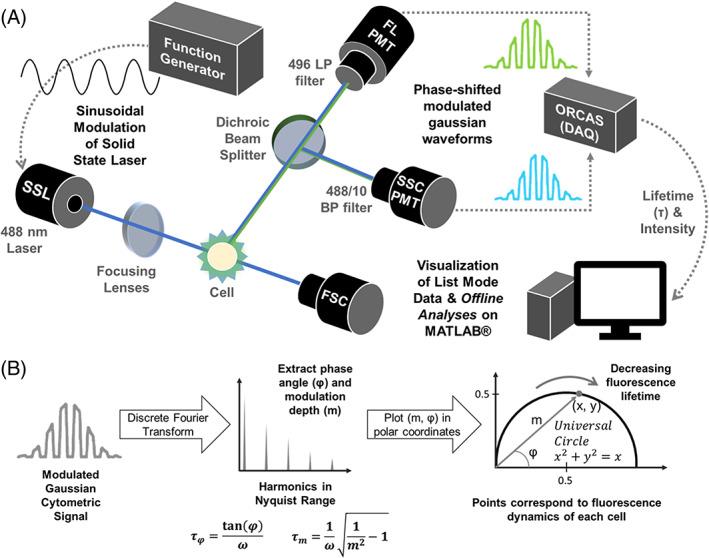
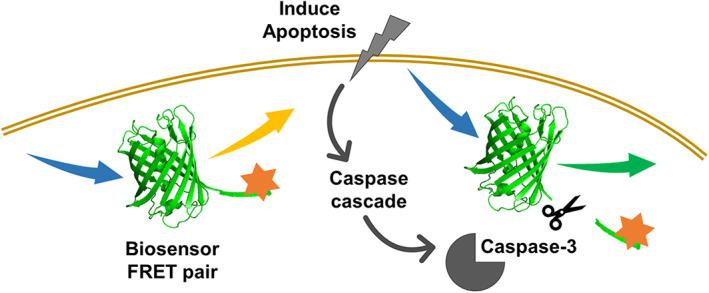
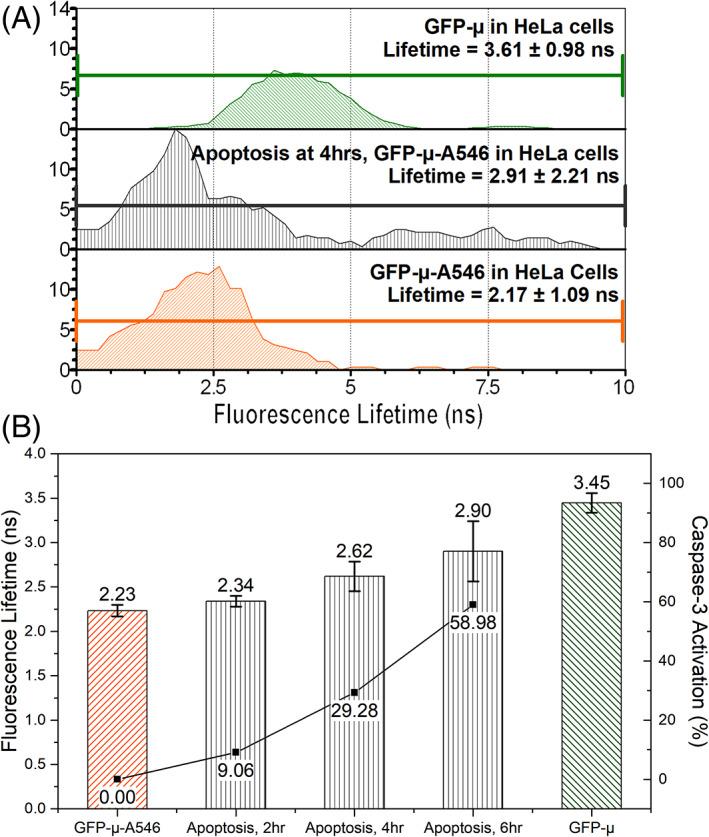
Caspase-3 is a well-described protease with many roles that impact the fate of a cell. During apoptosis, caspase-3 acts as an executioner caspase with important proteolytic functions that lead to the final stages of programmed cell death. Owing to this key role, caspase-3 is exploited intracellularly as a target of control of apoptosis for therapeutic outcomes. Yet the activation of caspase-3 during apoptosis is challenged by other roles and functions (e.g., paracrine signaling). This brief report presents a way to track caspase-3 levels using a flow cytometer that measures excited state fluorescence lifetimes and a signal processing approach that leads to a graphical phasor-based interpretation. An established Förster resonance energy transfer (FRET) bioprobe was used for this test; the connected donor and acceptor fluorophore is cleavable by caspase-3 during apoptosis induction. With the cell-by-cell decay kinetic data and phasor analyses we generate a caspase activation trajectory, which is used to interpret activation throughout apoptosis. When lifetime-based cytometry is combined with a FRET bioprobe and phasor analyses, enzyme activation can be simplified and quantified with phase and modulation data. We envision extrapolating this approach to high content screening, and reinforce the power of phasor approaches with cytometric data. Analyses such as these can be used to cluster cells by their phase and modulation "lifetime fingerprint" when the intracellular fluorescent probe is utilized as a sensor of enzyme activity. © 2020 The Authors. Cytometry Part A published by Wiley Periodicals LLC on behalf of International Society for Advancement of Cytometry.
Caspase-3 是一种描述详尽的蛋白酶,具有许多影响细胞命运的作用。在细胞凋亡过程中,Caspase-3 作为执行者 Caspase 发挥作用,具有重要的蛋白水解功能,导致细胞程序性死亡的最后阶段。由于其关键作用,Caspase-3 被作为细胞凋亡控制的靶点,用于治疗效果。然而,Caspase-3 在细胞凋亡过程中的激活受到其他作用和功能的挑战(例如,旁分泌信号)。本简要报告介绍了一种使用流式细胞仪测量激发态荧光寿命和信号处理方法来跟踪 Caspase-3 水平的方法,该方法导致基于图形相量的解释。为此测试使用了一种已建立的Förster 共振能量转移(FRET)生物探针;连接的供体和受体荧光团在凋亡诱导过程中可被 Caspase-3 切割。通过细胞逐个衰减动力学数据和相量分析,我们生成 Caspase 激活轨迹,用于解释整个凋亡过程中的激活。当寿命流式细胞术与 FRET 生物探针和相量分析相结合时,可以使用相位和调制数据简化和量化酶的激活。我们设想将这种方法推广到高通量筛选,并利用流式细胞术数据增强相量方法的威力。当细胞内荧光探针被用作酶活性的传感器时,可以使用这些分析方法根据细胞的相位和调制“寿命指纹”对细胞进行聚类。©2020 作者。Wiley Periodicals LLC 代表国际细胞分析协会出版了《细胞分析》。
 Zotero 插件