
COVID-19 大流行前早期急性呼吸窘迫综合征的顺应性表型。
Compliance Phenotypes in Early Acute Respiratory Distress Syndrome before the COVID-19 Pandemic.
机构信息
ICU, John Hunter Hospital, Newcastle, New South Wales, Australia.
School of Medicine and Public Health, University of Newcastle, Newcastle, New South Wales, Australia.
出版信息
Am J Respir Crit Care Med. 2020 Nov 1;202(9):1244-1252. doi: 10.1164/rccm.202005-2046OC.
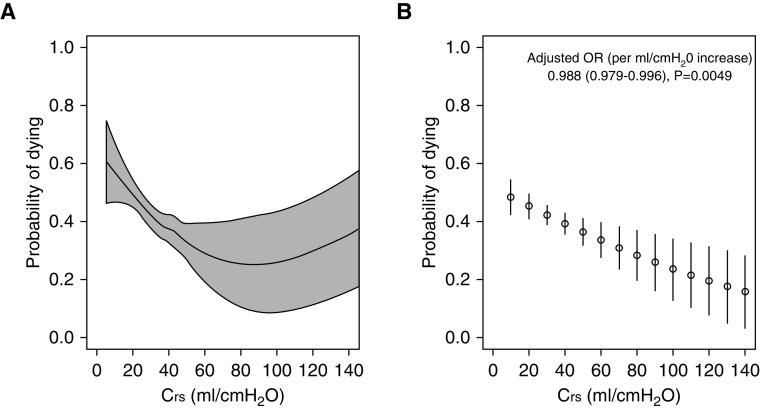
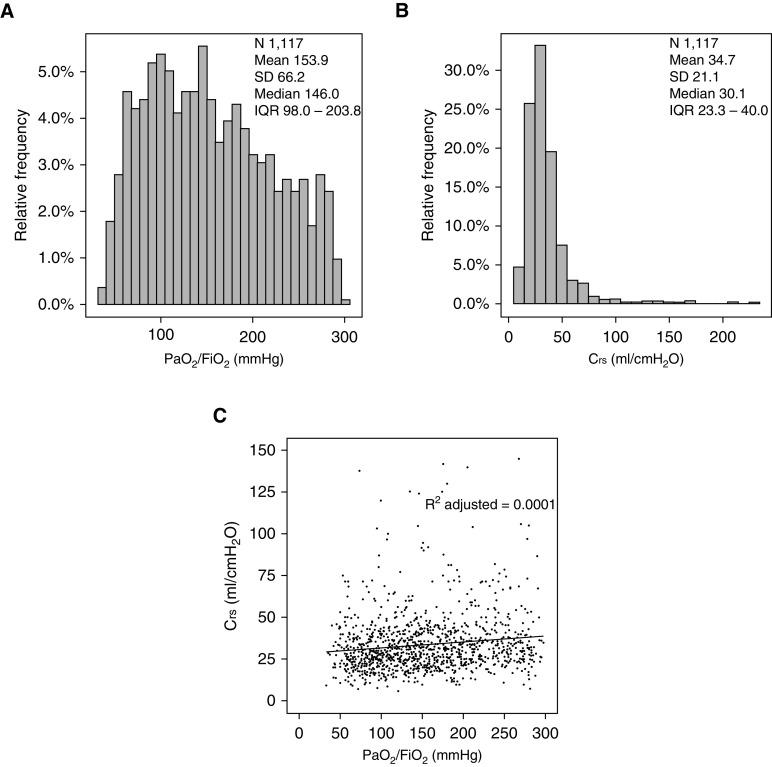
A novel model of phenotypes based on set thresholds of respiratory system compliance (Crs) was recently postulated in context of coronavirus disease (COVID-19) acute respiratory distress syndrome (ARDS). In particular, the dissociation between the degree of hypoxemia and Crs was characterized as a distinct ARDS phenotype. To determine whether such Crs-based phenotypes existed among patients with ARDS before the COVID-19 pandemic and to closely examine the Crs-mortality relationship. We undertook a secondary analysis of patients with ARDS, who were invasively ventilated on controlled modes and enrolled in a large, multinational, epidemiological study. We assessed Crs, degree of hypoxemia, and associated Crs-based phenotypic patterns with their characteristics and outcomes. Among 1,117 patients with ARDS who met inclusion criteria, the median Crs was 30 (interquartile range, 23-40) ml/cm HO. One hundred thirty-six (12%) patients had preserved Crs (≥50 ml/cm HO; phenotype with low elastance ["phenotype L"]), and 827 (74%) patients had poor Crs (<40 ml/cm HO; phenotype with high elastance ["phenotype H"]). Compared with those with phenotype L, patients with phenotype H were sicker and had more comorbidities and higher hospital mortality (32% vs. 45%; < 0.05). A near complete dissociation between Pa/Fi and Crs was observed. Of 136 patients with phenotype L, 58 (43%) had a Pa/Fi < 150. In a multivariable-adjusted analysis, the Crs was independently associated with hospital mortality (adjusted odds ratio per ml/cm HO increase, 0.988; 95% confidence interval, 0.979-0.996; = 0.005). A wide range of Crs was observed in non-COVID-19 ARDS. Approximately one in eight patients had preserved Crs. Pa/Fi and Crs were dissociated. Lower Crs was independently associated with higher mortality. The Crs-mortality relationship lacked a clear transition threshold.
一种基于呼吸系统顺应性 (Crs) 设定阈值的新型表型模型,最近在冠状病毒病 (COVID-19) 急性呼吸窘迫综合征 (ARDS) 中被提出。特别是,低氧血症和 Crs 之间的分离被认为是一种独特的 ARDS 表型。为了确定 COVID-19 大流行之前是否存在 ARDS 患者的这种基于 Crs 的表型,以及仔细检查 Crs-死亡率之间的关系。我们对接受控制模式机械通气的 ARDS 患者进行了一项二次分析,并将其纳入了一项大型跨国流行病学研究。我们评估了 Crs、低氧血症程度以及与 Crs 相关的表型模式与其特征和结局的关系。在符合纳入标准的 1117 名 ARDS 患者中,Crs 的中位数为 30(四分位距,23-40)ml/cmHO。136(12%)名患者 Crs 正常(≥50 ml/cmHO;顺应性低表型 [表型 L]),827(74%)名患者 Crs 差(<40 ml/cmHO;顺应性高表型 [表型 H])。与表型 L 相比,表型 H 的患者病情更严重,合并症更多,住院死亡率更高(32%比 45%;<0.05)。在 Pa/Fi 和 Crs 之间观察到几乎完全的分离。在表型 L 的 136 名患者中,58 名(43%)患者 Pa/Fi<150。在多变量调整分析中,Crs 与住院死亡率独立相关(每增加 1 ml/cmHO 的调整优势比,0.988;95%置信区间,0.979-0.996;=0.005)。在非 COVID-19 ARDS 中观察到 Crs 范围广泛。大约每 8 名患者中就有 1 名患者 Crs 正常。Pa/Fi 和 Crs 之间存在分离。较低的 Crs 与更高的死亡率独立相关。Crs-死亡率之间的关系缺乏明确的转换阈值。

 Zotero 插件