
急性呼吸窘迫综合征现场体外膜肺氧合插管后依从性降低的相关因素:一项回顾性观察队列研究。
Factors associated with decreased compliance after on-site extracorporeal membrane oxygenation cannulation for acute respiratory distress syndrome: A retrospective, observational cohort study.
作者信息
Le Pape Sylvain, Joly Florent, Arrivé François, Frat Jean-Pierre, Rodriguez Maeva, Joos Maïa, Marchasson Laura, Wairy Mathilde, Thille Arnaud W, Coudroy Rémi
机构信息
Centre Hospitalier Universitaire de Poitiers, Service de Médecine Intensive Réanimation, Poitiers, France.
INSERM Centre d'Investigation Clinique 1402, IS-ALIVE Research Group, Université de Poitiers, Poitiers, France.
出版信息
J Intensive Med. 2023 Dec 12;4(2):194-201. doi: 10.1016/j.jointm.2023.09.004. eCollection 2024 Apr.
BACKGROUND
Extracorporeal membrane oxygenation (ECMO) for acute respiratory distress syndrome (ARDS) is systematically associated with decreased respiratory system compliance (CRS). It remains unclear whether transportation to the referral ECMO center, changes in ventilatory mode or settings to achieve ultra-protective ventilation, or the natural evolution of ARDS drives this change in respiratory mechanics. Herein, we assessed the precise moment when CRS decreases after ECMO cannulation and identified factors associated with decreased CRS.
METHODS
To rule out the effect of transportation and the different modes of ventilation on CRS, we conducted a retrospective, single-center, observational cohort study from January 2013 to May 2020, on 22 patients with severe ARDS requiring on-site ECMO and ventilated in pressure-controlled mode to achieve ultra-protective ventilation. CRS was assessed at different time points ranging from 12 h before ECMO cannulation to 72 h after ECMO cannulation. The primary outcome was the relative change in CRS between 3 h before and 3 h after ECMO cannulation. The secondary outcomes included variables associated with the relative changes in CRS within the first 3 h after ECMO cannulation and the relative changes in CRS at each time point.
RESULTS
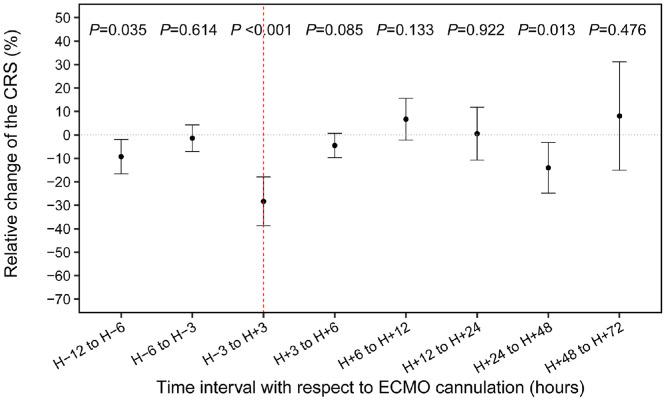
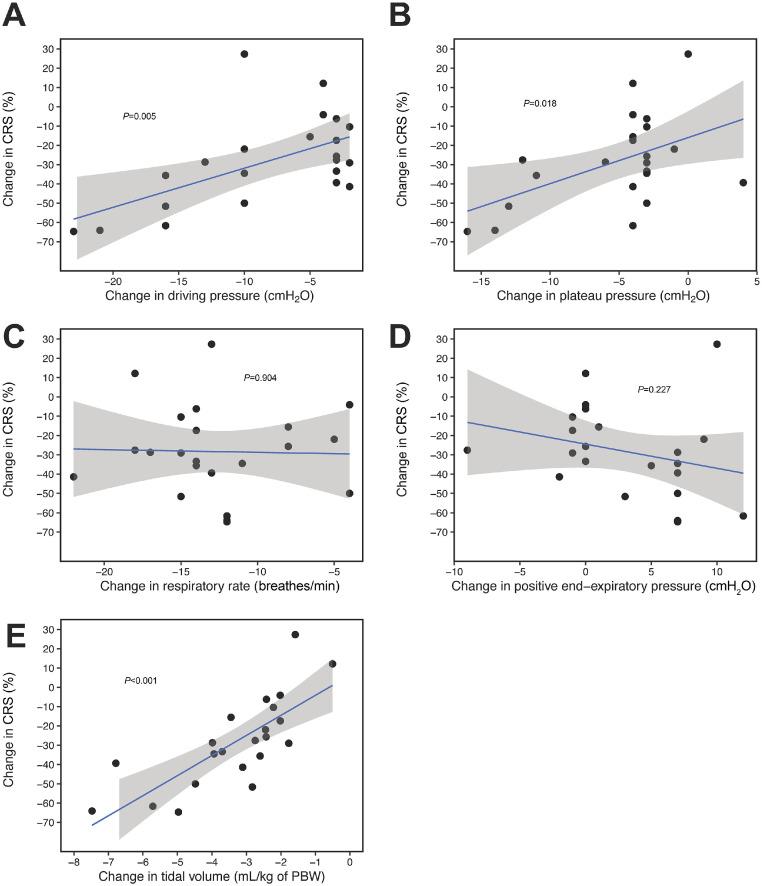
CRS decreased within the first 3 h after ECMO cannulation (-28.3%, 95% confidence interval [CI]: -38.8 to -17.9, <0.001), while the decrease was mild before and after these first 3 h after ECMO cannulation. To achieve ultra-protective ventilation, respiratory rate decreased in the mean by -13 breaths/min (95% CI: -15 to -11) and driving pressure by -8.3 cmHO (95% CI: -11.2 to -5.3), resulting in decreased tidal volume by -3.3 mL/kg of predicted body weight (95% CI: -3.9 to -2.6) as compared to before ECMO cannulation ( <0.001 for all). Plateau pressure reduction, driving pressure reduction, and tidal volume reduction were significantly associated with decreased CRS after ECMO cannulation, whereas neither respiratory rate, positive end-expiratory pressure, inspired fraction of oxygen, fluid balance, nor mean airway pressure was associated with decreased CRS.
CONCLUSIONS
Decreased driving pressure resulting in lower tidal volume to achieve ultra-protective ventilation after ECMO cannulation was associated with a marked decrease in CRS in ARDS patients with on-site ECMO cannulation.
背景
体外膜肺氧合(ECMO)用于急性呼吸窘迫综合征(ARDS)时,系统地与呼吸系统顺应性(CRS)降低相关。目前尚不清楚转运至转诊ECMO中心、为实现肺保护性通气而改变通气模式或设置,还是ARDS的自然病程导致了呼吸力学的这种变化。在此,我们评估了ECMO插管后CRS降低的确切时刻,并确定了与CRS降低相关的因素。
方法
为排除转运和不同通气模式对CRS的影响,我们进行了一项回顾性、单中心、观察性队列研究,研究对象为2013年1月至2020年5月期间22例需要现场ECMO且采用压力控制模式通气以实现肺保护性通气的重度ARDS患者。在ECMO插管前12小时至插管后72小时的不同时间点评估CRS。主要结局是ECMO插管前3小时与插管后3小时之间CRS的相对变化。次要结局包括与ECMO插管后最初3小时内CRS的相对变化以及每个时间点CRS的相对变化相关的变量。
结果
ECMO插管后最初3小时内CRS降低(-28.3%,95%置信区间[CI]:-38.8至-17.9,<0.001),而在ECMO插管后最初3小时前后降低幅度较小。为实现肺保护性通气,呼吸频率平均降低-13次/分钟(95%CI:-15至-11),驱动压降低-8.3cmH₂O(95%CI:-11.2至-5.3),与ECMO插管前相比,潮气量降低-3.3mL/kg预计体重(95%CI:-3.9至-2.6)(所有均<0.001)。平台压降低、驱动压降低和潮气量降低与ECMO插管后CRS降低显著相关,而呼吸频率、呼气末正压、吸入氧分数、液体平衡和平均气道压均与CRS降低无关。
结论
在现场进行ECMO插管的ARDS患者中,ECMO插管后为实现肺保护性通气而降低驱动压导致潮气量降低,这与CRS显著降低相关。


 Zotero 插件