
飞秒 X 射线发射研究血红蛋白中自旋交叉动力学。
Femtosecond X-ray emission study of the spin cross-over dynamics in haem proteins.
机构信息
Laboratoire de Spectroscopie Ultrarapide (LSU) and Lausanne Centre for Ultrafast Science (LACUS), Ecole Polytechnique Fédérale de Lausanne (EPFL), 1015, Lausanne, Switzerland.
Japan Synchrotron Radiation Research Institute (JASRI), 1-1-1, Kouto, Sayo-cho Sayo-gun, Hyogo, 679-5198, Japan.
出版信息
Nat Commun. 2020 Aug 18;11(1):4145. doi: 10.1038/s41467-020-17923-w.
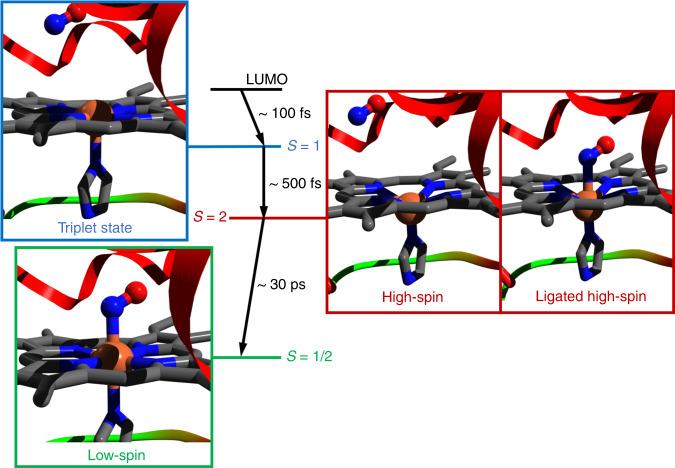
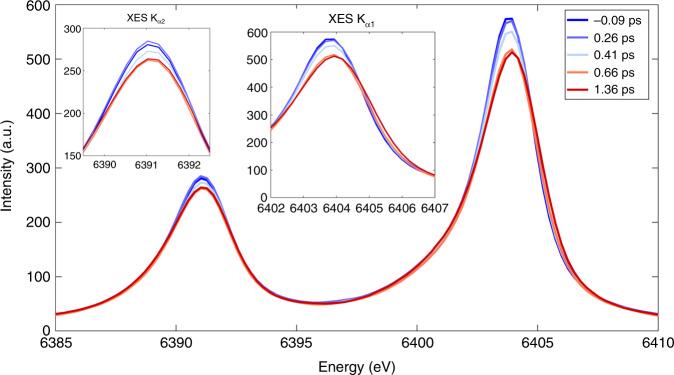
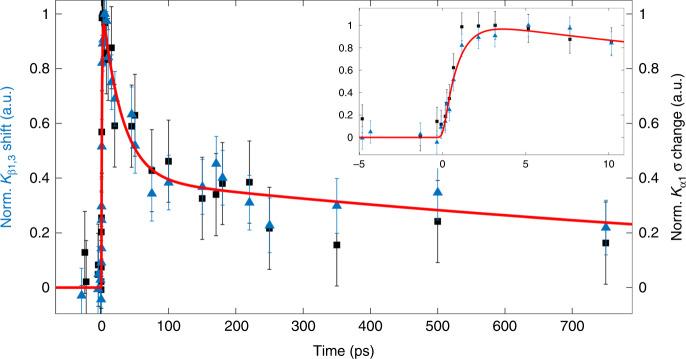
In haemoglobin the change from the low-spin (LS) hexacoordinated haem to the high spin (HS, S = 2) pentacoordinated domed deoxy-myoglobin (deoxyMb) form upon ligand detachment from the haem and the reverse process upon ligand binding are what ultimately drives the respiratory function. Here we probe them in the case of Myoglobin-NO (MbNO) using element- and spin-sensitive femtosecond Fe K and K X-ray emission spectroscopy at an X-ray free-electron laser (FEL). We find that the change from the LS (S = 1/2) MbNO to the HS haem occurs in ~800 fs, and that it proceeds via an intermediate (S = 1) spin state. We also show that upon NO recombination, the return to the planar MbNO ground state is an electronic relaxation from HS to LS taking place in ~30 ps. Thus, the entire ligand dissociation-recombination cycle in MbNO is a spin cross-over followed by a reverse spin cross-over process.
在血红蛋白中,当配体从血红素上脱离时,其状态会从低自旋(LS)六配位的血红素转变为高自旋(HS,S=2)五配位的穹顶脱氧肌红蛋白(脱氧 Mb),而当配体重新结合时则会发生相反的过程,这些最终驱动了呼吸功能。在这里,我们使用自由电子激光(FEL)的元素和自旋敏感的飞秒 Fe K 和 K X 射线发射光谱,在肌红蛋白-一氧化氮(MbNO)的情况下对其进行了探测。我们发现,从 LS(S=1/2)MbNO 到 HS 血红素的转变发生在800fs 内,并且它是通过一个中间(S=1)自旋态进行的。我们还表明,在 NO 重新结合时,从 HS 到 LS 的电子弛豫会使 MbNO 回到平面基态,这一过程发生在30ps 内。因此,MbNO 中整个配体解离-结合循环是一个自旋交叉过程,随后是一个反向自旋交叉过程。
 Zotero 插件