
英国非视网膜发育性眼部疾病的分子诊断挑战。
Molecular diagnostic challenges for non-retinal developmental eye disorders in the United Kingdom.
机构信息
Moorfields Eye Hospital NHS Foundation Trust, London, UK.
UCL Institute of Ophthalmology, London, UK.
出版信息
Am J Med Genet C Semin Med Genet. 2020 Sep;184(3):578-589. doi: 10.1002/ajmg.c.31837. Epub 2020 Aug 23.
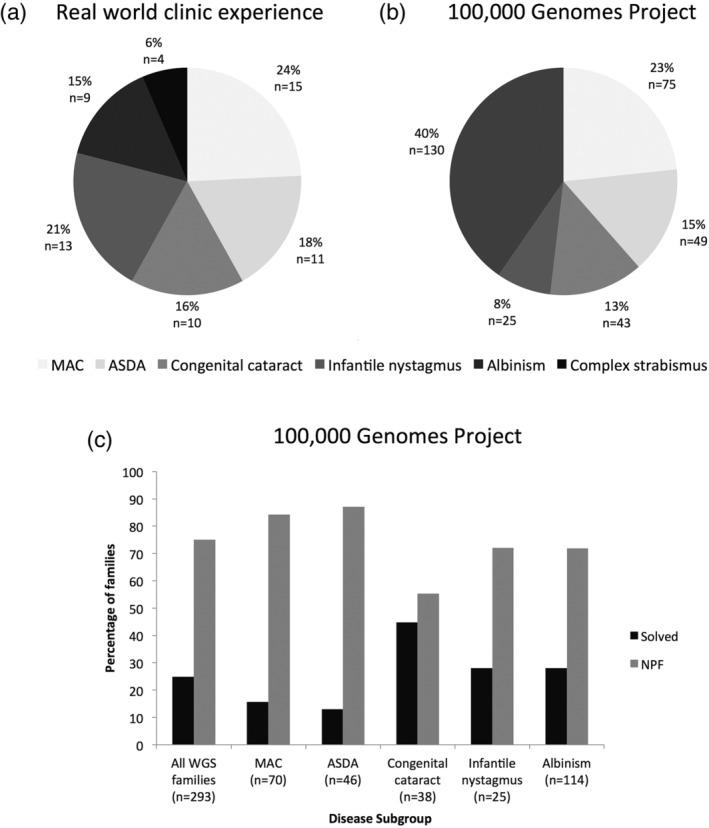
Overall, approximately one-quarter of patients with genetic eye diseases will receive a molecular diagnosis. Patients with developmental eye disorders face a number of diagnostic challenges including phenotypic heterogeneity with significant asymmetry, coexisting ocular and systemic disease, limited understanding of human eye development and the associated genetic repertoire, and lack of access to next generation sequencing as regarded not to impact on patient outcomes/management with cost implications. Herein, we report our real world experience from a pediatric ocular genetics service over a 12 month period with 72 consecutive patients from 62 families, and that from a cohort of 322 patients undergoing whole genome sequencing (WGS) through the Genomics England 100,000 Genomes Project; encompassing microphthalmia, anophthalmia, ocular coloboma (MAC), anterior segment dysgenesis anomalies (ASDA), primary congenital glaucoma, congenital cataract, infantile nystagmus, and albinism. Overall molecular diagnostic rates reached 24.9% for those recruited to the 100,000 Genomes Project (73/293 families were solved), but up to 33.9% in the clinic setting (20/59 families). WGS was able to improve genetic diagnosis for MAC patients (15.7%), but not for ASDA (15.0%) and congenital cataracts (44.7%). Increased sample sizes and accurate human phenotype ontology (HPO) terms are required to improve diagnostic accuracy. The significant mixed complex ocular phenotypes distort these rates and lead to missed variants if the correct gene panel is not applied. Increased molecular diagnoses will help to explain the genotype-phenotype relationships of these developmental eye disorders. In turn, this will lead to improved integrated care pathways, understanding of disease, and future therapeutic development.
总体而言,大约四分之一的遗传性眼病患者将接受分子诊断。患有发育性眼病的患者面临许多诊断挑战,包括表型异质性显著不对称、共存的眼部和系统性疾病、对人类眼部发育和相关遗传谱的理解有限,以及缺乏下一代测序技术,因为这不会影响患者的结局/管理,并带来成本影响。在此,我们报告了在 12 个月的时间里,我们从一个儿科眼科遗传学服务中获得的 72 名连续患者的真实世界经验,这些患者来自 62 个家庭,以及来自一个包含小眼球症、无眼球症、眼部裂畸形(MAC)、前节发育不良异常(ASDA)、原发性先天性青光眼、先天性白内障、婴儿性眼球震颤和白化病的 322 名患者的队列,这些患者通过英国基因组学 10 万基因组计划接受了全基因组测序(WGS)。总体而言,对于那些被招募到 10 万基因组计划中的患者,分子诊断率达到了 24.9%(293 个家庭中有 73 个家庭得到解决),但在临床环境中高达 33.9%(59 个家庭中有 20 个家庭得到解决)。WGS 能够提高 MAC 患者的遗传诊断率(15.7%),但对 ASDA(15.0%)和先天性白内障(44.7%)无效。需要增加样本量和准确的人类表型本体(HPO)术语,以提高诊断准确性。显著的混合复杂眼部表型会扭曲这些比率,并导致错过正确基因面板的变异。增加分子诊断将有助于解释这些发育性眼病的基因型-表型关系。反过来,这将导致更好的综合护理途径、对疾病的理解和未来的治疗发展。
 Zotero 插件