
黄酮类化合物对抗瓦博格表型——预测、预防和个性化医学的概念以解开癌细胞代谢的难题
Flavonoids against the Warburg phenotype-concepts of predictive, preventive and personalised medicine to cut the Gordian knot of cancer cell metabolism.
作者信息
Samec Marek, Liskova Alena, Koklesova Lenka, Samuel Samson Mathews, Zhai Kevin, Buhrmann Constanze, Varghese Elizabeth, Abotaleb Mariam, Qaradakhi Tawar, Zulli Anthony, Kello Martin, Mojzis Jan, Zubor Pavol, Kwon Taeg Kyu, Shakibaei Mehdi, Büsselberg Dietrich, Sarria Gustavo R, Golubnitschaja Olga, Kubatka Peter
机构信息
Clinic of Obstetrics and Gynecology, Jessenius Faculty of Medicine, Comenius University in Bratislava, 03601 Martin, Slovakia.
Department of Physiology and Biophysics, Weill Cornell Medicine in Qatar, Education City, Qatar Foundation, 24144, Doha, Qatar.
出版信息
EPMA J. 2020 Jul 30;11(3):377-398. doi: 10.1007/s13167-020-00217-y. eCollection 2020 Sep.
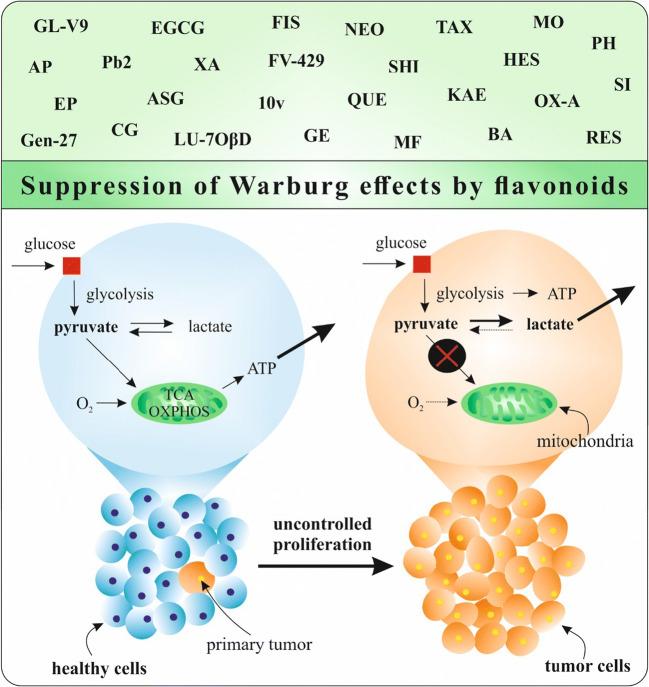
The Warburg effect is characterised by increased glucose uptake and lactate secretion in cancer cells resulting from metabolic transformation in tumour tissue. The corresponding molecular pathways switch from oxidative phosphorylation to aerobic glycolysis, due to changes in glucose degradation mechanisms known as the 'Warburg reprogramming' of cancer cells. Key glycolytic enzymes, glucose transporters and transcription factors involved in the Warburg transformation are frequently dysregulated during carcinogenesis considered as promising diagnostic and prognostic markers as well as treatment targets. Flavonoids are molecules with pleiotropic activities. The metabolism-regulating anticancer effects of flavonoids are broadly demonstrated in preclinical studies. Flavonoids modulate key pathways involved in the Warburg phenotype including but not limited to PKM2, HK2, GLUT1 and HIF-1. The corresponding molecular mechanisms and clinical relevance of 'anti-Warburg' effects of flavonoids are discussed in this review article. The most prominent examples are provided for the potential application of targeted 'anti-Warburg' measures in cancer management. Individualised profiling and patient stratification are presented as powerful tools for implementing targeted 'anti-Warburg' measures in the context of predictive, preventive and personalised medicine.
瓦伯格效应的特征是肿瘤组织代谢转变导致癌细胞中葡萄糖摄取增加和乳酸分泌增加。由于癌细胞中称为“瓦伯格重编程”的葡萄糖降解机制发生变化,相应的分子途径从氧化磷酸化转变为有氧糖酵解。参与瓦伯格转变的关键糖酵解酶、葡萄糖转运蛋白和转录因子在致癌过程中经常失调,被认为是有前景的诊断和预后标志物以及治疗靶点。类黄酮是具有多种活性的分子。类黄酮调节代谢的抗癌作用在临床前研究中得到广泛证实。类黄酮调节参与瓦伯格表型的关键途径,包括但不限于丙酮酸激酶M2、己糖激酶2、葡萄糖转运蛋白1和缺氧诱导因子-1。本文综述了类黄酮“抗瓦伯格”效应的相应分子机制及其临床相关性。文中提供了最突出的例子,说明靶向“抗瓦伯格”措施在癌症管理中的潜在应用。个性化分析和患者分层被视为在预测、预防和个性化医学背景下实施靶向“抗瓦伯格”措施的有力工具。


 Zotero 插件